Madeira Vine – a permaculture food plant, or a rampant and destructive invasive?

If you’ve been reading my blog for a while you will know that I’m very concerned about the encouragement of the use of invasive or potentially invasive species in permaculture (you can see where I’ve written on the subject here and here).

Now the folks at Milkwood Permaculture have thrown up a curly one – they’ve just posted on how Madeira Vine not only has edible leaves and tubers, but is widely eaten and cultivated in Japan, where it is known as “land seaweed” (okawakame)

Typical effect of unchecked Madeira Vine [from Milkwood Permaculture blog]

As they point out, Madeira Vine is an already “adapted, perennial, zero footprint and highly nutritious food plant” with the following characteristics which are desirable in a food plant:

  • “It grows without much assistance, is hardy and produces prolifically.
  • It requires minimal cultivation.
  • It dominates an area where it is planted (meaning far less weed control is needed)
  • It is spread only* by humans and by water flows distributing the bubils – an easy factor to contain with good design.”

The Milkwood guys are  planning on having it as a food plant in their garden.  They recognise that it is a potential problem, and will manage it by eating it and stopping it from spreading.

So, should we incorporate Madeira Vine into our permaculture food production?

My first question would be: Just how weedy/invasive is it really?

Madeira vine grows prolifically at rates of up to 1 m per week in high-light environments.  It produces large numbers of subterranean and aerial tubers that not only act as reproductive bodies, but also provide the plant with a carbohydrate source that enables it to survive through difficult times. As a consequence, Madeira vine can tolerate a range of adverse conditions including drought, snow and frost, and it has been found growing in areas as diverse as rainforests, riparian fringes, rocky outcrops and frontal dunes (source).  This same ability to tolerate adverse conditions also means that the tubers can survive for very long periods of time in suspended animation, before they experience the right conditions to shoot (source).

The vine reproduces through the proliferation of aerial tubers and also from rhizome (subterranean tuber) fragments that may be broken off (source).  The aerial tubers can persist for two to 15 years and rhizomes for five to 10 years, with tuber germination rates of up to 70 per cent (source).  Although Madeira Vine is widely believed not to set seed in Australia, up to 5% of dried flowers collected from southeast Queensland were found to contain germinable seed (see #Vivian-Smith et al, below).

Dispersal is believed to occur primarily* via human spread (cultivation for ornamental purposes, disposal of vegetative material and tubers, e.g. in green waste (source), or being spread by machinery and/or gravel during road construction).  However it also spreads downslope under the influence of gravity and water movement from ridges and down watershed, and via floods (source).

Saying that it is spread primarily by humans needs to be considered in relation to just how widespread it is, what a significant destroyer of habitats it is once established, and how extremely difficult it is to eradicate once established.  Here is how the Environment Australia weeds database summarises the facts about Madeira Vine:

Madeira Vine is a Weed of National Significance (WONS). It is regarded as one of the worst weeds in Australia because of its invasiveness, potential for spread, and economic and environmental impacts.

Madeira Vine has aggressive vegetative growth which competes with and replaces other vegetation, and is difficult to control once established. Its aggressive nature gives it the potential to smother other desirable plants. Its sheer weight is capable of breaking branches off trees, thereby reducing them to poles, potentially causing collapse of the rainforest canopy (ISSG 2006). It restricts light and thereby prevents germination of desirable native species (Harley undated).

Should we then include Madeira Vine in permaculture food production?  I think there are two things to take into account before making a decision on this.

First, the permaculture ethics of care for the Earth and care for people.  The potential impacts on the Earth from Madeira Vine escapes are obvious (see the sources and photo above) and well documented, as are its impacts on the people whose properties and amenity are impacted.

Second, based on an assessment of invasiveness and impact, Madeira vine was ranked 5th worst of1060 naturalised south-east Queensland plant species (#Batianoff & Butler, below).  How are you going to ensure that:

  • no seed is set, and neither seed nor tuber material is distributed by animals, or other agents of dispersal, including water (i.e. the area where you will grow it will never flood or be exposed to high volumes of water runoff;
  • everyone who works on your garden or caretakes for you while you are away is as careful as you would be not to allow any dispersal of aerial tubers, (fragments of) rhizomes or seeds;
  • before you move on, you will have somehow removed all aerial tubers and every last fragment of rhizome before you leave, or failing this, you have some guarantee that the next landholder is going to take the same careful management approach as you?

– – – – – – – –

*I consider the statement that it is spread “only by humans and by water flows distributing the bubils – an easy factor to contain with good design” to be dangerously simplistic for a number of reasons.  First, once a Madeira Vine has established itself in a vegetated area it does not sit and wait for humans or water flows to come along and move its tubers or rhizomes.  The tubers are spread naturally when they fall from the adult plants where they have climbed up and across the canopy (often a considerable distance) from where they originally grew. Second, anywhere that an established population of Madeira Vine grows over a waterway that even only occasionally flows, this will distribute the plant to any and all areas downstream.  Third, saying that it is spread “by humans” without mentioning the many ways in which human activity can spread the plant, or the very long viability period of the tubers, gives a very misleading impression of the ease with which human activity can (even unwittingly) result in spread.

Here is a rather more informative account of how it is spread:

The most common means of reproduction and spread is via asexual tubers formed on the roots and stems. Prolific numbers of aerial tubers are produced throughout the year, which drop to the ground when mature or in response to stress. Research indicates that aerial tubers can persist for two to 15 years and subterranean tubers for five to 10 years, with tuber germination rates of up to 70 per cent. In areas of heavy infestation, soil tuber densities are up to 1500 per m2. Madeira vine is also capable of shooting from sections of severed vine.

Dispersal occurs primarily via human spread such as cultivation for ornamental purposes, disposal in green waste, or spread by machinery during road construction. It can also spread via gravity and water movement from ridges and watersheds or during floods. Mammals and birds may also play a minor role in localised spread.
While seed production is believed to be rare in Australia, research indicates that up to 5 per cent of dried flowers collected from southeast Queensland contain germinable seed. It is speculated that seed set and germination may only occur under ideal environmental and seasonal conditions.

 Sources which aren’t linked above:

#Vivian-Smith et al, Alan Fletcher Research Station QLD Unpublished data (cited in this source)

#Batianoff, G.N. and Butler, D.W. (2002). Assessment of invasive naturalized plants in south- east Queensland. Plant Protection Quarterly 17: 27–34.


Is it possible to grow vegetables using no-till farming?

At various workshops and meetings I’ve often heard statements along the lines of “no-till approaches are all very well for broadacre cropping (e.g. grain crops), but no one uses them for vegetables” – to the point where I just assumed that there must be good reasons for not doing it.

Can it even be done, even if only by dedicated permaculturists willing to put in huge amounts of effort?  Well, yes it can, but not just through huge amounts of manual labour and on a small scale.  There are people our there successfully doing mechanised no-till vegetable production.  This article by Dr Mark Schonbeck on the Rodale Institute’s website tells the story.

Dr Ron Morse in a field of cover crops [Rodale Institute web site]

According to the article, Dr. Ron Morse, a professor of horticulture at Virginia Tech, in Blacksburg, Virginia has been working for more than two decades on soil-conserving systems for vegetable production.  This parallels efforts by Pennsylvania vegetable grower Steve Groff (in an article by Marni Katz) over the same period on his Cedar Meadow farm. The permanent cover cropping system that he has developed helped to eliminate tillage on 175 acres of pumpkins, tomatoes, sweet corn and other vegetable crops on his Cedar Meadow Farm. Not only has this approach reduced cultivation costs and improved yields and quality, it has also helped  manage the soil erosion from the farm’s sloping topography.

“You could not pay me to till my land anymore,” Groff says. “Soil erosion has gone from 15 tons per acre, per year, to almost nothing. Organic matter [in the soil] has gone from 2.7 percent 15 years ago to 4.8 percent this year, and yields have improved 10 percent.”

You can find a list of other articles about Steve Groff’s farm here.

Ron Morse (1999#) has attributed the progress and acceptance of no-till vegetable production in the US to advances in no-till planters, development of techniques for managing high residue cover crop mulches and the acceptance of (and improvements to) integrated weed management techniques.

However I think there are a lot of other factors involved, including: farmer attitudes to the “bottom line”, i.e. whether they are mainly profit-focussed or have an eye on the triple bottom line; farmers’ willingness to be different to their peers (i.e. operating outside the norm); and ability and willingness to deal with a different suite of pest problems arising from the use of cover crops.

No-till vegetable farming has been practised in Australia for around 20 years (e.g. Rogers et al. 2004#), but does not seem to have caught on widely.  However there was a study of seven trial sites at different latitudes in Australia (including one at Zeibarth’s farm at Laidley in the Lockyer Valley), published in 2006, that also reviewed a range of studies on the application of the approach in Australia.  Unfortunately it seems from a quick reading of the report that glyphosate was used to kill the cover crops at most if not all of the sites.  However, the report does include an assessment of the use of a combination of Organic Interceptor (a certified organic acceptable herbicide) and flame treatment, but concluded that only glyphosate gave acceptable long-term weed control – though clearly there are farmers in the other articles that I’ve provided links to here who are able to deal with this issue.

You can find a balanced and fairly comprehensive evaluation of the organic no-till approach here and here, providing you with a pretty comprehensive range of considerations to bear in mind when deciding whether to attempt an organic no-till approach to growing vegetables.

One thing to bear in mind though is that a lot of what has been published relates to large-scale vegetable production.  People who are looking to produce vegetables for family consumption with a surplus for bartering or giving away will be likely to have a different take on the pluses and minuses of the approach.  Steve Groff’s summary might be worth considering:

“… for the grower who does his homework, the no-till system offers significant advantages. No-till growers typically save money by reducing water use in irrigated systems, reducing cultivation equipment and fuel costs and minimizing inputs, such as herbicides and fertilizers.

In addition, Katz quotes Ron Morse who pointed out that growers often realize increased yields through soil moisture conservation and enhanced quality, particularly for crops that lay on the ground. At the same time, there are increased costs in equipment and seed for managing the cover crop.

“A grower has to be really careful to understand the system and do it right,” Morse notes. “It works if you do it right, and there are a lot of advantages.”

Unlinked Sources

# Morse, Ronald D. “No-till vegetable production—its time is now.” HortTechnology 9.3 (1999): 373-379.

# Rogers, G.S., Little, S.A., Silcock, S.J. and Williams, L.F. 2004. NO-TILL VEGETABLE PRODUCTION USING ORGANIC MULCHES. Acta Hort. (ISHS) 638:215-223


Imported Weeds and Invasive Exotic Plant Species

The use of “weedy” species, together with the use of non-local species of unknown weediness, incites very heated debate in permaculture circles, inspiring a lot of name-calling and pseduo-science.  My own view is that the promotion of known invasive, or potentially invasive, species as part of the permaculture approach is highly irresponsible and arguments for their use are often couched in language that approaches the mysticism or spirituality that is supposedly “banned” in serious permaculture.  (You can see my views on the use of Leucaena here.)

Of course, the topic of invasive species overlaps with the consideration of “weeds” as an element of food productions activities.  I’m not going to go into that here, but the eXtension website has an excellent article on weeds in agriculture (An Ecological Understanding of Weeds) that incorporates both the negative and positive aspects of weeds in agriculture.  Well worth reading – much of it reads as if it was written by an well-informed permaculturist.  In fact the author, Dr Mark Schonbeck, is credited by the the Virginia Association for Biological Farming as combining “deep scientific knowledge, practical farming technique and policy smarts”.  I recommend googling his name – it will turn up a plethora of interesting and informative articles.

Dr Schonbeck’s article also deals with invasive species, under the heading of Imported Weeds and Invasive Exotic Plant Species.  Among other things this part blows out of the water the permaculture argument that for a species to become invasive in an ecosystem there must have been a vacant niche in the ecosystem.

Below is the text of that part of the article (with what I think are the really telling points underlined by me), but I really recommend you read the whole article for its information about the place of weeds in food production systems.  Remember that the weed/invasive species referred to are in relation to the US, though it is interesting how many are familiar to us in Australia.

Many of a region’s most problematic weeds are those that are not native to the region, or even the continent. These exotic plant species often grow more vigorously in their new habitat than they do in their area of origin, where certain soil organisms, herbivorous insects, climate patterns, and/or competing vegetation keep them in check. Kudzu (Pueraria thunbergiana), imported from Japan as a forage crop, is one dramatic example whose enormous vines can cover and kill large trees in the southeastern US. However, a small (4–18 inches) perennial weed called purple nutsedge (Cyperus rotundus), which has invaded the southern United States, causes much greater losses in cultivated crops (even sugarcane and coffee trees), and is considered the world’s worst weed (Holm et al., 1991).

Some of our major agricultural weeds were intentionally brought to the United States from overseas to provide food or forage. European colonists carried common lambsquarters (Chenopodium album) to the New World as a vital source of early season greens that prevented scurvy and other nutritional deficiency conditions. Common lambsquarters has spread around the globe and is now listed as the world’s 10th worst agricultural weed. Livestock farmers imported bermudagrass (Cynodon dactylon, 2nd worst weed), johnsongrass (Sorghum halapense, 6th worst), and quackgrass (Elytrigia repens, a major weed of vegetable crops in the northeastern US) to this country for their utility as forages. Other serious exotic weeds were first planted as flowers and other ornamentals, and subsequently spread from cultivated gardens into surrounding farmland and/or natural ecosystems. Still others arrived by accident as a seed contaminant in imported crop seed, feed grain, foods, bedding plants, or other materials.

Many exotic weeds have become “naturalized” over time, and are now part of a region’s agricultural weed flora that must be managed (not necessarily eradicated) to protect crop yields. However, some newly introduced plants growing in the absence of the natural enemies with which they evolved may spread unchecked, choking out native vegetation as well as invading pastures or cultivated fields. Imported weeds that threaten natural ecosystems and/or rangeland over wide geographic areas are designated invasive exotic plant species or invasive exotic weeds, and often become the focus of regional or nationwide coordinated eradication efforts. Examples include water hyacinth (Eichhornia crassipes) and purple loosestrife (Lythrum salicaria) in wetlands; Canada thistle (Cirsium arvense), musk thistle (Carduus nutans), spotted knapweed (Centaurea maculosa), and St. Johnswort (Hypericum perforatum) in rangeland; and autumn olive (Elaegnus umbellata) and tree-of-heaven (Ailanthus altissimus) in eastern deciduous woodlands. Classical biological control—the introduction of herbivorous insects or microbial pathogens that are natural enemies of these weeds in their native lands—has been used with considerable success to combat some invasive exotic weeds.

Arrival of a new invasive exotic weed on an organic farm is one instance that may justify efforts to eradicate the new arrival. Early detection—combined with an understanding of the ecology of the weed—is vital for successful elimination of the invader.

Urban Farming

There are a lot of people in the world without access to land or good soil.  And I’m not talking only about landless people in developing countries.  Given the high level of urbanization in most countries and particularly in the developed world, urban farming ideas are applicable just about anywhere.

I’ve come across two great and proven ideas for “landless” farming lately.  The last was from the Accessible Edibles Project run by the Rotary Club of Rochdale, and uses recycled plastic bags (or other forms of container that can be hung from something.

from the Rochdale Rotary Club website

The method is very clearly set out in their manual and has been used successfully in many countries and at different latitudes.  The frames shown in the photos don’t need to be used – the bags can be hung from anything handy.

The other effective “landless” farming technique I’ve come across recently was developed by Roman and Janna Spur, who live in a flat in New Farm, an inner city suburb of Brisbane.  They have a great website which catalogues their approaches to sustainable living in a rental situation.

We went to their place last Sunday for a workshop on making a self-watering planter box from recycled materials (a broccoli box from the local fruit and vege shop, some 40 or 50mm PVC pipe, and a wooden skewer).  You can find an illustrated step-by-step guide here

a self-watering planter box in use [from Spurtopia website]

The planter-box workshop was followed by a fascinating presentation on the ways the family has developed an increasingly sustainable lifestyle in their rented accommodation, bearing in mind that there are limits on their ability to modify structures and systems, and that they want to be able to take their sustainable “infrastructure” with them if they move.

These guys are truly inspirational and I highly recommend their website and workshops.


The Foss and Holmgren Presentation

We went to the presentation by Nicole Foss and David Holmgren in Brisbane on Friday last week.

Very well attended, with a main lecture theatre pretty well packed – maybe 200 people.  There were eight people there from the Lockyer Valley whom I recognised and quite possibly more whom I didn’t recognise.  Pretty impressive, considering the massive disparity between the population of Brisbane and that of the Lockyer Valley.

Nicole Foss’s talk was absolutely riveting, starting with an overview of the history of money and the way that it has been expanded by the incorporation of debt/credit into the “money supply” and the risks that this poses.  She moved on to energy resource issues and linked this to the money supply (debt) through the cost of finding and producing the remaining “difficult” fossil energy sources, concluding that most of the hard to access fossil fuels will not be economic to produce.  The thread running through the presentation was the cyclical nature of the economy and the fact that massive levels of debt, coupled with the interconnectedness of the globalised economy and energy shortages/high energy prices, mean that sooner or later (and very likely sooner) there will be a depression cycle from which the global economy will not be able to recover.

Not all of it was as gloom-and-doomish as that may sound.  Foss gave examples of broad strategies for weathering the storm.

Of course this summary cannot possibly do justice to what was one of the most well delivered, highly informed, logical, well structured and thought provoking presentations that I have ever had the pleasure of listening to.  We came away with a lot of food for thought, and a resolve to review our sustainability planning.

She set the scene perfectly for David Holmgren to step in and elaborate the ways in which permaculture can contribute to creating a way through the economic (and social) breakdown that is coming.

What he started with were a series of bland generalisations, some of which touched on areas Foss had already covered, though some of what he said seemed strangely at odds with what she had presented.

The major part of his presentation though was an attempt to breathe life into his Aussie Street  scenario.  For those who haven’t seen it, this is a series of morphing diagrams tracing the evolution of households on four house blocks in an Australian suburban street.  It is long, barely entertaining, and the ratio of stimulating ideas to slightly cute waffle is very low.  We first saw it about eight years ago, and neither of us could decide whether there was actually any new material in Friday’s presentation.  As an illustration of the application of permaculture principles to suburban planning and lifestyle it can only be described as weak.  As a follow-up to the opportunity that Nicole Foss had set up for someone to highlight the role that permaculture can play in dealing with the coming disastrous wind-down of the economy and associated resource issues, Holmgren’s presentation was a massive lost opportunity.

We kept thinking, there’s got to be more.  A friend of ours said later, “I just wanted to throw things at him to wake him up to what he needed to be saying”.

But if you can get to the the Melbourne presentation on July 15, don’t miss it.  This is a chance to hear Nicole Foss give a truly remarkable overview of where we are headed and why.  If you are thinking of going to the Hobart presentation (Holmgren without Foss) on July 19, my advice is don’t bother.

Pruning fruit trees demystified

I love pruning fruit trees – when it works.  I think I understand the theory and mechanics of it, but I have one lemon tree that totally defies my pruning objectives.  Now Erica over at Northwest Edible Life has put out a blog post that explains pruning, from the essentials on up.  I didn’t know as much as I thought I did.

Here’s how she approaches it:

What The Backyard Orchard Culture Grower Wants

  • Healthy, long-lived, productive trees.
  • A long harvesting period of family-appropriate quantities of fruit.
  • Great quality fruit.
  • Backyard-appropriate size (small – think fruit bushes, not fruit trees!).
  • To never have to get out a ladder for any tree maintenance.

What A Fruit Tree – Any Fruit Tree! – Wants

  • To reproduce by making seeds.
  • To maximize captured sunlight and grow.
  • To balance its root mass with its leaf canopy (this is so important I’m going to talk about it in depth below).

After reading through the rest of her post I now understand that my lemon tree is trying to meet these three objectives, but a the same time is trying to deal with restrictions imposed by being hard up against the end of a shadehouse.  I have been pruning it without recognising the struggle it is going through.  To find an image that would illustrate this problem, I just went through my collection of photos of the development of the garden – pretty huge and extending back over about ten years – there’s not a single one that includes the recalcitrant lemon tree.  Sort of suggests how frustrated I am with my lack of pruning success with it .

Have a look at Erica’s post, it’s well worth not only reading but maybe making notes in your garden book, or dropping the post into your favourites list or database.  I’ve just clipped it into DevonThink Pro so I can refer to it whenever I need to.  Happy and successful pruning.

An urban agriculture website that has lessons for us all.

Urban agriculture is receiving growing attention in permaculture circles, whether it is highly productive permaculture backyards (or balconies!) or rooftop farms on city buildings.

Urban agriculture can take many forms (click on the image to read the article on the importance of urban agriculture in developing countries)

I know that the Lockyer Valley isn’t exactly “urban”, but in fact there is a significant proportion of the population of the Lockyer Valley Region living in urban or suburban environments – and there are followers of this blog who live in urban areas outside the Lockyer.  And if we are concerned about food security, whether at present or under more difficult circumstances in the future, urban agriculture is, and will continue to be, an important element in maintaining food security and social resilience.

All of which is a long-winded way of introducing the website of the RUAF (Resource Centres on Urban Agriculture and Food Security).

If you check out their home page it’s likely you’ll find something of interest, whether it’s in their publications, Urban Agriculture Magazine or bibliographic database on urban agriculture, or in the Hot News section on the home page.  Take a look – one of the things I’ve learned about implementing permaculture is that lessons come from the most unexpected places.

Soils ain’t just soils – and compost isn’t just compost

Sorry for the long gap between posts.  I’ve mostly been off touring around national parks and permaculture places in northern New South Wales and southern central and southeastern Queensland with my daughter.  Some great walks in spectacular country, and some interesting comparisons between different permaculture demonstration sites.

Not long after we got back I discovered the great blog Living at Gully Grove via a guest post that its author, Chris, wrote on Farmer Liz’s Eight Acres blog about how their family uses permaculture.

When I clicked across to Living at Gully Grove, I found to my delight that, like us, they live in the hilly margins of the Lockyer Valley and clearly face some of the same issues.  It’s always great to find someone who lives in your region who is willing to share their knowledge.

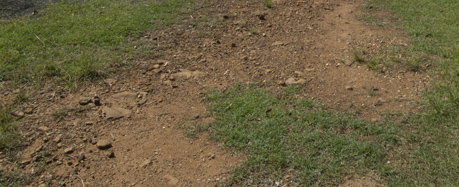
That happy discovery led to an exchange of views via comments on Chris’ blog and the start of a “conversation” about sandstone soils.  As you may know if you’ve been following this blog, our place is steep sandstone country, with many rock outcrops and soil that is made up of sandstone in various stages of decomposition, and generally not more than 60-70 cm deep.  Even that shallow layer of “soil” often has at least half its volume made up of gravel and small rocks.

What passes for soil on a sandstone ridge

What passes for soil on a sandstone ridge

Early on we recognised that one of our main food production challenges was going to be the need to create suitable soil.  To that end we have done all kinds of things, including sieving the rocks and gravel out of huge quantities of the native “soil”, green manuring, mulching, terracing, etc.

So when Chris said:

Have you ever let a garden bed go (ran out of time to keep up to it) and noticed the good soil revert to something like dry potting mix?

The hardest challenge for us hasn’t been building the soil, but rather maintaining it. I notice where we have swales, the soil doesn’t need much of our attention, except where it crosses a sandstone shelf. It only takes a season of hot dry weather, to cook any good soils we don’t maintain.

I knew exactly what she meant.

For us, the challenge hasn’t only been to create good quality soil (and I can’t claim to have satisfactorily cracked that one), but to keep it in good condition.  An apparently well prepared garden bed can start the growing season with lovely fluffy, moist soil that holds together exactly right when squeezed in the hand and produces a good crop.  Then, unless it is constantly maintained, a few months later it is dry, loose and apparently lifeless.  Chris’ description of “dry potting mix” soil hits the nail on the head, particularly if one interprets it as the crap bagged potting mix that supermarkets and garden supply places sell. The plant material in these mixes is generally at best only partly broken down, and there is no evidence that there is, or ever was, life in them.

I’m no expert on soil processes, but I suspect that the coarse material in our “dry potting mix” soils is compost “residue” that has not been broken down. This is probably because (a) the soil was not sufficiently healthy initially, and in particular did not contain sufficient humic matter and soil organisms; (b) when we let the bed go there isn’t sufficient ongoing moisture in the system for biological processes to continue creating and maintaining humic matter; (c) if there isn’t a continuous cover of thick (but air and water permeable) mulch then soil temperatures rise and water content decreases; and, on a sandstone base, there is likely to be significant leaching of nutrients when major rainfall events occur. I have to say though that I have had this problem in some beds that I was actively managing, not just in ones that I’d been ignoring for a few months, but that may have been due to the leaching mentioned in the last point above.

Does the above explanation seem to match your experience / observations?

My way of tackling this problem is still evolving, but it includes:
# keeping a fluffy straw mulch cover on the soil that allows air and water to penetrate, and at the same time significantly reduces drying and insulates from overheating;
# adding green manure to the soil and digging it in. This isn’t the usual “green crop dug in” approach, but a mix of moist and drier (but still living) plant material put through the chipper / mulcher sufficient to make a 25-50mm layer on the surface, then watering it and digging it in;
# adding sieved compost “fines” (containing the humic material) to the soil;
# adding dry horse manure that has been put through the chipper / mulcher to the surface layer.  Processing it this way produces a fine, light fluffy material that holds moisture and gives the soil a great “texture”; and
# to the extent that our water supply allows (we have only tank water), keeping the soil moist, even when the area is not in production.

Good compost of course contains humic material, but can also contain a lot of woody material if you use coarse chip mulch as part of your carbon source.  This is part of the reason it’s a good idea to sieve your compost and put the finer, humic, fraction into the soil, reserving the coarser material for mulch or for feeding the next batch of compost. Unless you already have a healthy soil, there’s not a lot of point in incorporating coarse, only partly broken down, compost material into it.

If you want a good guide to how soil “works” and how to maintain its health, the best book I’ve come across is Toby Hemenway’s Gaia’s Garden (Chapter 4: Bringing Soil to Life). This is by far the best and most practical permaculture text I know. The other good source for soil matters is, perhaps surprisingly, Harvey Ussery’s The Small-scale Poultry Flock (pages 137-144 for soil matters). We have a pretty comprehensive permaculture / organic library but these are the two books I go to first when I have a question, and I seldom need to go past them.

Learning

Sorry for the long gap between posts.  Sometimes life gets a bit too busy, and sometimes I’d just rather do physical things that make a difference to our level of sustainability than sit down and write a blog post.

This will be a short one, just to point you to an article that I find inspiring.  It’s by someone with the unlikely name of Shepherd Bliss and for some reason reading it really lifted my spirits.  It’s about learning from the community of the land

Here’s an example of what he says:

I farm with nature in mind, rather than against it. Permaculture is a helpful design system for this kind of agriculture. It teaches placing cardboard, burlap bags and newspapers around the berries, on top of which I put composted manure. This fertilizes, reduces weeds, and keeps moisture in the ground, as well as builds soil. The Earth does not want to be bare, so when factory farms strip it with chemical herbicides, it throws up a new covering, called “weeds.”

The boysenberries with which I share this land are the under-story within a forest. That diversity provides beauty and protects my main crop from pests, as well as providing fallen leaves for mulch. The redwoods, oaks and other tall trees draw moisture from the atmosphere onto the farm. I put large, flexible used flour bags as bedding for chickens, which catch their manure. I then put those manure-enriched bags around the berries and add other compost.

You can see more at: http://transitionvoice.com/2011/06/learning-from-the-community-of-the-land

Here’s an element of sustainability that should be a major election issue

Do you keep a three-month stockpile of food in your house, including a freezer with frozen foods, or perhaps you are a keen permaculture gardener with a well stocked backyard?  Is there a stockpile of petrol in the backyard (this might be illegal where you live)?

Do you depend on having an essential prescription filled by your local pharmacy when you run out?  If you had a sudden medical emergency, would you assume that you could receive immediate treatment in a hospital that was well stocked with pharmaceutical supplies?

According to a report  on Australia’s Liquid Fuel Security, prepared by Air Vice-Marshal John Blackburn (Retired) and released by the NRMA in February this year, if Australia’s oil supply was cut off:

  • dry goods could run out within nine days;
  • chilled and frozen goods could run out within seven days;
  • retail pharmacy supplies could run out within seven days;
  • hospital pharmacy supplies could run out within three days; and
  • fuel available to the public could run out within three days.

This is because Australia is one of the few developed nations that lacks a standard stockpile of fuel reserves.

The report highlights the nation’s dependence on foreign oil and fuel.

NRMA Motoring & Services Director Graham Blight said 85 per cent of Australia’s transport fuel comes from overseas crude oil or imported fuel.

This is a major sustainability issue, not just at the national level but also at the individual household level.  We can’t do much about the national issue, apart from raising it as a factor in the current election campaign.  However, at the household level it is one that we can prepare for.

If you haven’t got a large pantry (or even if you have) what about setting aside another cupboard – maybe clear some shelves in your linen cupboard, or get rid of the junk in those bottom drawers to make space – and set up a stock of dry goods, with each category arranged in use-by date.  You’d be surprised how far off the “best before” date is for a lot of dry and canned foods.  You can then rotate these into your pantry as needed and make a note on your shopping list to fill the gap in your stockpile the next time you go shopping.

How about starting a permaculture garden in the backyard; or joining a community garden; or asking if you can start a garden in that unused lot down the street.  And start growing staples first, not exotic herbs or fruits that you seldom eat.  That way you have a garden you not only can rely on in an emergency, but also one which makes an ongoing contribution to better nutrition.

Of course if you are in a suburban situation it is unlikely you will be able to grow significant quantities of a wide range of foods, but you might be able to link up with other gardeners to exchange excess produce of one type for something that you don’t grow.

From a permaculture principles point of view, the problem contains solutions – the fact that we have had a series of shortsighted national governments resulting in no liquid fuel reserves – contains the solutions to a whole lot of issues (emergency shortages, inadequate fresh foods in our diet, need for more outdoor exercise, not enough community linkages).  Addressing all of these through stockpiling, growing some of our own food, and establishing links within the community also increases resilience.

[Update Edit 9/8/13:]

For an idea of how little it can take to tip countries into an emergency situation based on the lack of liquid fossil fuels have a look at this report by Kathy McMahon in August 2006, on her blog Peak Oil Blues.  She provides a detailed account of the impact on the UK in 2000 when oil supplies were cut off by public action.  It all started when some French fishermen blockaded the English Channel as a protest against high fuel prices.  They were joined by truckers and farmers who were similarly angry about fuel prices and blockaded refineries and distribution centres throughout Europe.

England was possibly the most affected country and within nine days of the first protests:

  • Enormous lines appeared at gas stations as panic buying spread across the country on day 4;
  • Over half of Britain’s gas stations were closed by day 6, 90% by day 9;
  • Food stores experienced the same wave of panic buying, forcing supermarkets to close or impose rationing;
  • Hospitals suspended all but emergency care and began to run out of blood and essential supplies;
  • Mail delivery and public transportation operated on reduced schedules;
  • Heavy industries — auto manufacturers, steel plants, aerospace plants and the like — began planning immediate cutbacks, layoffs and closures as they ran short of fuel, parts, raw materials and workers who could get to work [quoted from: Transition Voice]

This summary gives only an indication of the nature and extent of the impact.  For a more nuanced description read Kathy McMahon’s material.

Reading her material should lead you to greatly expand the list of measures that you need to take to be ready for interruptions to the fossil fuel supply.  Such interruptions will not necessarily come about through the actions of terrorists, and certainly will occur well before the oil actually “runs out” (it never will, but the price will become prohibitive for all practical purposes).
In nine days, from 5 September to 14 September 2000, a small number of angry people brought one of the major developed economies to its knees.  This needs to be remembered when governments are considering their policies in relation to peak oil.  It is not safe to assume that people will “adapt” to rising fuel prices brought on by diminishing supplies.  As Kathy McMahon says:

“We are facing a life or death situation that creates both an intellectual and emotional strain. Even this brief look into the British Petrol Sedition tells an interlocking and devastating tale of what an oil shortage looks like. It tells a frightening tale of the power held in the hands of a small number of emotional, angry people who feel that their very livelihoods are being challenged by high oil prices and want their governments to do something about it.”

I am grateful to Tom Lewis at Transition Voice who re-posted from original article at The Daily Impact (which includes a podcast version), for bringing Kathy McMahon’s excellent article to my attention.  Her article is fully referenced, so it constitutes a rich vein of material on the topic.