Leucaena leucocephala – a tale of ongoing stupidity – or is it dishonesty?

What, you may ask, is Leucaena leucocephala?  And why a blog about it in relation to sustainability in the Lockyer Valley?

Well, first let me admit that this is a bit of a “vent”, as they say.  It is also a reminder that misleading and stupid advice by government agencies is not something that was invented recently.

In the early ’80s I came back from the Northern Marianas Islands, where I’d been working on archaeological surveys to trace the history of the Chamorro people who were suspected of having been on the islands for up to 2000 years.  The Marianas are a group of about 15 islands in the northwest Pacific Ocean, southeast of Japan and about half way between Hawaii and the Philippines.  Only three of the islands are permanently inhabited: Saipan, Tinian and Rota.

Up until the Second World War the Marianas were under Japanese control as part of the South Pacific Mandate granted by the League of Nations.  They’re now a Commonwealth in Political Association with the United States of America, though why anyone would want such an association is beyond me.

What’s this got to do with Leucaena or sustainability?  Well … read on.  The islands of the Marianas were part of the chain of island “stepping stones” utilised by the US on its path to the eventual conquest of the Japanese mainland.  Some of the most violent battles of the World War II were fought there.  Saipan and Tinian were bombed, shelled and fought over until they were, across large areas, bare cratered earth.  The battles were so fierce that when I was there you could pick up about ten bits of shrapnel or actual bullets per square metre on parts of the bare limestone on the coast of Tinian.  There were larger bits of bomb casing sticking out of some of the few remaining trees, and in places bits of war debris, including sometimes aircraft parts, were mixed in with 2000 year old archaeological layers.

When the war finished the nearly denuded islands of Saipan and Tinian were in danger of literally having most of their topsoil washed into the sea in the wet season.  The surviving Chamorro people were at risk of losing the agriculture which was the basis if their existence.  Rota was spared invasion and destruction because it had no strategic value, lacking major Japanese fortifications or areas where airstrips could be built.  The troops stationed there were cut-off and left to starve until they surrendered, so the island was spared the destruction visited on Saipan and Tinian.

So what to do?  The quick, and as it turned out “dirty”, solution was to bomb the islands with huge quantities of the seeds of Leucaena leucocephala, a fast-growing member of the Mimosa family (like our Acacias) that originated in Central America.  They got the seeds from the Philippines where it had become naturalised and was widely distributed.  Leucaena is very well adapted to the tropics and sub-tropics.  It grows in dense stands as a small (up to six metres or so), whip-stick tree which produces seeds prolifically.  The stands are often so dense that nothing else can grow under them.

Leucaena grows in dense stands

Prolific seed production by Leucaena

Having done field work on Rota, Tinian and Saipan I had seen both the original lush, tropical vegetation of Rota, which luckily had not needed post-war soil stabilisation and is rich in species and wildlife, and the widespread, mono-species stands of Leucaena across Tinian and Saipan with very little wildlife.  The farmers on those islands spent a lot of their time in controlling the Leucaena regrowth, often to the point that agriculture became uneconomic, and in the towns it was even a pest in the lawns, growing faster than the grass.  Clearly the species was a mega-weed.

Arriving back in Australia, one of the first things I read in the newspaper was about how the Queensland Department of Primary Industries was promoting the planting of Leucaena as a cattle fodder, ideally adapted to tropical and sub-tropical areas with poor soils and monsoonal rainfall patterns.  Unbelievable!

Very concerned, I phoned the DPI to find out more and to share my observations of what Leucaena can do to the environment.  The agronomist I spoke to heard me out, then said that this might be the case in places where the seed was distributed willy nilly across the landscape, but I had to understand that what DPI was advocating for Queensland was “controlled” use of Leucaena in pasture – where it would never grow to seed-bearing stage because it would be grazed off before that.  Seriously.  Like the cattle were going to be in the paddocks the whole time, never turning their backs in case a plant set seed?

I was under the impression that Leucaena was being introduced into Australia at that time (remember this was before the internet and Google, and I’m not an agronomist), and that perhaps they really didn’t believe that it could become a pest.  But according to the UN Food and Agriculture Organisation (FAO) Leucaena had been introduced into Australia in the late 19th century and it was naturalised in parts of northern Australia by 1920.  So there should have been plenty of evidence that it was a very potent pest species.

Despite this, during the 1970s and early 1980s, Leucaena was being touted around the world as the ‘miracle tree’ because of its worldwide success as a long-lived and highly nutritious forage tree according to FAO, and the Queensland DPI were right there on the bandwagon and not about to listen to any contrary views.

Fast forward to the present:  According to the Biosecurity Queensland Factsheet on Leucaena it is “A very troublesome weed of waterways and roadsides in tropical and sub-tropical regions. It is also found in open woodlands, gardens, parks, waste areas, disturbed sites and on coastal foreshores and offshore islands.” and is “… widely naturalised and relatively common in the coastal and sub-coastal districts of northern and eastern Australia. It is most common in south-eastern, central and northern Queensland and in the northern parts of the Northern Territory. Also present in the coastal districts of northern and central New South Wales, in the coastal districts of Western Australia, on Christmas Island and on the Cocos Islands”.

So we come to the Lockyer Valley.  Try keeping a careful watch on the roadsides in the Valley, as well as between Toowoomba and Brisbane, including along Mt Crosby Road if you take that route into Brisbane – there’s no doubt that Leucaena is well and truly established in Southeast Queensland.

In fact, the Queensland Department of Agriculture, Forestry and Fisheries (DAFF) is now warning that “Unless heavily grazed or otherwise controlled, it is able to rapidly spread to adjacent areas”.

And this wasn’t bleeding obvious in the early 1980s to anyone who wanted to take more than a narrow, rose-coloured view of the species?  Give me a break.  Was I the only person who had noticed that it was a very noxious weed?

The cat, as they say, is now out of the bag – though in this case, given the number of other highly environmentally impacting species that have been introduced or promoted by government agencies across Australia, it might be more appropriate to say that Pandora’s Box is well and truly open.

Has anything changed?  Well, Leucaena is now well recognised as a problem here in Australia.  But is it really?

The Australian Government, through the Australian Centre for International Agricultural Research (ACIAR, which funds and advises on a lot of our foreign aid policy and projects) is running a website called Tropical Forages: An interactive selection tool, in partnership with the CSIRO, the Queensland Government and a number of other organisations.  This website advises that Leucaena “Will not normally spread under grazing as cattle relish young seedlings.  Some thickening up of grazed stands has occurred in eastern Australia where leucaena is left ungrazed during the growing season for provision of autumn feed.”  Is my 1980s agronomist friend now working in Australia’s international aid industry?

This ongoing level of ignorance and stupidity is beyond belief.  I hope to see the day when there will be major legal class actions in Australia against government agencies for the massive damage done to our environment and economy as a result of the lack of proper consideration of plant introductions.

Peak oil, fracking and the fate of technological society

Been a while between posts – mostly due to ongoing shoulder problems causing chronic pain and a resultant lack of interest in doing anything that requires focussed concentration.  Now I have discovered that the physical posture associated with sitting meditation takes the pressure off the damaged areas and virtually eliminates the pain – possibly for 12 hours or more, so more blogging may be on the way.

I’ve just been reading a great post by the Archdruid, addressing the apparently increasingly widespread view that coal seam gas and shale oil fracking have solved the world’s fossil fuel dilemma by permanently banishing the spectre of peak oil and, starting with the US, have put us back on the road to endless technological progress and economic growth.  The reality, as he says so eloquently is that:

… technological progress, as well as the sciences that helped to make it possible, are subject to the law of diminishing returns; furthermore, that what has been called progress is in large part a mere side effect of a short-term, self-limiting process of stripping the planet’s easily accessible carbon reserves at an extravagant pace, and will stop in its tracks and shift into reverse as those reserves run short; more broadly, that modern industrial society is in no way exempt from the common fate of civilizations.

Click HERE to read a very well argued presentation of the evidence that the reserves can be produced using fracking and other CSG technologies are within the predicted long tail of fossil fuel reserves that would become accessible once prices were sufficiently high, and make no difference to the arrival of peak oil or the eventual outcome.

Who wants to prepare for the future?

This article by Liese Coulter from The Conversation seems like a pretty accurate take on how most of us deal with some of the difficult issues in our (the World’s) future.  Rather relevant at this time of annual reviewing of the past year and making resolutions about our future actions.

_________________________

For most of us, preparing for the future means having a retirement fund and health coverage, choosing our preferred tree change or sea change option and keeping on the good side of the relatives who will eventually pick out our nursing home. For the most part we don’t want to think about these things at all, as anyone who has tried to talk this over with their partners has probably found out.

Talking about preparing for a future affected by climate change is even less welcome a topic and many of the same considerations hold true.

We know there will be some big-impact events but not when and where they will happen. The Australian Climate Change Science Program (ACCSP ) produces great technical information but not what I need on a personal level. Looking at the Climate Change in Australia website I can get a general idea of the risks I face from higher temperatures and changed rainfall patterns over the coming decades, but not what to actually expect in any given year. How can I reduce the risk? Having a high-set Queenslander house reduces my risks of climate impacts from very hot weather and flooding while I live on the Brisbane flood plain.

On the same level, the National Stroke Foundation shows my changing risk as I age, but not for certain if I will have a stroke. With my family history of diabetes and heart disease, my risk is high. But I also know that by keeping fit and eating light, I can improve my chances.

Preparing for both ageing and for climate change involves managing the risks and deciding what we are willing to change and what we are willing to chance. Mostly we don’t want to think about either one and like to see difficult times as far off in the future.

How much we do not want to think about dealing with impacts from climate change was brought home to me through a series of casual conversations in 2007, where I mentioned newly released climate projections for 2050. I could see people mentally counting in their head and then say “I’ll be dead then!” as a big smile spread across their face.

When this kept happening no matter where I travelled, I came to think that many people would rather be dead than have to face what we expect from climate change.

In the same way, when young people express a horror at the prospect of getting old, they picture the losses in reduced options and opportunities, without appreciating the benefits gained over a lifetime. As old age gets closer our attitudes change along with our expectations. A fit and well off 70-year old can have a very good day, but he is still 70. Someone in 2050 dealing with unpredictable weather patterns, fewer food options and having to learn new job skills will likely have different expectations than we do now and can still have a very good day.

In some ways I think we have a failure of imagination looking at the climate-affected future. We have seen climate change as something to be stopped, that global warming could be avoided if we reduce greenhouse gas emissions to the atmosphere.

Now weather patterns have started to change and emission reductions aim to keep the changes from reaching a dangerous level, even as some climate impacts have become unavoidable. Changes have been set in motion through inertia in the climate system and emissions absorbed in the oceans that will enter the atmosphere over the coming decades.

The small and large choices we make each year will shape how prepared we are to meet new challenges. Like ageing, the key to adapting to climate change is to act now to increase our capacity to enjoy the benefits and opportunities, and decrease our vulnerability to the negative impacts.

When I picture myself at 70 I have an image of my parents and grandparents at that age but with the benefits of better nutrition and medical care. What is more difficult is picturing the world around me. The very tricky thing about adapting to climate change is knowing what to expect, expressed in the standard disclaimer for financial products, “past performance is not necessarily indicative of future results”. That has not stopped us investing for our retirement but it will be even more important as we prepare for climate change.

_________________________

Author Disclosure Statement

Liese Coulter works for the National Climate Change Adaptation Research Facility (NCCARF). She is affiliated with the Australian Science Communicators (ASC) and the Public Communication of Science and Technology network (PCST).

_________________________

This article was originally published at The Conversation.
Read the original article.

The Conversation

We are funded by CSIRO, Melbourne, Monash, RMIT, UTS, UWA, Canberra, CDU, Deakin, Flinders, Griffith, La Trobe, Murdoch, QUT, Swinburne, UniSA, USQ, UTAS, UWS and VU

A carbon tax that cuts greenhouse gas emissions AND the budget deficit

I know it is physically a long way from the Lockyer Valley to Ireland.  The link is that both are subject to carbon taxes – and the difference is that the Irish carbon tax is cutting greenhouse gas emissions and making a significant contribution to reducing government debt.  And it’s not just carbon taxes: a range of environmental impacts whose cost is usually externalised by those responsible for creating them (meaning that we all pay for those impacts, whether we had a part in causing them or not), are now being charged to the source, whether it is a business or private individuals.

The following is taken from an article by Elisabeth Rosenthal in the New York Times  of December 27.

Over the last three years, with its economy in tatters, Ireland embraced a novel strategy to help reduce its staggering deficit: charging households and businesses for the environmental damage they cause.

The government imposed taxes on most of the fossil fuels used by homes, offices, vehicles and farms, based on each fuel’s carbon dioxide emissions, a move that immediately drove up prices for oil, natural gas and kerosene. Household trash is weighed at the curb, and residents are billed for anything that is not being recycled.

Derek Speirs for The New York Times

The Irish now pay purchase taxes on new cars and yearly registration fees that rise steeply in proportion to the vehicle’s emissions.

Environmentally and economically, the new taxes have delivered results. Long one of Europe’s highest per-capita producers of greenhouse gases, with levels nearing those of the United States, Ireland has seen its emissions drop more than 15 percent since 2008.

Although much of that decline can be attributed to a recession, changes in behavior also played a major role, experts say, noting that the country’s emissions dropped 6.7 percent in 2011 even as the economy grew slightly.

“We are not saints like those Scandinavians — we were lapping up fossil fuels, buying bigger cars and homes, very American,” said Eamon Ryan, who was Ireland’s energy minister from 2007 to 2011. “We just set up a price signal that raised significant revenue and changed behavior. Now, we’re smashing through the environmental targets we set for ourselves.”

… when the Irish were faced with new environmental taxes, they quickly shifted to greener fuels and cars and began recycling with fervor. Automakers like Mercedes found ways to make powerful cars with an emissions rating as low as tinier Nissans. With less trash, landfills closed. And as fossil fuels became more costly, renewable energy sources became more competitive, allowing Ireland’s wind power industry to thrive.

Even more significantly, revenue from environmental taxes has played a crucial role in helping Ireland reduce a daunting deficit by several billion euros each year.

The three-year-old carbon tax has raised nearly one billion euros ($1.3 billion) over all, including 400 million euros in 2012. That provided the Irish government with 25 percent of the 1.6 billion euros in new tax revenue it needed to narrow its budget gap this year and avert a rise in income tax rates.

Although first proposed by the Green Party, the environmental taxes enjoy the support of all major political parties “because it puts a lot of money on the table,” said Frank Convery, an economist at University College Dublin. The bailout plan for 2013 requires Ireland to embrace a mix of new tax revenues and spending cuts.

Not everyone is happy. The prices of basic commodities like gasoline and heating oil have risen 5 to 10 percent. This is particularly hard on the poor, although the government has provided subsidies for low-income families to better insulate homes, for example. And industries complain that the higher prices have made it harder for them to compete outside Ireland.

“Prices just keep going up, and a lot of people think it’s a scam,” said Imelda Lyons, 45, as she filled her car at a gas station here. “You call it a carbon tax, but what good is being done with it to help the environment?”

The carbon tax is levied on fossil fuels when they enter the country and is then passed on to consumers at the point of purchase. The automobile sales tax, which ranges from 14 to 36 percent of a car’s market price depending on its emissions, is simply folded into the sticker price.

That sent manufacturers racing to reduce emissions. Automakers like Mercedes and Volvo began making cars with high-efficiency diesel engines that shut off rather than idle when they stop, for example. “For manufacturers it’s all, ‘How low you can get?’ ” said Donal Duggan, a brand manager at an MSL showroom near central Dublin.

Other emissions taxes on cars, including the annual car registration fee, or road tax, are billed directly to customers, potentially adding thousands to annual operating costs. Ninety percent of new car sales last year were in the two lowest-emission tiers.

The taxes on garbage had an immediate impact. In Dun Laoghaire Rathdown County in southeastern Dublin, each home’s “black bin” for garbage headed to the landfill is weighed at pickup to calculate quarterly charges. Green bins for recyclables are emptied free of charge.

“There was a big furor initially, but now everything I throw out, I think, ‘How could I recycle this?’ ” said Tara Brown, a mother of three.

How much of a crisis does Australia have to experience before we have a government that has the guts to introduce a real and effective carbon tax?

Our electricity consumption

I just did a couple of calculations of our electricity consumption.

For the first calculation I used the total number of days our system has been running (1,695) and the total energy consumption (4,765 kWh) to get 2.81 kWh/day.  But we have been away for some of that time (say three months), so I subtracted 90 days = 2.96 kWh/day.

Even then, there has been only one person here for some of that time, maybe around 5-6 months, so 2.96 is an under-estimate of our average energy usage.  More relevant is the fact that until around late 2010 we were living in what is now the office, so fewer lights, no load from the fridge for most of that time because we used a gas fridge, and for much of the time, no washing machine. When we did get a washing machine, quite late in our shed-living days, it was a very old one that was about to be dumped by the neighbour of a friend, so had very high energy consumption.

We don’t keep a note of our meter readings (though we should), so it isn’t possible to track changes in electricity use over time. But I do have meter readings for today and two weeks ago, so can do the sums for that period – it comes out at a surprising 4.57 kWh/day.

Why surprising? Well, almost all our lights are 5W LED downlights, and they are set up in “banks” or as individual work bench lights so that their usage can be minimised. (Though they are rated at 5W, an energy meter on a bank of five in the office shows that their average power usage is 6W per LED).  This is probably mostly a result of losses in the 50W transformers that we use (each of which has a maximum of 10 LEDs connected to it).  Even with no lights turned on, each transformer uses 4.4W continuously, probably through hysteresis in the iron core, so for the four transformers that are constantly on we are using (losing) just over half a kWh per day.

Another reason for the higher than expected power use is that this is summer, and we have been having heat waves off and on for weeks, so the fridge has probably been running much more than usual.  It is a Vestfrost with separate compressors (and separate doors) for the fridge and freezer components, so is pretty economical.  When we bought it, it was way ahead of even the most economical of the commonly available brands.  However now there are quite a few models with similar storage space that are, on paper at least, are equal or better.   It’s set up in front of the pantry, so there is plenty of space behind it, and the gap between the top of the fridge and the ceiling is 2-3 metres, so there is plenty of vertical air circulation.

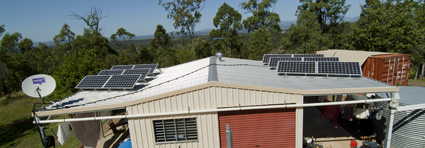
Our 1.98kW solar array on the roof of the "office"

Our 1.98kW solar array on the roof of the “office”

We aren’t too worried about this level of energy use on our part, because we are on off-grid solar.  All of our power comes directly from solar panels during most of sunny days, and from a large battery bank during the night or cloudy parts of the day.  The battery bank consists of 24 two-volt 650 amp hour gel batteries.

Our solar PV system has a design load of 5.4 kWh/day – based on our estimated usage at the time of 3.95 kWh/day.  Since most of the power we use comes directly from the solar panels (fridge, washing machine, tools and computers are operating mostly during the day when the solar panels are producing much more then we use at any one time), our current 4.57 kWh daily usage represents a much smaller load on the batteries and leaves us plenty of leeway within our design load.

We manage our batteries so that they don’t go below 80% capacity, and even with this conservative management approach we need to turn on the generator to recharge the battery bank fewer than three times per year on average.  With gel batteries and this low level of draw-down we expect to get 15 years or more out of our batteries.

Though I say that we aren’t too worried about our level of electricity consumption, we do try to minimise our use, just because it feels right – and because one of our objectives in living where and how we do is to demonstrate a range of approaches to sustainable living.  I’ll deal with other ways in which we strive for sustainability in other posts.

In the meantime we can get some satisfaction from the fact that our level of electricity consumption is nowhere near the average 13.9 kWh/day of two-person households in our postcode area.

Solar Feed-in Tariffs – how essential was it to get rid of them?

Australian governments at Federal and State level had a collective rush of blood to the head over the last two years and dropped solar PV feed-in tariffs to levels that are only a fraction of what they were two years ago.

No doubt this was largely inspired by a combination of pressure from power companies, surgent neo-liberal philosophy reinforced by a drive to achieve budget surpluses, and panic in the face of the rapid increase in domestic solar PV installations – yikes!! the policy is working – not something that the current Federal government is used to seeing.

The level of installed domestic solar PV in Australia increased dramatically in 2010-2012.  The graph below shows the change up to 2011, and it continued at the same rate into 2012.

Take up of solar PV in Australia.  Circles show total installed capacity, rectangles show new capacity installed in the given year. [Data from DataMarket (http://data.is/naKtrl), image by Mike Sandiford. Figure in this blog from link to: http://theconversation.edu.au/whos-afraid-of-solar-pv-8987%5D

Yes, people did continue to install grid-connected solar power, but not at the levels they would have done with the incentive of higher feed-in tariffs.

Does this matter?  Well, yes, very much so, given that the rate at which the world has been generating greenhouse gases means that we have to totally phase out the use of fossil fuels over the next two decades if we are to have any chance of avoiding 6 degC of global warming by the end of the century.(#)

An investment in higher solar power feed-in tariffs for few years now would have very significantly reduced the use of fossil fuels for electricity generation now and into the future, and would have bought time to find alternatives so that we could replace existing fossil fuel generating plants with non-fossil fuel generation.

Japan, a country which has been in more or less permanent recession for 20 years and which, as a result of very significant ongoing tsunami reconstruction expenses, has every reason to cut other budget programs would seem an unlikely country to introduce or maintain high solar feed-in tariffs.

A member of the Alternative Technology Association‘s Brisbane group reported on their discussion group today that large Sharp solar panels (made in Japan) have been becoming increasingly difficult to source in Australia.  Here’s what he said:

Sharp 167W 24V poly panels have been almost impossible to get all year.  185W 16V mono panels have been easier but not available from usual channels for the last 6 months or so.
Sharp is no longer importing their made in Japan panels into Australia because they are instead servicing the world leading Japanese feed in tariff of over 50c/kWh L. [sorry can’t give you a link, you have to be a member to access the discussion group]

In fact, the Japanese government has, for a long time, been seeking to expand solar power by enacting subsidies and a feed-in tariff. In December 2008, the Ministry of Economy, Trade and Industry announced a goal of 70% of new homes having solar power installed, and would be spending $145 million in the first quarter of 2009 to encourage home solar power.

The Japanese government enacted a feed-in tariff on November, 2009 that requires utilities to purchase excess solar power sent to the grid by homes and businesses and pay twice the standard electricity rate for that power. In that year, Japan had the third largest solar capacity in the world (behind Germany and Spain), with most of it grid connected

On June 18, 2012, despite being in the top five globally for installed PV, a new feed-in tariff was approved, of 42 Yen/kWh, about 0.406 Euro/kWh or USD 0.534/kWh. The tariff covers the first ten years of excess generation for systems less than 10 kW, and generation for twenty years for systems over 10 kW. It became effective July 1, 2012. (Source: Solar Power in Japan – Wikipedia)

But here in the Lucky Country, raking in the taxes and royalties from a mining boom, the government thinks we can’t afford higher feed-in tariffs, even to protect our grandchildren from globally destructive chaos.

__________________

# There are a lot of recent sources to back this up, but you could start with:

http://www.huffingtonpost.com/tom-zeller-jr/climate-change-math-politicians_b_2147001.html and www.guardian.co.uk/environment/2011/nov/09/fossil-fuel-infrastructure-climate-change [see particularly the paragraph beginning: The new research adds to that finding…]

Pumpkin greens

Part of our pumpkin management is to pinch off the growing tips once a runner has reached a certain length.  This forces them to put out additional branches, providing  more sites for flower production.  We then use the tips as a vegetable, either steamed or stir-fried.

Fresh pumpkin growing tip

However every year we have self-sown pumpkins coming up in garden beds or anywhere else that we use our compost.

“Rogue” pumpkin seedlings

Until now we have just weeded these out, though sometimes we move them to where they can usefully grow or pot them up to give to friends.  This morning I was doing something else in the garden and my eye was caught by the sight of a fresh, bright green new pumpkin leaf.

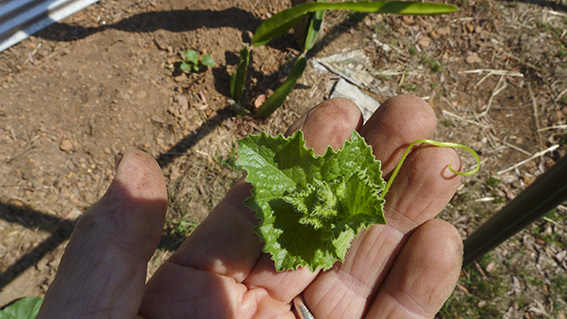
New pumpkin leaf

Curious, I picked it and ate it.  Delicious!  Fresh, sweet, full of flavour.  Wow.  I would not have suspected that a leaf that size would be tender and sweet.  We now have a new vegetable, and wherever possible the volunteer seedlings will be left in place for a while so we can harvest the young leaves.

We have a new variation on pinching the tips off the pumpkin vines to promote flowering.  Meg McGowan suggested restricting each vine to one square metre – she finds it promotes much more productivity.  We are trying it this pumpkin season.

Lockyer up with the best in Australia on level of solar PV power installations

A new report by Sunwiz has revealed that the Federal electorate of Wright (containing all or most of the Lockyer Valley Region) has the highest number of domestic solar power installations (solar PV plus solar hot water) of any Federal electorate in the country.  SunWiz has performed an analysis of Clean Energy Regulator data as of 1 October 2012 to identify the top solar electorates.

The electorate of Wright has a total of 26,417 installations, made up of 16,420 solar PV and 9,998 solar hot water systems.

Of course, raw figures on the number of installations in an electorate are not particularly meaningful, given that there is some variation in household numbers per electorate (though electorates generally have populations of around 150,000).  The percentage of households with solar installations (known as “penetration”) is a much more useful number, both for comparison and for revealing the level of uptake of renewable energy at the household level.

Wright figured 6th in level of penetration of solar PV (out of 150 electorates) with a penetration level of 20% – one in five dwellings (the national maximum was 23%) and 15th in solar hot water with 12% – one in eight (national maximum 21%).

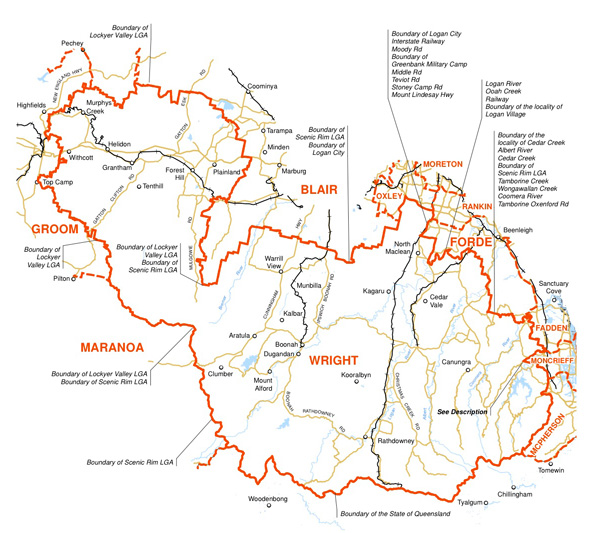
The electorate of Wright encompass an area stretching from the western Gold Coast through the rural areas left out of the more urban electorates between Logan City and the NSW border, before curving northwest to include the Lockyer Valley Region west of Ipswich. As well as the western edge of the city of Gold Coast, Wright includes the towns of Beaudesert, Jimboomba, Boonah, Gatton, Laidley, Hatton and Helidon (ABC 2010 election web site).

Given its location, Wright may not be what you would think of as a particularly Green electorate, and it isn’t, though there was a significant swing to the Greens in the 2010 election.  Conservative parties (LNP, ALP and Family First) – yes, I’ve identified the ALP as a conservative party – got over 80% of the vote.  The voting pattern in that election was:

How does the Lockyer Valley Region fit into this solar power picture?

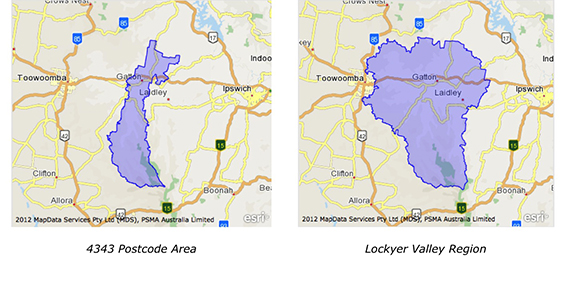
Census records for the Lockyer Valley Region do not include solar PV installation data.  However it doesn’t seem unreasonable to take the 4343 postcode area as a proxy for the Region.  As can be seen from the map below, it clearly takes up a significant proportion of the Region.

The Sunwiz analysis is based on postcode data (their methodology is explained at the foot of the web page reporting their findings), but understandably in a national report they do not provide the separate postcode data.

The Clean Energy Regulator’s web site includes detailed data on “small generation units” (= solar panel installations) for each postcode area.  In the 4343 area 677 units had been installed as of October 2012, with a total generating capacity of 2,012 kW.  The total is likely to be higher than this because the data is based on registration for Renewable Energy Certificates, which can be done up to 12 months after installation.

There were 3,610 occupied private dwellings in the 4343 postcode area at the time of the 2011 Census.  This suggests a “penetration” of solar PV power of 18.7%.  However, solar power is seldom installed on apartments, flats, and similar, and is much more likely to be found on private houses, of which the Census recorded 3,190, leading to a penetration level of 21.2%.  It seems fair enough to say that the solar PV penetration level in the 4343 postcode area is between 18.7% and 21.2%, and that the level for the Lockyer Valley Region is probably in this range.  (There were 11,900 private dwellings, and 11,200 occupied private houses recorded in the Region in the Census, so the 4343 figures represent 30.3% and 28.9% respectively of these totals. Seems like a pretty good sample).

What this means is that the penetration level for solar PV power installation in the Lockyer Valley Region (around 18.7-21.2%) is clearly of the same order as that for the larger Wright electorate (20%) and close to the highest penetration rate in the country (23%).

Let’s take a walk around our systems

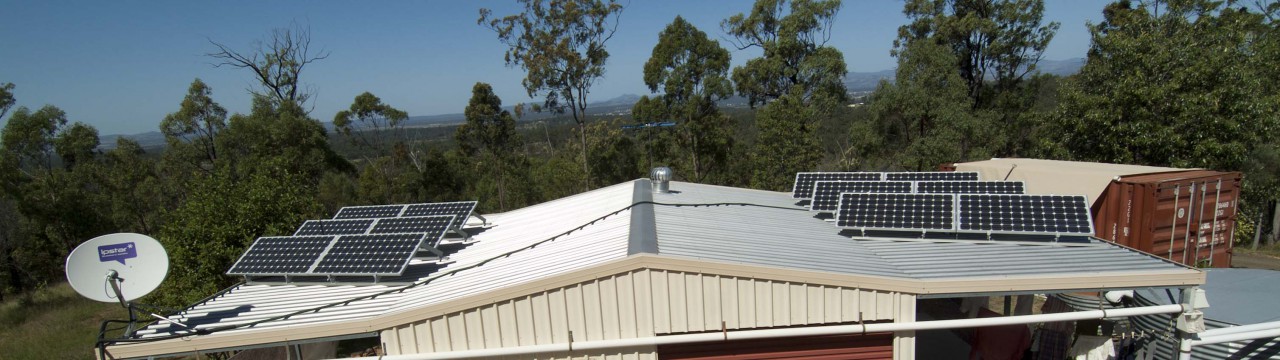
How about a quick tour for a preview of some of our different life support systems?  Solar power first.  There are 12 panels making up a 1.9 kW array feeding into a battery bank that lasts up to three days without sun.  The building was our home for nearly ten years, and has now been lined, insulated and fitted out as a study and TV room with a guest bed.  Much more comfortable than when we lived in it.  The container at the back is currently a storage area, but there are plans to eventually convert it into guest accommodation.  I’ve always been fascinated by the idea of using shipping containters as the basis for housing.

On the righ of the photo you can make out one of our water tanks. This one is “aquaplate”, but the others are mainly stainless steel.  The dish on the left is for satellite broadband internet access.  Our phone line can’t handle any but the lowest data transfer speeds and certainly isn’t up to delivering modern internet content.

Then there is the house, with its passive solar design. The tall windows and wide eaves on the north-facing wall allow winter sun to shine across half the width of the house at midday in mid-winter.  The heat of the sun is absorbed by the concrete and is returned to the interior during the night.  Lots more features of the house to talk about later, like the insulation and lighting.  And the whole story of our owner-building journey.

On the right you can see the first flush diverters coming down the corner of the wall.  These discharge the first flow from the roof and gutters to the ground, preventing accumulated dust and dirt from entering the storage tanks.

This is the smallest, lowest impact house we could build within the constraints of our space requirements, the design demands of bushfire safety considerations, and government building regulations.

We use composting toilets, both inside and outside the house.  Manure of any kind is too valuable a resource to waste.  Once full, the bin is moved to the back, stocked with compost worms and left to mature until the other bin is near full.  This can be up to 12 months, by which time the resting bin has produced about 150 litres of friable, rich soil ready to go into the garden beds.  In this photo the bin on the left is covered with shade cloth to stop it getting too hot in the summer sun.

Before we built the house we had a very productive greywater treatment system comprising a worm farm, a sand filter and a storage tank.  Not only did it produce water for the garden that was clean enough to store for 3-4 days without any smells, it also produced thousands of compost worms and lots of worm castings to fertilize the garden beds.  Alas, plumbing regulations do not allow such productive creativity, so now we are fully legal, and our greywater all goes to waste, literally.  It is discharged under the ground in an absorption area, out of reach of our gardens and fruit trees.

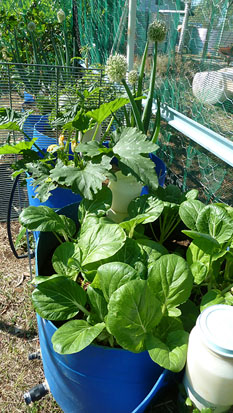
The loss of this greywater matters in our dry climate.  One of the solutions we are trying in order to save water is the use of wicking pots to grow vegetables.  In this method water is stored in the bottom of the pot, and wicks up through the soil to the root zone.  The only water that escapes is what is transpired through the leaves of the plants.  Depending on the size of the plants and the weather the water needs topping up only every four to seven days.

We also have small portable worm farms, producing useful quantities of worm castings and worm tea, and a worm farm that processes the discharge from our kitchen sink before it enters the greywater system.  At present we are thinking about designs for a vermiponics system (worm farms connected to flood-and-drain vege grow beds).  If these are successful they will become the precursor to a full-fledged aquaponics system, with native fish tanks connected to the grow beds, but that’s some way in the future.

Well, that’s a quick introduction to some of our life support systems.  I hope it has whetted your interest.  There will be separate posts on each of these systems as time allows.  Of course there are other systems that I haven’t touched on heree, including: a range of approaches to compost making, the wood-fired heating (for those few winter nights when the passive solar doesn’t quite overcome the cold), and the solar hot water. Those will be the sugject of future posts – possibly many posts, because most of our systems are in a process of ongoing development and improvement.