Harvested – April to June

Here’s a record of the different things we harvested from the garden from the beginning of April to the end of June this year.

No weights or volumes, just harvested or not.  I can’t be bothered weighing everything that comes in from the garden; life’s too short for that sort of record keeping.  If it’s there and we need it, we harvest as much as we need.  What doesn’t get used by us gets given away – usually after a quick rush around the garden as visitors are leaving or as we leave to go visiting, with no time to weigh things; or it goes into the compost when past its prime.

And of course the produce that gets sampled as we graze different things while working it the garden doesn’t get recorded at all, even though it probably amounts to quite a lot over the course of a month.  I assume almost everyone grazes as they move around their garden.  For me it is not only satisfying, a lot of it is “quality control”.  Are the lettuce going bitter yet?  How does this tomato like growing here?

Over the three month period I’d say that something like 80% of our vegetable consumption came from the garden, which has put a big dent in our grocery bill.

Sorry about the crappy layout.  I haven’t figured out how to set up a table in WordPress yet, so this is just blocked and copied from MS Word.

Common Name April ’14 May ’14 June ’14
Arrowroot, Queensland
Basil, Italian/Sweet
Basil, Greek
Basil, Thai
Beans, Snake
Beetroot
Bok Choy
Chilli
Chives, Garlic
Dragon Fruit (red variety)
Gai Laan
Kale, Curly
Kangkung / Water Morning Glory
Leek, Clumping
Lemon, Eureka
Lemon Grass, West Indian
Lettuce, Perpetual
Lime, Tahitian
Lime, West Indian
Luffa salad, stir fry, sponge salad, sponge sponge
Mint
Pak Choi
Parsley, Flat-leaf
Pineapple
Potato, Kipfler
Pumpkin, Japanese tips
Radish leaves, bulbs bulbs
Rosemary
Silverbeet, Fordhook Giant
Spinach, Ceylon
Spinach, Brazillian
Spring Onions/ Shallots
Sweet Potato, Orange tips
Tomato, Cherry
Tomato, Gros Lisse

Urban Farming

There are a lot of people in the world without access to land or good soil.  And I’m not talking only about landless people in developing countries.  Given the high level of urbanization in most countries and particularly in the developed world, urban farming ideas are applicable just about anywhere.

I’ve come across two great and proven ideas for “landless” farming lately.  The last was from the Accessible Edibles Project run by the Rotary Club of Rochdale, and uses recycled plastic bags (or other forms of container that can be hung from something.

from the Rochdale Rotary Club website

The method is very clearly set out in their manual and has been used successfully in many countries and at different latitudes.  The frames shown in the photos don’t need to be used – the bags can be hung from anything handy.

The other effective “landless” farming technique I’ve come across recently was developed by Roman and Janna Spur, who live in a flat in New Farm, an inner city suburb of Brisbane.  They have a great website which catalogues their approaches to sustainable living in a rental situation.

We went to their place last Sunday for a workshop on making a self-watering planter box from recycled materials (a broccoli box from the local fruit and vege shop, some 40 or 50mm PVC pipe, and a wooden skewer).  You can find an illustrated step-by-step guide here

a self-watering planter box in use [from Spurtopia website]

The planter-box workshop was followed by a fascinating presentation on the ways the family has developed an increasingly sustainable lifestyle in their rented accommodation, bearing in mind that there are limits on their ability to modify structures and systems, and that they want to be able to take their sustainable “infrastructure” with them if they move.

These guys are truly inspirational and I highly recommend their website and workshops.


The Foss and Holmgren Presentation

We went to the presentation by Nicole Foss and David Holmgren in Brisbane on Friday last week.

Very well attended, with a main lecture theatre pretty well packed – maybe 200 people.  There were eight people there from the Lockyer Valley whom I recognised and quite possibly more whom I didn’t recognise.  Pretty impressive, considering the massive disparity between the population of Brisbane and that of the Lockyer Valley.

Nicole Foss’s talk was absolutely riveting, starting with an overview of the history of money and the way that it has been expanded by the incorporation of debt/credit into the “money supply” and the risks that this poses.  She moved on to energy resource issues and linked this to the money supply (debt) through the cost of finding and producing the remaining “difficult” fossil energy sources, concluding that most of the hard to access fossil fuels will not be economic to produce.  The thread running through the presentation was the cyclical nature of the economy and the fact that massive levels of debt, coupled with the interconnectedness of the globalised economy and energy shortages/high energy prices, mean that sooner or later (and very likely sooner) there will be a depression cycle from which the global economy will not be able to recover.

Not all of it was as gloom-and-doomish as that may sound.  Foss gave examples of broad strategies for weathering the storm.

Of course this summary cannot possibly do justice to what was one of the most well delivered, highly informed, logical, well structured and thought provoking presentations that I have ever had the pleasure of listening to.  We came away with a lot of food for thought, and a resolve to review our sustainability planning.

She set the scene perfectly for David Holmgren to step in and elaborate the ways in which permaculture can contribute to creating a way through the economic (and social) breakdown that is coming.

What he started with were a series of bland generalisations, some of which touched on areas Foss had already covered, though some of what he said seemed strangely at odds with what she had presented.

The major part of his presentation though was an attempt to breathe life into his Aussie Street  scenario.  For those who haven’t seen it, this is a series of morphing diagrams tracing the evolution of households on four house blocks in an Australian suburban street.  It is long, barely entertaining, and the ratio of stimulating ideas to slightly cute waffle is very low.  We first saw it about eight years ago, and neither of us could decide whether there was actually any new material in Friday’s presentation.  As an illustration of the application of permaculture principles to suburban planning and lifestyle it can only be described as weak.  As a follow-up to the opportunity that Nicole Foss had set up for someone to highlight the role that permaculture can play in dealing with the coming disastrous wind-down of the economy and associated resource issues, Holmgren’s presentation was a massive lost opportunity.

We kept thinking, there’s got to be more.  A friend of ours said later, “I just wanted to throw things at him to wake him up to what he needed to be saying”.

But if you can get to the the Melbourne presentation on July 15, don’t miss it.  This is a chance to hear Nicole Foss give a truly remarkable overview of where we are headed and why.  If you are thinking of going to the Hobart presentation (Holmgren without Foss) on July 19, my advice is don’t bother.

Don’t be fooled by the coal seam gas industry’s advertising

I love The Conversation.  There isn’t a morning goes by that I don’t find at least one enlightening, fascinating, or just plain interesting article in their daily serve of articles – though I do suspect that it could be bad for my health.  Sitting with the laptop on my knees over breakfast for two hours can’t be good.  Memo to self: get up more often; and spread reading of The Conversation over the day.

Today’s “must share” story is about the three myths that the coal seam gas industry wants to have us believe as part of their campaign to sell the idea that it’s in Australia’s national interest to allow a massive expansion of coal seam gas activities.  These are:

Myth 1: The gas industry is a big employer

Rather than the 100,000 jobs that they claim were created in their industry last year, CSG employment is too small for the Australian Bureau of Statistics to measure as a separate category.  Even the combined employment in the whole oil and gas industry as at November 2013 was only 23,200 – whereas Bunnings employs around 36,000 people Australia-wide.

Myth 2: More CSG will stop the gas price rises

There is a considerable difference between the Australian domestic gas price and the price in international trade.  The domestic market will be competing more and more with that international price as export volumes increase.  Any of you who use gas in your home will have seen very significant rises in gas prices over the last five years – well, the impact of international trade contract prices hasn’t really begun to bite yet.  CSG will only bring down domestic gas prices if there is such a glut of gas in the international market that prices crash, leading to flow-on effects in the domestic market.  This might happen eventually, but not any time soon.

Myth 3: CSG can act as a low-emission “bridge” from coal to renewables

This is a longstanding argument from the CSG industry, along the lines of “Don’t worry, it’s just a transition phase, and luckily it has a lot less emissions than burning coal”.

But is it just a transition fuel – what would the lifetimes of CSG-burning power plants be, and would they be likely to be abandoned before that lifetime expired (or while there are still supplies of CSG available)?  Wouldn’t the resistance from industry and government to moving to renewables be just as great in relation to CSG resources and infrastructure as it is to the transition from coal?

As for the lower emissions from burning CSG – yes, natural gas, including CSG, does have lower emissions when it is burned to produce electricity.  However the process of extracting CSG turns out to substantially reduce its emission reduction benefits.  Fugitive emissions, including those resulting from leaks out of the ground associated with hydraulic fracking, have not been properly assessed in the approval of Australian CSG operations.  In the United States, studies on shale gas have found that fugitive emissions rates are substantially higher than from extraction of conventional natural gas.

Anyway, this is a rather long-winded introduction to the article in The Conversation, where you’ll find a whole lot more information, as well as links to further sources, including a just-published report, Fracking the Future, which sets out a lot of background information on this issue.

Avoiding spam comments

I’ve been getting quite a few comments lately along the following lines:

“Hey there,  You have done a fantastic job. I’ll definitely digg it and in my view suggest to my friends. I am confident they will be benefited from this website.”

and

“Pretty nice post. I just stumbled upon your weblog and wished to say that I have really loved browsing your blog posts. In any case I’ll be subscribing in your feed and I am hoping you write once more very soon!”

I clicked on the email address associate with a similar comment a week or so back, my browser shut down.  Coincidence?  Maybe.

When I checked the IP addresses of these latest vague comments on whois.com, they were associated with a Venezuelan company, CANTV Servicios.  I’ve sent them an email, but I suspect that their site has been hijacked for nefarious purposes.

So I’m afraid that in future all comments which are similarly vague and do not make reference to the content of a post will be deleted as spam.  I just hope I won’t be deleting any genuine comments – your thoughts on this blog are precious.

Pruning fruit trees demystified

I love pruning fruit trees – when it works.  I think I understand the theory and mechanics of it, but I have one lemon tree that totally defies my pruning objectives.  Now Erica over at Northwest Edible Life has put out a blog post that explains pruning, from the essentials on up.  I didn’t know as much as I thought I did.

Here’s how she approaches it:

What The Backyard Orchard Culture Grower Wants

  • Healthy, long-lived, productive trees.
  • A long harvesting period of family-appropriate quantities of fruit.
  • Great quality fruit.
  • Backyard-appropriate size (small – think fruit bushes, not fruit trees!).
  • To never have to get out a ladder for any tree maintenance.

What A Fruit Tree – Any Fruit Tree! – Wants

  • To reproduce by making seeds.
  • To maximize captured sunlight and grow.
  • To balance its root mass with its leaf canopy (this is so important I’m going to talk about it in depth below).

After reading through the rest of her post I now understand that my lemon tree is trying to meet these three objectives, but a the same time is trying to deal with restrictions imposed by being hard up against the end of a shadehouse.  I have been pruning it without recognising the struggle it is going through.  To find an image that would illustrate this problem, I just went through my collection of photos of the development of the garden – pretty huge and extending back over about ten years – there’s not a single one that includes the recalcitrant lemon tree.  Sort of suggests how frustrated I am with my lack of pruning success with it .

Have a look at Erica’s post, it’s well worth not only reading but maybe making notes in your garden book, or dropping the post into your favourites list or database.  I’ve just clipped it into DevonThink Pro so I can refer to it whenever I need to.  Happy and successful pruning.

An urban agriculture website that has lessons for us all.

Urban agriculture is receiving growing attention in permaculture circles, whether it is highly productive permaculture backyards (or balconies!) or rooftop farms on city buildings.

Urban agriculture can take many forms (click on the image to read the article on the importance of urban agriculture in developing countries)

I know that the Lockyer Valley isn’t exactly “urban”, but in fact there is a significant proportion of the population of the Lockyer Valley Region living in urban or suburban environments – and there are followers of this blog who live in urban areas outside the Lockyer.  And if we are concerned about food security, whether at present or under more difficult circumstances in the future, urban agriculture is, and will continue to be, an important element in maintaining food security and social resilience.

All of which is a long-winded way of introducing the website of the RUAF (Resource Centres on Urban Agriculture and Food Security).

If you check out their home page it’s likely you’ll find something of interest, whether it’s in their publications, Urban Agriculture Magazine or bibliographic database on urban agriculture, or in the Hot News section on the home page.  Take a look – one of the things I’ve learned about implementing permaculture is that lessons come from the most unexpected places.

Bioregionalism – and a taste of Italy

A rather bland definition of bioregionalism is “the belief that social organization and environmental policies should be based on the bioregion rather than on a region determined by political or economic boundaries.”

Others would describe it more practically as “a fancy name for living a rooted life. Sometimes called “living in place,” bioregionalism means you are aware of the ecology, economy and culture of the place where you live, and are committed to making choices that enhance them.”

It’s a concept I have been vaguely aware of without really thinking about it, even though it clearly links to my recognition of “connectedness with place” as a significant factor in the mental health of many people, including (but definitely not restricted to) the original Australians and families living for many generations in the one location.  I’m sure many of us in the Lockyer can recognise this.

Now a friend has brought the latest edition of the journal PAN: Philosophy Activism Nature to my attention, for its focus on fungi, and it happened also to contain a report on the Italian bioregional movement.  I can’t think of a better way to “get” the concept of bioregionalism than to read this delightful report – and at the same time to soak up the mood of Italian enjoyment of life and place.  Enjoy.

Soils ain’t just soils – and compost isn’t just compost

Sorry for the long gap between posts.  I’ve mostly been off touring around national parks and permaculture places in northern New South Wales and southern central and southeastern Queensland with my daughter.  Some great walks in spectacular country, and some interesting comparisons between different permaculture demonstration sites.

Not long after we got back I discovered the great blog Living at Gully Grove via a guest post that its author, Chris, wrote on Farmer Liz’s Eight Acres blog about how their family uses permaculture.

When I clicked across to Living at Gully Grove, I found to my delight that, like us, they live in the hilly margins of the Lockyer Valley and clearly face some of the same issues.  It’s always great to find someone who lives in your region who is willing to share their knowledge.

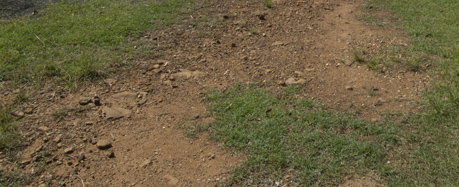
That happy discovery led to an exchange of views via comments on Chris’ blog and the start of a “conversation” about sandstone soils.  As you may know if you’ve been following this blog, our place is steep sandstone country, with many rock outcrops and soil that is made up of sandstone in various stages of decomposition, and generally not more than 60-70 cm deep.  Even that shallow layer of “soil” often has at least half its volume made up of gravel and small rocks.

What passes for soil on a sandstone ridge

What passes for soil on a sandstone ridge

Early on we recognised that one of our main food production challenges was going to be the need to create suitable soil.  To that end we have done all kinds of things, including sieving the rocks and gravel out of huge quantities of the native “soil”, green manuring, mulching, terracing, etc.

So when Chris said:

Have you ever let a garden bed go (ran out of time to keep up to it) and noticed the good soil revert to something like dry potting mix?

The hardest challenge for us hasn’t been building the soil, but rather maintaining it. I notice where we have swales, the soil doesn’t need much of our attention, except where it crosses a sandstone shelf. It only takes a season of hot dry weather, to cook any good soils we don’t maintain.

I knew exactly what she meant.

For us, the challenge hasn’t only been to create good quality soil (and I can’t claim to have satisfactorily cracked that one), but to keep it in good condition.  An apparently well prepared garden bed can start the growing season with lovely fluffy, moist soil that holds together exactly right when squeezed in the hand and produces a good crop.  Then, unless it is constantly maintained, a few months later it is dry, loose and apparently lifeless.  Chris’ description of “dry potting mix” soil hits the nail on the head, particularly if one interprets it as the crap bagged potting mix that supermarkets and garden supply places sell. The plant material in these mixes is generally at best only partly broken down, and there is no evidence that there is, or ever was, life in them.

I’m no expert on soil processes, but I suspect that the coarse material in our “dry potting mix” soils is compost “residue” that has not been broken down. This is probably because (a) the soil was not sufficiently healthy initially, and in particular did not contain sufficient humic matter and soil organisms; (b) when we let the bed go there isn’t sufficient ongoing moisture in the system for biological processes to continue creating and maintaining humic matter; (c) if there isn’t a continuous cover of thick (but air and water permeable) mulch then soil temperatures rise and water content decreases; and, on a sandstone base, there is likely to be significant leaching of nutrients when major rainfall events occur. I have to say though that I have had this problem in some beds that I was actively managing, not just in ones that I’d been ignoring for a few months, but that may have been due to the leaching mentioned in the last point above.

Does the above explanation seem to match your experience / observations?

My way of tackling this problem is still evolving, but it includes:
# keeping a fluffy straw mulch cover on the soil that allows air and water to penetrate, and at the same time significantly reduces drying and insulates from overheating;
# adding green manure to the soil and digging it in. This isn’t the usual “green crop dug in” approach, but a mix of moist and drier (but still living) plant material put through the chipper / mulcher sufficient to make a 25-50mm layer on the surface, then watering it and digging it in;
# adding sieved compost “fines” (containing the humic material) to the soil;
# adding dry horse manure that has been put through the chipper / mulcher to the surface layer.  Processing it this way produces a fine, light fluffy material that holds moisture and gives the soil a great “texture”; and
# to the extent that our water supply allows (we have only tank water), keeping the soil moist, even when the area is not in production.

Good compost of course contains humic material, but can also contain a lot of woody material if you use coarse chip mulch as part of your carbon source.  This is part of the reason it’s a good idea to sieve your compost and put the finer, humic, fraction into the soil, reserving the coarser material for mulch or for feeding the next batch of compost. Unless you already have a healthy soil, there’s not a lot of point in incorporating coarse, only partly broken down, compost material into it.

If you want a good guide to how soil “works” and how to maintain its health, the best book I’ve come across is Toby Hemenway’s Gaia’s Garden (Chapter 4: Bringing Soil to Life). This is by far the best and most practical permaculture text I know. The other good source for soil matters is, perhaps surprisingly, Harvey Ussery’s The Small-scale Poultry Flock (pages 137-144 for soil matters). We have a pretty comprehensive permaculture / organic library but these are the two books I go to first when I have a question, and I seldom need to go past them.
Garlic harvest

P1050884_small

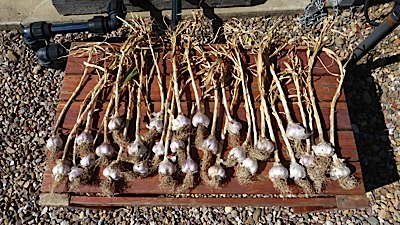
the garlic crop in May this year

In early September we harvested the first of the garlic, a hard-neck variety called Monaro Purple. That’s the garlic bed in the photo above.  At this stage the Monaro Purple (the right-hand half of the main crop in the photo) aren’t easily distinguished from the Glen Large on the left. The three in the foreground are Elephant Garlic.

the harvest in September

the harvest in September

From 30 cloves of Monaro Purple we got 30 bulbs (thanks Green Harvest).  They aren’t  huge (but the flavour is great).  I planted them a little late, and we have had hardly any winter at all, followed by Summer in Spring, and hardly any rain for months, so you can’t expect too much.  Last year the tops died off in late September, but they were two weeks earlier this year.  Green Harvest say that Monaro Purple is mainly suitable for cooler areas, but as I haven’t been able to find a hard-neck garlic suitable for the sub-tropics that was what I grew (can anyone suggest a better variety for Southeast Queensland?).

I thought I’d done something really clever by green-manuring the bed a few weeks before planting with a mix of lemon grass, pigeon pea and mulberry prunings (there’s a post on it here).  It certainly achieved an almost miraculous improvement in the soil texture, and I was expecting a similarly spectacular improvement in the garlic harvest.  However, 12 hours after harvesting the garlic I read a  post on Root SimpleTips on Growing Great Garlic.  Here’s an extract from the post:

When I asked a garlic farmer I met yesterday how to grow garlic he said, “It’s like giving a credit card to your wife . . . you’ve got to give her all she wants.” When I asked him to clarify, he told me that garlic requires as much compost, nutrients and water as you can spare. [Garlic expert, Jeffrey] Nekola said he doesn’t even plant garlic unless he’s prepped his beds for at least two to three years and noted that one of the best heads of garlic he ever grew took root accidentally in a compost pile.

Pull the garlic cloves apart (leave the skins on) and plant them in the ground with the pointy end up. Nekola suggests planting them with a tablespoon of soybean meal (found at feed stores as animal feed). Nekola also recommended mulch. Let the garlic sprout first, but then pack down at least an inch of straw. Lay your drip tubing under the straw.

the harvest - minus quite a few already used or given away

the harvest – minus quite a few already used or given away

So my green-manuring should have been just the start of the bed preparation.  Right after reading that I put a load of chicken manure onto the bed that the garlic came out of, as the first stage in getting ready for a really good garlic harvest next year.

I had expected to be harvesting the Glen Large garlic from the same bed some time in October.  It’s a soft-neck variety, with large cloves and a fantastic garlic flavour, and keeps well when frozen in olive oil.

There were also a few Elephant Garlic, planted as a trial in the same bed – this is the first year I’d grown it.  Up until late October the Glen Large were apparently doing well, if what was above ground was anything to go by.  However we got some heavy rain before they were ready to harvest, and when I pulled up a couple of bulbs around a week after the rain they were slimy and stinking.  Heavy rain is the last thing you want when a garlic crop is near ready to harvest.  All of the Glen Large were the same, as were the Elephant Garlic.  Oh well.  But in fact when I checked on the Glen Large bulbs, all were small and unformed.  I suspect it may have been the inadequate rainfall over several months, as the soil was definitely in a better state than last year, when I got a bumper drop of Glen Large.

As a footnote, Root Simple is one of the many blogs I follow and it is well worth subscribing to.  Oh, and I use NetNewsWire as my “feed reader”.  Great app.