A tour of the vege garden

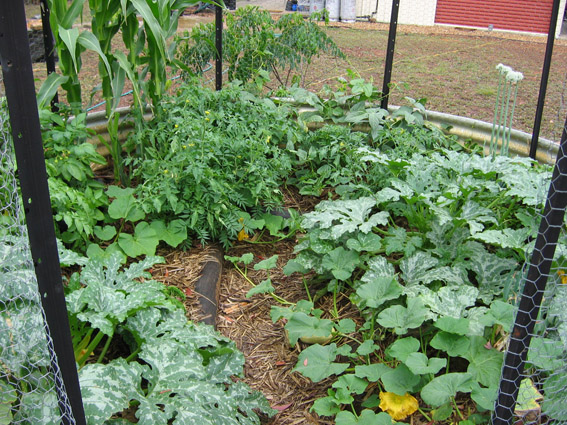
In this post I’m going to give you an overview of the food garden areas, with a few “before & after” progress shots – starting with this shot of our first garden (it’s roughly where the porch is now on the plan below – middle right edge).
013_First Garden

First garden, 4 November 2006, in a section of an old tank.  Eventually we had three tank sections in a clover-leaf garden.  We were living in the shed at the back, which is now our office, TV room, library, etc.

Veg Garden - Skitch markup

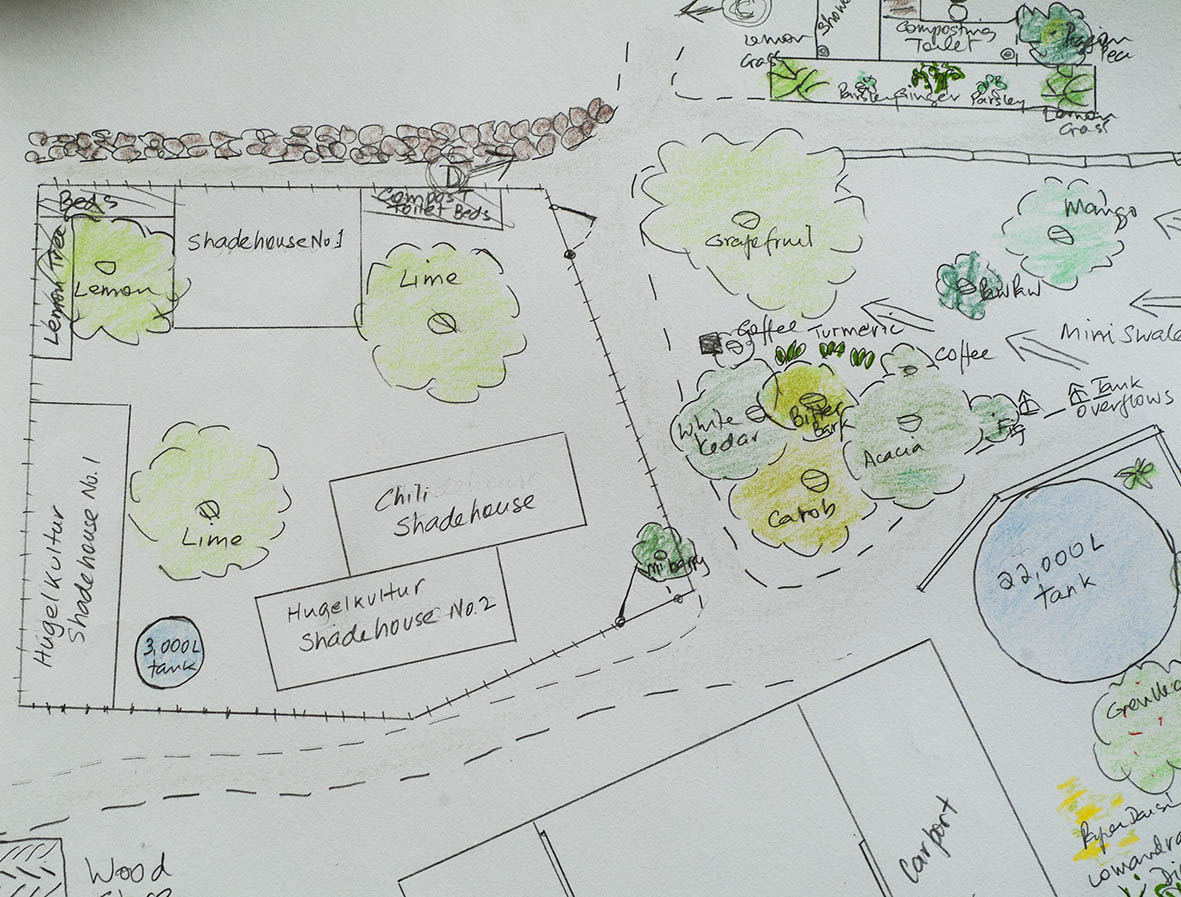
A section of the plan of our infrastructure on Black Cockatoo Ridge

Our current main food growing areas are: the Veg Garden, The Grove, and the Path Garden (left to right on the map above).  North is slightly left of up (the house is pretty much E-W), and for a scale, the widest (E-W) dimension of the Veg Garden is 13m and it is 11m N-S.

The area from the house to the Path Garden is more or less flat, but then drops away steeply, so the Path Garden is sort of a terrace.

A_P1050949_Path Garden_small

Looking west toward the outside toilet (in the ugly shadecloth structure)

DSCF4448_Path Garden Sweet Potato_small

Sweet Potato crop in western end of Path Garden – early April 2014

Anything we grow in the Path Garden must be either unappetising to the wildlife or secure behind some kind of barrier – hence the collar on the paw paw tree and the net tunnel over the sweet potatoes.  The sweet potatoes were growing in an area of around two square metres, though the foliage spreads much further, and yielded 9.5kg despite months of dry weather.

DSCF4449_The Grove_small

Looking West into The Grove

The Grove is a small area that we never planned to become part of our productive garden. It had a Carob tree, and an unidentifiable citrus tree when we arrived.  The citrus didn’t even flower for about 10 years, then when we pruned it one wet year it suddenly burst into flower and yielded 70 pomelo/grapefruit type fruit – absolutely delicious. When I was plumbing in the water tanks for the house I decided to run their overflows into a series of mini-swales that drain into and through The Grove.

DSCF4321_Turmeric_small

Turmeric (early Autumn before they died off in Winter) and a Coffee bush peeking in on the right

Friends gave us a couple of Coffee bushes, so we needed a shady place for them and The Grove seemed just right, and they’ve thrived ever since.  Now they’ve been joined by Turmeric and a Mango tree.

No time to go into the details of Fanya Juu terracing now (a later blog post) but here’s the area where they are being developed.  This was taken from photo point C in the map above.

C_P1050952_Fanya Juu_small

Looking West from the outdoor toilet. That’s the Veg Garden on the left

I always regarded this area as too steep to do anything with, even though it has a really good aspect, but when I came across Fanya Juu terracing I decided to give it a go.

P1060556_04032014_Fanya Juu_small

First terrace partly constructed

It’s a long way from complete, and doesn’t get very high priority, but whenever I feel like a bit of a work-out I dig some more swale or haul more rocks for the terrace wall.  That’s Queensland Arrowroot growing on the terrace – a great potato substitute requiring very little care and attention.

OK, now let’s go into the Veg Garden.
Veg Garden Map_DSCF4676_small

That’s the Veg Garden on the left, behind a tall fence with an electric tape on top to keep the possums out

This area was totally unplanned from the outset.  When the house construction started we were suddenly faced with the problem of disposing of the spoil from the foundation excavation, so some of it was dumped here.  Then came the problem of what to do with the Lime and Lemon trees that were in the way.  No time to think about it, so the back-hoe operator dug them up one at a time and carried them in the bucket to this area, dug a new hole and “planted” them.  They thrived!  And that gave us the “constraints” for later planning of shadehouse locations.

You can see Shadehouse No.1 in the photo above of the Fanya Juu location – it’s an old temporary carport someone gave us when the cover had perished.  Here’s another view from in The Grove.

300_Garden_P1030412_First Tunnel_small

First shadehouse. The rocky drop beside it gives an idea of the stony nature of the fill that was dumped here

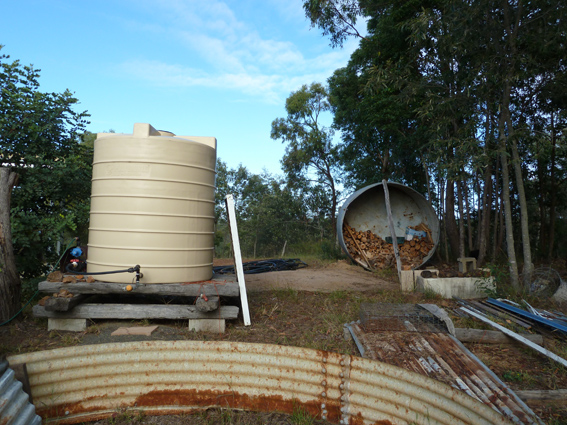
Here’s the location of the next shadehouse as it was in June 2010.
Garden June 2010_P1010212_250610_Location_small

The tank IS vertical – the photographer wasn’t. The First Hugelkultur Shadehouse was constructed about where the sheet of iron is to the right of the tank. That’s our firewood store at the back.

Making an above ground mound of wood and covering it with soil in typical hugelkultur style would result in a very dry bed in our climate, so we dug the base out 300mm deep (about 1 foot), and filled it with old wood, branches, leaves, poultry manure and chip mulch.  Then the rocks were sieved out of the soil that had been removed and it was put on top of the base in alternating layers with straw and poultry manure.  We did about two metres of the floor of this shadehouse in October 2012 as a trial.
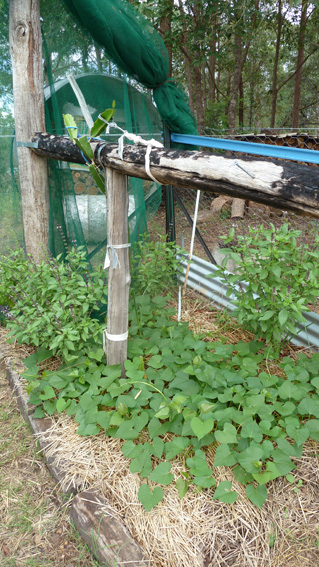
01042013P1050514_Heugel_Sweet Potato_smallThis is what the first crop of Sweet Potato and Thai Basil looked like  – with a young Dragon Fruit just peeking over the log trellis.

The plants in this area remained green while others in the garden were drooping from lack of water, so we decided to extend the hugelkultur treatment for the full (5m) length of this shadehouse.

It has been very successful, with continued “drought resistance” and crops of Kale, Gai Laan, Silverbeet, Ginger, Dragon Fruit, Baby Broccoli, Flat-leaf Parsley and Radish.  After 18 months the soil level has dropped by up to 200mm in places, presumably as a result of the rotting of the wood underneath (that’s what is supposed to happen), so I’ll be topping it up with fresh soil in the next couple of months.

Our success with this approach inspired us to try it again with Hugelkultur Shadehouse No.2.


P1020108_100814_Hugelkulture No 2_small

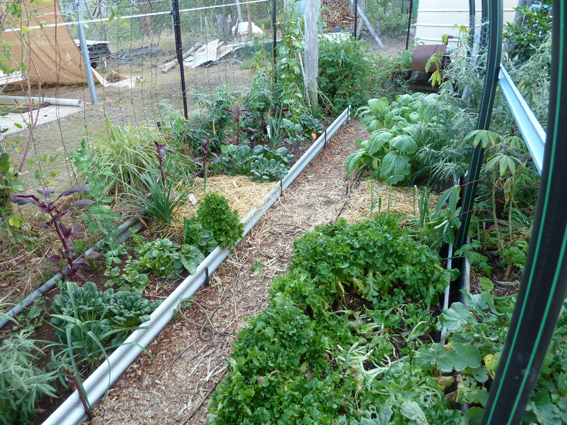
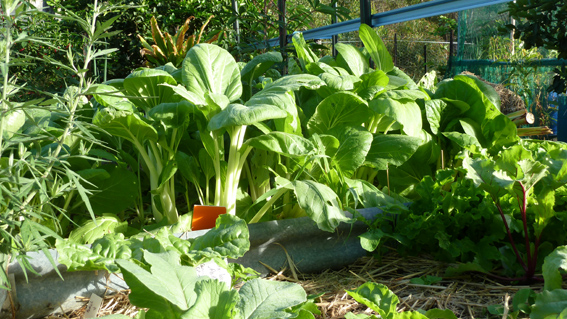
Hugelkultur Shadehouse No.2 in early August 2014

This has been even more productive than No.1, if that is possible.  In this photo there are: Loose-leaf Lettuce, Aibika, Spring Onions, Bok Choy, Brazillian Spinach, Cassava, Cherry Tomato, Ceylon Spinach, Tat Soi, Sugar Snap Peas, Clumping Leek, Amaranth, Mugwort and Perpetual Coriander.

After the massive effort in digging out two shadehouse bases, each five metres long and two metres wide, I thought it might be time to try some simple raised beds.

P1060236 (1)_101213_Chili Tunnel_small

The Chili Shadehouse in mid-December 2013

The Chili Shadehouse is “grafted” onto the previous  shadehouse because space in the enclosed Veg Garden is now in short supply.  Its raised beds are sitting on rocky fill, and the “soil” is all “manufactured” because, as you are probably starting to gather by now, we don’t have much actual soil on top of the ridge.  Or anywhere else on the property for that matter.  The recipe for the soil is: 9 parts of sand and silt out of the drainage gutters on our access track; 3-4 parts of fine sieved compost; and 3 parts of chipped matured horse manure.  It makes a rich, well drained but water absorbent, “fluffy” loam.
P1020110_100814_Chili Tunnel_small

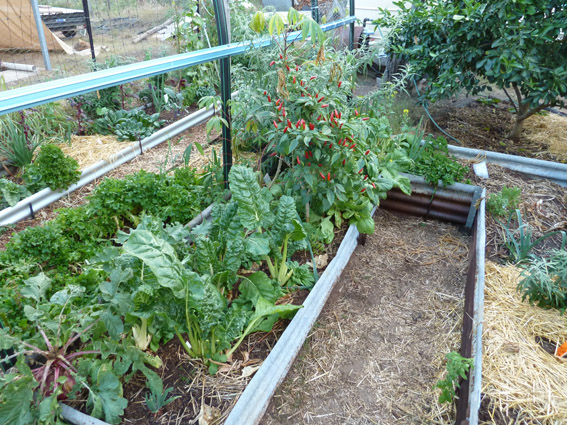
Chili Shadehouse in early August this year

This gives some idea of how productive this shadehouse has been.  There are Radish (left to go to seed), Silverbeet, Corn Salad, Chili (growing madly, hence the name of the shadehouse), Pak Choy, Curly Parsley, Brazillian Spinach, Greek Basil, Clumping Leek, Mugwort, Cassava and Aibika.  A month or so before this photo I’d harvested Turmeric and Kipfler Potatoes from the empty areas you can see on the right of the above photo.

And, finally, these are the beds across the front of the Chili Shadehouse.
P1060657_end of Chili Tunnel_small

End of Chilli Shadehouse

In late May this year these two beds had Bok Choy, Pak Choy, Beetroot, Silverbeet, Radish, Corn Salad and Loose-leaf Lettuce.  With the exception of the Silverbeet that has all been harvested and I’m about to start Spring planting in these beds.

I’ve left out the Lemon Tree Fence Beds and the Composting Toilet Beds (I’ll leave the explanation of that name till another time).

I hope you’ve enjoyed the tour.


A refreshingly different approach to food forests

I’ve just been reading a post by Tom at Sustainable Veg with the intriguing title: A Forest Garden Without the Forest.

It first caught my eye because of my scepticism about permaculture “food forests” as an efficient use of land for producing our daily meals.  I’m not talking about the food forests that surround hamlets and households in Southeast Asia and other parts of the world.  I’ve had a lot of contact with these, and in general these food forests are fruit, leaf and herb production areas, often with some poultry, and which also provide shade to cool the area around the house.  Their production supplements the range of day-to-day basic foods from more distant wet or dry rice areas or upland gardens.

My scepticism relates to the tendency of many permaculture followers to focus the majority of their production efforts on food forests dominated by fruit trees of one type or another.  And there seems to be a common belief that if it doesn’t have a food forest, then it isn’t permaculture.  Permies coming into a new garden will frequently ask “where’s your food forest?”.  Of course, many people with food forests also have “kitchen gardens”, but even so, there is often a serious over-allocation of area and effort to the food forest, out of all proportion to the negligible volume of “staples” produced there and the generally low productivity per unit area.

As Tom says in another post: “Billions of people need feeding … (w)e can be an alternative, organic movement but we need to produce carbohydrate, protein and vitamin dense food, in large amounts…” (I’m not suggesting here that Tom shares my views on food forests – to be honest, I don’t know).

A view of part of Tom’s garden – click on the image to go to a gallery of photos of the garden

Tom’s describes his back garden (he also has an allotment) as “a productive, organic, kitchen garden with substantial amounts of perennial vegetables, some annual vegetables and five dwarfing fruit trees”.  But he also calls it a forest garden, and refers to his techniques as forest gardening, and for good reason.

His reason for classifying his approach as forest gardening is that he is concerned with the ecology of the garden and of the soil, and therefore uses many of the techniques of forest gardening, while stopping short of trying to create either a closed tree canopy or a climax forest situation – not least because he doesn’t have the space to grow more trees without shading out his vegetables.  Nevertheless he has adopted an impressive array of permaculture / food forest techniques –

I’ll don’t want to spoil the pleasure of reading his post for yourself, but in summary these are the forest gardening techniques he uses:

  • Vertical stacking, with three diverse layers of plants, in association with individual fruit trees.
  • The use of support plants, with half the area of his garden devoted to these, but with the difference that he composts the prunings from the support plants before putting it around the food plants.  In this way he can focus on the needs of the support plants in one area and those of the food plants in another.  I also suspect, from what he writes and from the photos in his gallery (including the one above), that many of the things growing in his food production area are supporting each other.
  • Growing a wide range of perennial vegetables.
  • Adopting a “closed loop fertility” approach whereby he grows all of the ingredients for the compost on his own land.  You can see a separate post on it here.  I find this an admirable but daunting prospect.  I certainly wish I could imagine getting to that stage on our stony dry ridge.  At the moment the bulk of our compost ingredients come from off-site (but within 10km).

Please do yourself a favour and read Tom’s article for yourself.  What Tom has done is to apply the key food forest approaches without having his productive area dominated by forest.  I’m in awe of what he’s doing and the strong ethical approach he takes, and I’ll be adopting some of his approaches as I develop and expand our food production area.

As I finished writing this I noticed that Tom has added a post about compost which gives more insights into his approaches.  Enjoy.

Lee Reich: unusual fruits, soil organisms, compost tea, moon planting and a lot more

Just a quick one to alert you to a very interesting new podcast on the Northwest Edible Life blog featuring an interview with Lee Reich.

Lee Reich: soil scientist, horticultural scientist, author [link to leereich.com]

Reich has graduate degrees in soil science and horticulture and has worked in plant and soil research with the USDA and Cornell University, before turning to writing, lecturing, and consulting.  He has written at least nine books as well as running an interesting blog.   Because of his educational, research and practical experience in two fields which are an important part of the basis of permaculture, a lot of what he says in this interview will be of interest.  Erica, the host of the Northwest Edible Life blog, has a lively and easy to listen to interviewing style that keeps the flow of ideas coming throughout the interview.

You can also download the podcast – which leads me to the topic of mp3 player programs.  I’ve found a lot of the programs available for Macs to be a bit of a pain in the neck – and I totally refuse to use iTunes because like a lot of Apple’s market oriented software it is just too focussed on data collection.  Then I just stumbled on the fact that if I stored an mp3 file in Evernote I could also keep comments about the content of the podcast in the same in the same Note, as well as using Evenote’s very functional mp3 player straight from the note.  In fact what I do is to store the file in my General Library folder, along with pdfs etc, then link an Evernote Note to that file.

Screen shot 2014-08-11 at 3.03.12 PMEvernote is available for Mac Windows phones and tablets.  I recommend it as a great place to dump information that will be useful one day, or to keep copies of receipts (e.g. for equipment with a warranty), warranties, manuals, etc.  My only problem with it is that it can be difficult to extract files from Evernote once they are saved into a Note, but I get around that by “attaching” files to Notes (and by keeping most of my technical notes in Devonthink Pro Office).


Madeira Vine – a permaculture food plant, or a rampant and destructive invasive?

If you’ve been reading my blog for a while you will know that I’m very concerned about the encouragement of the use of invasive or potentially invasive species in permaculture (you can see where I’ve written on the subject here and here).

Now the folks at Milkwood Permaculture have thrown up a curly one – they’ve just posted on how Madeira Vine not only has edible leaves and tubers, but is widely eaten and cultivated in Japan, where it is known as “land seaweed” (okawakame)

Typical effect of unchecked Madeira Vine [from Milkwood Permaculture blog]

As they point out, Madeira Vine is an already “adapted, perennial, zero footprint and highly nutritious food plant” with the following characteristics which are desirable in a food plant:

  • “It grows without much assistance, is hardy and produces prolifically.
  • It requires minimal cultivation.
  • It dominates an area where it is planted (meaning far less weed control is needed)
  • It is spread only* by humans and by water flows distributing the bubils – an easy factor to contain with good design.”

The Milkwood guys are  planning on having it as a food plant in their garden.  They recognise that it is a potential problem, and will manage it by eating it and stopping it from spreading.

So, should we incorporate Madeira Vine into our permaculture food production?

My first question would be: Just how weedy/invasive is it really?

Madeira vine grows prolifically at rates of up to 1 m per week in high-light environments.  It produces large numbers of subterranean and aerial tubers that not only act as reproductive bodies, but also provide the plant with a carbohydrate source that enables it to survive through difficult times. As a consequence, Madeira vine can tolerate a range of adverse conditions including drought, snow and frost, and it has been found growing in areas as diverse as rainforests, riparian fringes, rocky outcrops and frontal dunes (source).  This same ability to tolerate adverse conditions also means that the tubers can survive for very long periods of time in suspended animation, before they experience the right conditions to shoot (source).

The vine reproduces through the proliferation of aerial tubers and also from rhizome (subterranean tuber) fragments that may be broken off (source).  The aerial tubers can persist for two to 15 years and rhizomes for five to 10 years, with tuber germination rates of up to 70 per cent (source).  Although Madeira Vine is widely believed not to set seed in Australia, up to 5% of dried flowers collected from southeast Queensland were found to contain germinable seed (see #Vivian-Smith et al, below).

Dispersal is believed to occur primarily* via human spread (cultivation for ornamental purposes, disposal of vegetative material and tubers, e.g. in green waste (source), or being spread by machinery and/or gravel during road construction).  However it also spreads downslope under the influence of gravity and water movement from ridges and down watershed, and via floods (source).

Saying that it is spread primarily by humans needs to be considered in relation to just how widespread it is, what a significant destroyer of habitats it is once established, and how extremely difficult it is to eradicate once established.  Here is how the Environment Australia weeds database summarises the facts about Madeira Vine:

Madeira Vine is a Weed of National Significance (WONS). It is regarded as one of the worst weeds in Australia because of its invasiveness, potential for spread, and economic and environmental impacts.

Madeira Vine has aggressive vegetative growth which competes with and replaces other vegetation, and is difficult to control once established. Its aggressive nature gives it the potential to smother other desirable plants. Its sheer weight is capable of breaking branches off trees, thereby reducing them to poles, potentially causing collapse of the rainforest canopy (ISSG 2006). It restricts light and thereby prevents germination of desirable native species (Harley undated).

Should we then include Madeira Vine in permaculture food production?  I think there are two things to take into account before making a decision on this.

First, the permaculture ethics of care for the Earth and care for people.  The potential impacts on the Earth from Madeira Vine escapes are obvious (see the sources and photo above) and well documented, as are its impacts on the people whose properties and amenity are impacted.

Second, based on an assessment of invasiveness and impact, Madeira vine was ranked 5th worst of1060 naturalised south-east Queensland plant species (#Batianoff & Butler, below).  How are you going to ensure that:

  • no seed is set, and neither seed nor tuber material is distributed by animals, or other agents of dispersal, including water (i.e. the area where you will grow it will never flood or be exposed to high volumes of water runoff;
  • everyone who works on your garden or caretakes for you while you are away is as careful as you would be not to allow any dispersal of aerial tubers, (fragments of) rhizomes or seeds;
  • before you move on, you will have somehow removed all aerial tubers and every last fragment of rhizome before you leave, or failing this, you have some guarantee that the next landholder is going to take the same careful management approach as you?

– – – – – – – –

*I consider the statement that it is spread “only by humans and by water flows distributing the bubils – an easy factor to contain with good design” to be dangerously simplistic for a number of reasons.  First, once a Madeira Vine has established itself in a vegetated area it does not sit and wait for humans or water flows to come along and move its tubers or rhizomes.  The tubers are spread naturally when they fall from the adult plants where they have climbed up and across the canopy (often a considerable distance) from where they originally grew. Second, anywhere that an established population of Madeira Vine grows over a waterway that even only occasionally flows, this will distribute the plant to any and all areas downstream.  Third, saying that it is spread “by humans” without mentioning the many ways in which human activity can spread the plant, or the very long viability period of the tubers, gives a very misleading impression of the ease with which human activity can (even unwittingly) result in spread.

Here is a rather more informative account of how it is spread:

The most common means of reproduction and spread is via asexual tubers formed on the roots and stems. Prolific numbers of aerial tubers are produced throughout the year, which drop to the ground when mature or in response to stress. Research indicates that aerial tubers can persist for two to 15 years and subterranean tubers for five to 10 years, with tuber germination rates of up to 70 per cent. In areas of heavy infestation, soil tuber densities are up to 1500 per m2. Madeira vine is also capable of shooting from sections of severed vine.

Dispersal occurs primarily via human spread such as cultivation for ornamental purposes, disposal in green waste, or spread by machinery during road construction. It can also spread via gravity and water movement from ridges and watersheds or during floods. Mammals and birds may also play a minor role in localised spread.
While seed production is believed to be rare in Australia, research indicates that up to 5 per cent of dried flowers collected from southeast Queensland contain germinable seed. It is speculated that seed set and germination may only occur under ideal environmental and seasonal conditions.

 Sources which aren’t linked above:

#Vivian-Smith et al, Alan Fletcher Research Station QLD Unpublished data (cited in this source)

#Batianoff, G.N. and Butler, D.W. (2002). Assessment of invasive naturalized plants in south- east Queensland. Plant Protection Quarterly 17: 27–34.


Is it possible to grow vegetables using no-till farming?

At various workshops and meetings I’ve often heard statements along the lines of “no-till approaches are all very well for broadacre cropping (e.g. grain crops), but no one uses them for vegetables” – to the point where I just assumed that there must be good reasons for not doing it.

Can it even be done, even if only by dedicated permaculturists willing to put in huge amounts of effort?  Well, yes it can, but not just through huge amounts of manual labour and on a small scale.  There are people our there successfully doing mechanised no-till vegetable production.  This article by Dr Mark Schonbeck on the Rodale Institute’s website tells the story.

Dr Ron Morse in a field of cover crops [Rodale Institute web site]

According to the article, Dr. Ron Morse, a professor of horticulture at Virginia Tech, in Blacksburg, Virginia has been working for more than two decades on soil-conserving systems for vegetable production.  This parallels efforts by Pennsylvania vegetable grower Steve Groff (in an article by Marni Katz) over the same period on his Cedar Meadow farm. The permanent cover cropping system that he has developed helped to eliminate tillage on 175 acres of pumpkins, tomatoes, sweet corn and other vegetable crops on his Cedar Meadow Farm. Not only has this approach reduced cultivation costs and improved yields and quality, it has also helped  manage the soil erosion from the farm’s sloping topography.

“You could not pay me to till my land anymore,” Groff says. “Soil erosion has gone from 15 tons per acre, per year, to almost nothing. Organic matter [in the soil] has gone from 2.7 percent 15 years ago to 4.8 percent this year, and yields have improved 10 percent.”

You can find a list of other articles about Steve Groff’s farm here.

Ron Morse (1999#) has attributed the progress and acceptance of no-till vegetable production in the US to advances in no-till planters, development of techniques for managing high residue cover crop mulches and the acceptance of (and improvements to) integrated weed management techniques.

However I think there are a lot of other factors involved, including: farmer attitudes to the “bottom line”, i.e. whether they are mainly profit-focussed or have an eye on the triple bottom line; farmers’ willingness to be different to their peers (i.e. operating outside the norm); and ability and willingness to deal with a different suite of pest problems arising from the use of cover crops.

No-till vegetable farming has been practised in Australia for around 20 years (e.g. Rogers et al. 2004#), but does not seem to have caught on widely.  However there was a study of seven trial sites at different latitudes in Australia (including one at Zeibarth’s farm at Laidley in the Lockyer Valley), published in 2006, that also reviewed a range of studies on the application of the approach in Australia.  Unfortunately it seems from a quick reading of the report that glyphosate was used to kill the cover crops at most if not all of the sites.  However, the report does include an assessment of the use of a combination of Organic Interceptor (a certified organic acceptable herbicide) and flame treatment, but concluded that only glyphosate gave acceptable long-term weed control – though clearly there are farmers in the other articles that I’ve provided links to here who are able to deal with this issue.

You can find a balanced and fairly comprehensive evaluation of the organic no-till approach here and here, providing you with a pretty comprehensive range of considerations to bear in mind when deciding whether to attempt an organic no-till approach to growing vegetables.

One thing to bear in mind though is that a lot of what has been published relates to large-scale vegetable production.  People who are looking to produce vegetables for family consumption with a surplus for bartering or giving away will be likely to have a different take on the pluses and minuses of the approach.  Steve Groff’s summary might be worth considering:

“… for the grower who does his homework, the no-till system offers significant advantages. No-till growers typically save money by reducing water use in irrigated systems, reducing cultivation equipment and fuel costs and minimizing inputs, such as herbicides and fertilizers.

In addition, Katz quotes Ron Morse who pointed out that growers often realize increased yields through soil moisture conservation and enhanced quality, particularly for crops that lay on the ground. At the same time, there are increased costs in equipment and seed for managing the cover crop.

“A grower has to be really careful to understand the system and do it right,” Morse notes. “It works if you do it right, and there are a lot of advantages.”

Unlinked Sources

# Morse, Ronald D. “No-till vegetable production—its time is now.” HortTechnology 9.3 (1999): 373-379.

# Rogers, G.S., Little, S.A., Silcock, S.J. and Williams, L.F. 2004. NO-TILL VEGETABLE PRODUCTION USING ORGANIC MULCHES. Acta Hort. (ISHS) 638:215-223


Imported Weeds and Invasive Exotic Plant Species

The use of “weedy” species, together with the use of non-local species of unknown weediness, incites very heated debate in permaculture circles, inspiring a lot of name-calling and pseduo-science.  My own view is that the promotion of known invasive, or potentially invasive, species as part of the permaculture approach is highly irresponsible and arguments for their use are often couched in language that approaches the mysticism or spirituality that is supposedly “banned” in serious permaculture.  (You can see my views on the use of Leucaena here.)

Of course, the topic of invasive species overlaps with the consideration of “weeds” as an element of food productions activities.  I’m not going to go into that here, but the eXtension website has an excellent article on weeds in agriculture (An Ecological Understanding of Weeds) that incorporates both the negative and positive aspects of weeds in agriculture.  Well worth reading – much of it reads as if it was written by an well-informed permaculturist.  In fact the author, Dr Mark Schonbeck, is credited by the the Virginia Association for Biological Farming as combining “deep scientific knowledge, practical farming technique and policy smarts”.  I recommend googling his name – it will turn up a plethora of interesting and informative articles.

Dr Schonbeck’s article also deals with invasive species, under the heading of Imported Weeds and Invasive Exotic Plant Species.  Among other things this part blows out of the water the permaculture argument that for a species to become invasive in an ecosystem there must have been a vacant niche in the ecosystem.

Below is the text of that part of the article (with what I think are the really telling points underlined by me), but I really recommend you read the whole article for its information about the place of weeds in food production systems.  Remember that the weed/invasive species referred to are in relation to the US, though it is interesting how many are familiar to us in Australia.

Many of a region’s most problematic weeds are those that are not native to the region, or even the continent. These exotic plant species often grow more vigorously in their new habitat than they do in their area of origin, where certain soil organisms, herbivorous insects, climate patterns, and/or competing vegetation keep them in check. Kudzu (Pueraria thunbergiana), imported from Japan as a forage crop, is one dramatic example whose enormous vines can cover and kill large trees in the southeastern US. However, a small (4–18 inches) perennial weed called purple nutsedge (Cyperus rotundus), which has invaded the southern United States, causes much greater losses in cultivated crops (even sugarcane and coffee trees), and is considered the world’s worst weed (Holm et al., 1991).

Some of our major agricultural weeds were intentionally brought to the United States from overseas to provide food or forage. European colonists carried common lambsquarters (Chenopodium album) to the New World as a vital source of early season greens that prevented scurvy and other nutritional deficiency conditions. Common lambsquarters has spread around the globe and is now listed as the world’s 10th worst agricultural weed. Livestock farmers imported bermudagrass (Cynodon dactylon, 2nd worst weed), johnsongrass (Sorghum halapense, 6th worst), and quackgrass (Elytrigia repens, a major weed of vegetable crops in the northeastern US) to this country for their utility as forages. Other serious exotic weeds were first planted as flowers and other ornamentals, and subsequently spread from cultivated gardens into surrounding farmland and/or natural ecosystems. Still others arrived by accident as a seed contaminant in imported crop seed, feed grain, foods, bedding plants, or other materials.

Many exotic weeds have become “naturalized” over time, and are now part of a region’s agricultural weed flora that must be managed (not necessarily eradicated) to protect crop yields. However, some newly introduced plants growing in the absence of the natural enemies with which they evolved may spread unchecked, choking out native vegetation as well as invading pastures or cultivated fields. Imported weeds that threaten natural ecosystems and/or rangeland over wide geographic areas are designated invasive exotic plant species or invasive exotic weeds, and often become the focus of regional or nationwide coordinated eradication efforts. Examples include water hyacinth (Eichhornia crassipes) and purple loosestrife (Lythrum salicaria) in wetlands; Canada thistle (Cirsium arvense), musk thistle (Carduus nutans), spotted knapweed (Centaurea maculosa), and St. Johnswort (Hypericum perforatum) in rangeland; and autumn olive (Elaegnus umbellata) and tree-of-heaven (Ailanthus altissimus) in eastern deciduous woodlands. Classical biological control—the introduction of herbivorous insects or microbial pathogens that are natural enemies of these weeds in their native lands—has been used with considerable success to combat some invasive exotic weeds.

Arrival of a new invasive exotic weed on an organic farm is one instance that may justify efforts to eradicate the new arrival. Early detection—combined with an understanding of the ecology of the weed—is vital for successful elimination of the invader.

Edible and Useful Plants

Was just searching the internet for information on what is used to inhibit sprouting in onions (and potatoes) in Australia and came across a series of well written and informative articles on useful and edible plants by Penny Woodward.  Well worth having a look at.  She includes some unusual and interesting members of the onion family and herbs as well.  She has written a series of books (available for purchase through her website) which look interesting too.  Unfortunately she doesn’t have a subscription link to her blog, offering only advice on new material via Facebook and Twitter, neither of which I use.

Haven’t definitely nailed the anti-sprouting issue yet.  But I did discover that, like many fruits, onions can be stored for long periods before appearing in the shops.  It’s time we had a “harvest date” advice on fruit and veg.  It appears that the most common approach is some formulation of Maleic Hydrazide, often as Potassium Maleic Hydrazide.  I don’t have time to chase it up further right now, but it appears that while the potassium salt might be relatively harmless, one can’t say the same for Maleic Hydrazide, particularly in relation to its impact on aquatic organisms.  If anyone has detailed information on what is used in Australia, how it’s used, and what the impacts are please add a comment.

If you’re having any problems loading the new header photo please let me know.

Harvested – April to June

Here’s a record of the different things we harvested from the garden from the beginning of April to the end of June this year.

No weights or volumes, just harvested or not.  I can’t be bothered weighing everything that comes in from the garden; life’s too short for that sort of record keeping.  If it’s there and we need it, we harvest as much as we need.  What doesn’t get used by us gets given away – usually after a quick rush around the garden as visitors are leaving or as we leave to go visiting, with no time to weigh things; or it goes into the compost when past its prime.

And of course the produce that gets sampled as we graze different things while working it the garden doesn’t get recorded at all, even though it probably amounts to quite a lot over the course of a month.  I assume almost everyone grazes as they move around their garden.  For me it is not only satisfying, a lot of it is “quality control”.  Are the lettuce going bitter yet?  How does this tomato like growing here?

Over the three month period I’d say that something like 80% of our vegetable consumption came from the garden, which has put a big dent in our grocery bill.

Sorry about the crappy layout.  I haven’t figured out how to set up a table in WordPress yet, so this is just blocked and copied from MS Word.

Common Name April ’14 May ’14 June ’14
Arrowroot, Queensland
Basil, Italian/Sweet
Basil, Greek
Basil, Thai
Beans, Snake
Beetroot
Bok Choy
Chilli
Chives, Garlic
Dragon Fruit (red variety)
Gai Laan
Kale, Curly
Kangkung / Water Morning Glory
Leek, Clumping
Lemon, Eureka
Lemon Grass, West Indian
Lettuce, Perpetual
Lime, Tahitian
Lime, West Indian
Luffa salad, stir fry, sponge salad, sponge sponge
Mint
Pak Choi
Parsley, Flat-leaf
Pineapple
Potato, Kipfler
Pumpkin, Japanese tips
Radish leaves, bulbs bulbs
Rosemary
Silverbeet, Fordhook Giant
Spinach, Ceylon
Spinach, Brazillian
Spring Onions/ Shallots
Sweet Potato, Orange tips
Tomato, Cherry
Tomato, Gros Lisse

Urban Farming

There are a lot of people in the world without access to land or good soil.  And I’m not talking only about landless people in developing countries.  Given the high level of urbanization in most countries and particularly in the developed world, urban farming ideas are applicable just about anywhere.

I’ve come across two great and proven ideas for “landless” farming lately.  The last was from the Accessible Edibles Project run by the Rotary Club of Rochdale, and uses recycled plastic bags (or other forms of container that can be hung from something.

from the Rochdale Rotary Club website

The method is very clearly set out in their manual and has been used successfully in many countries and at different latitudes.  The frames shown in the photos don’t need to be used – the bags can be hung from anything handy.

The other effective “landless” farming technique I’ve come across recently was developed by Roman and Janna Spur, who live in a flat in New Farm, an inner city suburb of Brisbane.  They have a great website which catalogues their approaches to sustainable living in a rental situation.

We went to their place last Sunday for a workshop on making a self-watering planter box from recycled materials (a broccoli box from the local fruit and vege shop, some 40 or 50mm PVC pipe, and a wooden skewer).  You can find an illustrated step-by-step guide here

a self-watering planter box in use [from Spurtopia website]

The planter-box workshop was followed by a fascinating presentation on the ways the family has developed an increasingly sustainable lifestyle in their rented accommodation, bearing in mind that there are limits on their ability to modify structures and systems, and that they want to be able to take their sustainable “infrastructure” with them if they move.

These guys are truly inspirational and I highly recommend their website and workshops.


Pruning fruit trees demystified

I love pruning fruit trees – when it works.  I think I understand the theory and mechanics of it, but I have one lemon tree that totally defies my pruning objectives.  Now Erica over at Northwest Edible Life has put out a blog post that explains pruning, from the essentials on up.  I didn’t know as much as I thought I did.

Here’s how she approaches it:

What The Backyard Orchard Culture Grower Wants

  • Healthy, long-lived, productive trees.
  • A long harvesting period of family-appropriate quantities of fruit.
  • Great quality fruit.
  • Backyard-appropriate size (small – think fruit bushes, not fruit trees!).
  • To never have to get out a ladder for any tree maintenance.

What A Fruit Tree – Any Fruit Tree! – Wants

  • To reproduce by making seeds.
  • To maximize captured sunlight and grow.
  • To balance its root mass with its leaf canopy (this is so important I’m going to talk about it in depth below).

After reading through the rest of her post I now understand that my lemon tree is trying to meet these three objectives, but a the same time is trying to deal with restrictions imposed by being hard up against the end of a shadehouse.  I have been pruning it without recognising the struggle it is going through.  To find an image that would illustrate this problem, I just went through my collection of photos of the development of the garden – pretty huge and extending back over about ten years – there’s not a single one that includes the recalcitrant lemon tree.  Sort of suggests how frustrated I am with my lack of pruning success with it .

Have a look at Erica’s post, it’s well worth not only reading but maybe making notes in your garden book, or dropping the post into your favourites list or database.  I’ve just clipped it into DevonThink Pro so I can refer to it whenever I need to.  Happy and successful pruning.