Preserving Food – and how to avoid botulism

Preserving excess food is one of the cornerstones of a sustainable lifestyle.  I used to do a lot of preserving of stone fruit when I lived in country Victoria, but those days are gone, along with the antique Fowlers preserving set.

Now that we are trying to establish a permaculture lifestyle I think the time has come to get back to preserving food, not least so we have a more varied back-up larder to increase our food independence.

There was a good blog post by Farmer Liz over at Eight Acres the other day, with consideration of the pros and cons of preserving fruit, vegetables, and meat.  Farmer Liz concluded that with our climate (Southeast Queensland) allowing us to produce vegetables pretty much all year round, there’s no reason to preserve vegetables.

Meat isn’t usually preserved (canned) in Australia, possibly because it’s always available (if you are getting yours from the butcher or supermarket) and can always be dried or smoked.  Personally I’d rather store my meat by keeping it on the hoof (or claw) till it’s needed.  If we buy meat in bulk we tend to freeze it, and when we finally get some chooks, if we ever have to kill more than one then they’ll go in the freezer too.

Speaking of meat, we just bought a quarter of a Low-line Angus and it’s in the freezer now, all bagged up in daily serves.  We have friends who raise this breed of beef cattle in an ecologically sustainable (pasture fed on cell grazing) and humane way, and market them by the quarter.  Not that you have to buy a front quarter or a back quarter, but you get a quarter of all the cuts from the animal.  It’s a nice feeling to know where our meat comes from and how it was raised, even to the point of having seen the paddocks that it grazed.  The fact that we are supporting friends who are members of our community is an additional consideration.  More and more farmers seem to be changing over to specialty marketing of sustainably produced bulk meat.

Aren’t we worried about blackouts and losing all the food in the freezer?  Not while we are off the grid and on solar power – and own a generator that can take over from the solar batteries if the need ever arises (it hasn’t).

When the floods hit in 2011 (remember the disastrous Grantham/Toowoomba floods in the early part of that year) we were cut off for days, and when we eventually got out to the supermarket pretty much all the shelves were bare.  All of the people on the electricity grid had experienced days of no power, but our solar power kept right on going.  We didn’t even have to run the generator to top up the batteries (I thought about doing it, just to be on the safe side, but a mouse had made its home in the alternator and it and the wiring got fried when I turned the generator on).  Anyway, we had a quarter of a cow in the freezer and about three-months’ supply of non-perishables in the pantry, so being cut off wasn’t a problem.

The subject of preserving meat always starts a discussion on botulism.  Botulism is caused by the bacterium Clostridium botulinum, which can occur in the soil, the bottoms of waterways, or in the intestines of mammals such as humans, cattle and horses.  The spores are not killed by boiling.  However botulism is uncommon because special, rarely obtained conditions are necessary for botulinum toxin production from C. botulinum spores, including an anaerobic, low-salt, low- acid, low-sugar environment at ambient temperatures – the kind of habitat you might find in a container of badly preserved meat, for instance.

While I was thinking about preserving, Northwest Edible Life (another of my regular reads) came out with a post on “How Not to Die from Botulism”.  It’s a must-read if you are doing any preserving, and is useful generally if you are regularly preparing or storing food.  You can find the blog here  and you can download a full-size pdf file of the poster below here.

Avoiding botulism

Yams instead of potatoes?

Following on from yesterday’s post about the need to focus more on producing our staple foods, I just came across a couple of posts on Jerry Coleby-Williams’ blog about growing yams as a potato substitute.

You are probably aware of Jerry from his writing in Gardening Australia and The Organic Gardener magazines, or as the presenter for the national gardening program Gardening Australia for over twelve years.  Hanneke and I were lucky enough to be guides at his home “Bellis” in a Brisbane bayside suburb when he opened it to the public on Sustainable House Day a few years ago – we weren’t really “guides” (Jerry did that), our role was to greet people when they arrived and to keep them entertained until Jerry had completed the previous tour of the back garden.  It is amazing what we could find to say about even his front garden.  Jerry is an inspiring person and his backyard garden is one of the most prolific I have ever seen.

Jerry recommends yams because they are “adaptable, space and energy saving, productive and easy to store [and t]hey taste and cook like potato, but the starch is far more sustaining”.

He grows Winged Yam, Dioscorea alata, and Aerial Potato, D. bulbifera, and in his latest post on the subject reports a “low yield” this year for his Winged Yams of only17.2kg per square metre, instead of the 20 – 30 kg/sq. m. that he normally gets.  This compares to his average potato harvest of 3.5 kg/sq. m.

In another post he provides a lot more detail on the characteristics of each species, their cultivation, pests, storage, etc.

If you are thinking of growing the Aerial Potato, please take into account Jerry’s warnings on keeping them under control, and the comment on one of his postings from an ecologist on the Sunshine Coast about “escapes”

We are now on the lookout for both of these yams.  If you know of anyone in Southeast Queensland who has these available please let us know.

Producing the staples

What do you eat?  I don’t mean a literal list of all the different varieties of plant and meat that you consume, but rather the main elements of your diet – the staples, as they are traditionally known.  These are food “eaten routinely and in such quantities that it constitutes a dominant portion of a standard diet” (Wikipedia).

Here on Black Cockatoo Ridge we can divide our main food items into six groups, not all which are staples in the normal sense, but we eat them at least every week, if not daily.  In rough order of volume consumed they are:

  • starchy roots (potatoes, sweet potatoes, pumpkin – I know it’s not a starchy root, but we often use it as a substitute);
  • grains/seeds (rice, beans, gluten free grains/seeds used as flour or in muesli – corn, rice, buckwheat, quinoa, chickpeas);
  • fruit (bananas, apples, melons, pawpaw, avocado);
  • meat (kangaroo, or when we can get a bulk order from a sustainably and humanely raised and slaughtered animal, beef, fish);
  • dairy products (milk and yoghurt);
  • leafy greens (pak choi, lettuce, broccoli); and
  • onion family (onions, garlic, spring onions).

Which of these do we produce ourselves?  Potatoes – very infrequently.  Sweet potatoes – just started harvesting our first (poor) crop.  Pumpkin – seasonal, and depends on whether the bandicoots and possums get to them first. Beans – seasonal, and I’m bad at succession planting, so the supply is intermittent. Pawpaw – we have one amazing tree that has kept us in pawpaws for the last few years. Garlic – seasonal, and not enough to last more than a few months.  Spring onions – constant supply using cut-and-come-again approach.  Pak choi – more or less continuous supply. Lettuce – very occasionally, due to pests and poor succession planting.

Given that our objective is to be as self-sufficient as possible, this is a pretty poor showing.  Not that this is by any means all we grow – the total list would probably be more than 30 species – but most could not form staple elements of our diet.  If we suddenly had to rely on our own production for our food supply we would probably be starving within a six months.  Even lasting that long would be mostly because we have a policy of keeping up to three months’ food supply on hand and this could be eked out with production from the garden.  That would give us a bit of a buffer during which we could try to ramp up our production of staples.  However given the work involved in bringing new garden areas into production and the need to find seed/breeding stock during a period when lots of other people were doing the same, it would be at best a precarious situation to be in.

How would you go if you suddenly found the supermarket shelves empty and unlikely to be re-supplied for an unknown period?

You don’t think that is a likely situation?  Supermarkets rely on a just-enough and just-in-time inventory system.  They generally have a 3-5 day stock of items on hand, and if there is an emergency situation the shelves will be cleared out of staples quicker than that.  If supplies cannot get through (roads blocked, fuel unavailable, civil unrest making roads untrafficable), then you could find yourself reliant on your own food stocks/production very suddenly and for a prolonged period.  Those of us who experienced the Lockyer Valley floods in 2011 will know what this feels like.

But for most of us, being self-sufficient in food isn’t mainly about emergency situations; it’s about having a supply of unadulterated food with a known history – e.g. no harmful chemicals, no exploitative or inhumane practices involved in its production, low food-miles to limit green-house gas emissions.

How does your garden stack up in terms of producing your staple foods, and how do you think you could improve the situation?

Permaculture Design Certificate

Sorry about another long gap in blog posts.  I just got back from doing a twelve-day Permaculture Design Certificate course in Kin Kin (on the Sunshine Coast between Noosa and Gympie) with Tom Kendall at Maungaraeeda, the permaculture centre that he and his wife Zaia run.  Fantastic experience.  After doing some research on available PDC courses (see below), I went to Maungaraeeda with high expectations – and they were exceeded.  Tom is a wonderful teacher, very warm, very knowledgeable, and very committed to ensuring his students get the most out of the course.

The course sessions are based on Bill Mollison’s book Permaculture: A Designers’ Manual  – Bill Mollison, one of the founders of permaculture, was one of Tom’s PDC teachers (the other was Geoff Lawton).  The sessions run for 72 hours over 12 days, and are given credibility by examples drawn from Tom’s long agricultural experience.  He grew up on an 11,000 acre wheat and sheep farm at Grasspatch, north of Esperance in Western Australia, which he took over after his father retired.  In 2000 he sold the farm and moved to the Sunshine Coast, where he bought the property that is now Maungaraeeda in 2005 and developed it as a permaculture-based operation

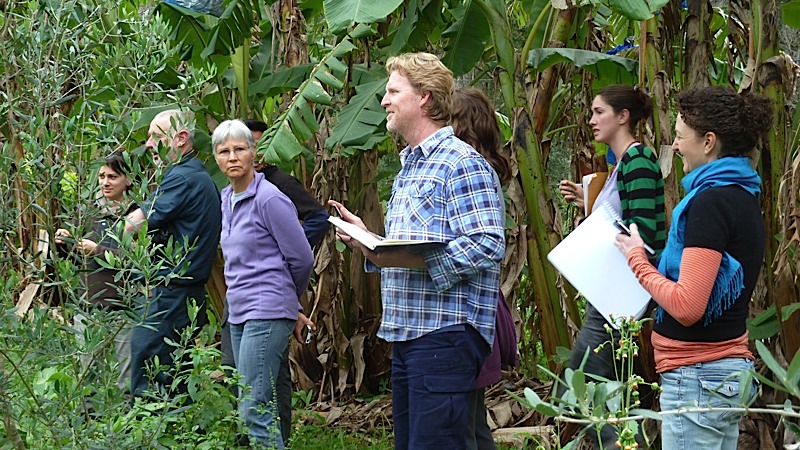
An outdoor class in the food forest

An outdoor class in the food forest.

Classroom sessions were frequently interrupted for practical activities, including several walks over the property while Tom explained specific permaculture features of the management.  It is a delightful setting, in a small valley just outside Kin Kin, with the house and food production areas down near the road, the grazing areas above that, and rainforest along the ridge-tops.

Tom in a fairly new food forest, surrounded by mostly support species.

Tom in a fairly new food forest, surrounded by mostly support species.

But Maungaraeeda isn’t just about Tom.  Zaia is in charge of Administration and Marketing, but in reality her role goes far further than that, and every aspect of the running of the place, from the first contact one has about enrolment to the mouth-watering meals, shows evidence of Zaia’s warmth and attention to detail.  From the moment I set up my tent on the lawns near the student dining area there was a strong feeling of “home”.

Tom and Zaia are supported by two long-term volunteers whose personalities and contribution to the running of the course added to the warm atmosphere.

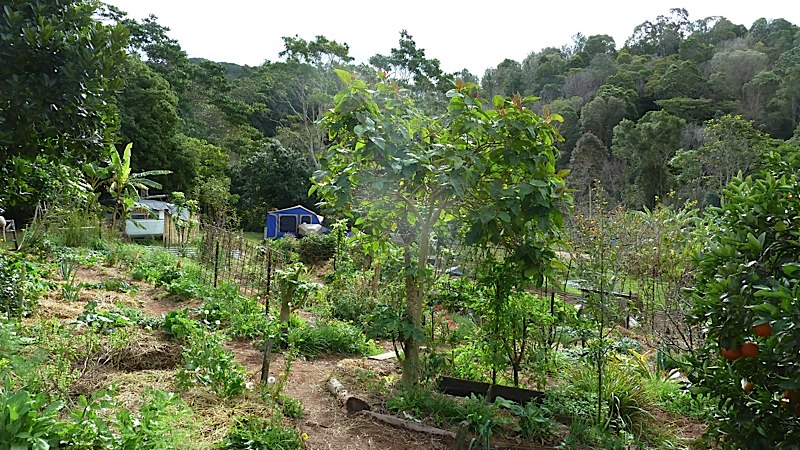
Part of the kitchen garden at Maungaraeeda.

Part of the kitchen garden at Maungaraeeda.

And then there were the other students (there were nine of us in all). All I can say about them is that I think I had the extreme good fortune to find myself among a group of amazing individuals from whom I learned a lot, and whose company I still miss now, five days after the course ended.  We parted with promises of keeping in contact and setting up a “class wiki” to share our permaculture experiences and I really hope that happens.

The class and Tom, posing behind a fruit tree we planted and surrounded with about 30 "support" species.

The class and Tom, posing behind a fruit tree we planted and surrounded with about 30 “support” species.

There was a choice of accommodation – byo tent, a dormitory bus, or cabins.  I took my own tent, and even though it rained for part of the time, and was often pretty cold at night, it was really comfortable – particularly after they lent me a camping mattress to keep the ground chill out.

One of the lovely cabins, or you could bring your own tent.

One of the lovely cabins, or you could bring your own tent.

I promised above to comment on how I came to decide on doing the PDC with Tom.  In fact I had been thinking of doing a permaculture course for a while, and realised about six weeks ago that there would be a window in my commitments around late June/July, so I checked out the courses that were available and not too far away from Southeast Queensland.  The three I found were: the one taught by Tom; one led by Geoff Lawton (but presented by seven named instructors plus unspecified others) at Geoff Lawton’s Zaytuna Farm; and another at Northey Street City Farm in Brisbane, also with multiple instructors.  Costs ranged from $1,230 to $2,585, with Tom’s falling in between.

After I’d looked at what information I could find about the three organisations and particularly the backgrounds of their instructors, there really wasn’t any option for me other than Tom’s course.  Courses with multiple instructors didn’t appeal at all.  Permaculture is a “package” and needs to be taught and understood as that, not as a series of topics.  Cost was an issue, but not nearly as much as value-for-money, and with Tom’s practical background and his very hands-on ongoing experience in setting up his own permaculture farm, plus the small class size (they limit classes to 15) the value was definitely there.

Did the course change my life?  Yes, and a lot more than I had expected – not in the sense of an epiphany or even a change of direction, but in giving me more confidence that I now have a good theoretical and practical grounding for achieving the goals we have set for our property; and the knowledge that I have someone I can turn to for advice in the future.  Not only that, but now, whenever I see any agricultural area, my brain immediately starts mapping out swales – I guess you could say that my “permaculture eyes” have been opened.

Now that's a swale - Tom has swales on his property ranging from this down to hand-dug swales through the kitchen garden

Now that’s a swale – Tom has swales on his property ranging from this down to hand-dug swales through the kitchen garden.

A couple of interesting web sites

In my meandering around the sustainable parts of cyberspace, from my seat near the fire on a damp and overcast day, I came across a couple of web sites that may be of interest.

The first was on urban farming.

MY HOME HARVEST copyAs the header says, My Home Harvest is about providing motivation and inspiration to the urban farmers of Australia.  But from what I’ve seen of the content it is going to inspire a wider range of people interested in sustainable food production that just urban farmers.

For example, the Expert Advice and FAQs tab currently leads to posts on:starting your own food swap; preserving kale, silverbeet and chard, a factsheet on edible weeds, and a pest-profile of the cabbage white butterfly.  There’s also a library of articles and resources, a range of discussions on the forum, and much more – including a diary of upcoming food, seed and produce swaps (ranging from Victoria to the Margaret River in WA.

This web site first launched as Swap Shuffle Share in January 2012 and the change to My Home Harvest was undertaken in April 2013 to better reflect the purpose of the project and to take into account the feedback received from members during the project’s first year of operation.  So it’s relatively new in this format and content is being developed and expanded all the time. Well worth registering to become a member and being involved in the journey.

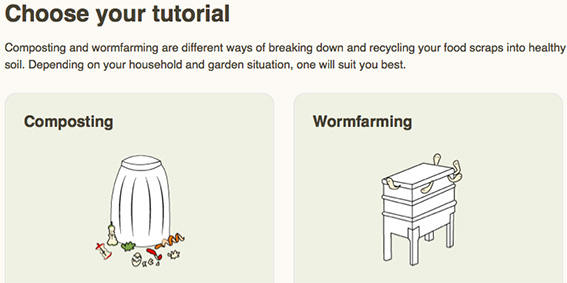
The other interesting find was on the Liverpool City Council’s web site – two very good tutorials, one on composting and one on worm-farming.

TUTORIALS copyThe tutorials are arranged in a series of simple steps, with each step presenting fairly detailed information, but in a format that makes it easy to take in.  Whoever designed these on-line tutorials really knows their stuff in terms of designing instructional materials.

New ideas for things to plant in the vege garden

Susan Kwong has set up a new database/wiki on perennial plants or plants that can be “perennialised” in Australia’s temperate climate zones. She takes the view that the plants we currently grow as annuals were probably originally “domesticated” by selecting for individuals which produced edible crops quickly, and which were either already annuals, or were made annual by a process of selection.  From her point of view, growing annuals as basic food crops introduces an element of uncertainty into every year – if the annual crop fails there not only isn’t any food from it, there aren’t any seeds for the next year’s crop.

Some annuals can be “perennialised” by selecting more long-lived, longer producing individuals so that, once established, they carry over their production into second and subsequent years.

So far there doesn’t seem to be much focus on the process of perennialising specific annuals, but the database is a wealth of information that isn’t just relevant to Australia’s temperate zones – a lot of the plants are grown in the sub-tropical zone (includes the Lockyer Valley) as well.

Here’s the article where she sets out the concept and the thinking behind it (someone should tell her about using shorter paragraphs for legibility and maintaining reader interest).

It turns out that a lot of the plants documented in the database so far are things that you might not have thought about as food plants at all, or might not have been aware of.  Here’s an example from the first set of plants, published in September.

Tree OnionsThe second data set is here: http://www.permaculturenews.org/2012/11/21/food-from-perennialising-plants-in-temperate-climate-australia-for-october-2012/

What I find most useful about this database is that it introduces me to new food plants, and gives me additional information about the ones I already know.

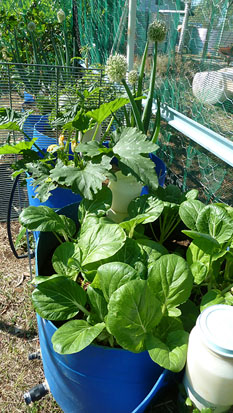
For example, a while back I was looking to identify something we’ve been growing successfully for two seasons now (in the post about wicking pots in November).  It’s the plant in the foreground.

Well, in the latest monthly issue of Susan Kwong’s perennialising database I found it listed as non-heading Chinese Cabbage (Brassica rapa, subspecies chinensis). Definitely the same plant, but I was a bit surprised about the common name.  Here in Australia Chinese Cabbage is usually used for wombok (Brassica rapa ssp. pekinensis) and I didn’t know there was a non-heading variety. This is a plant that I’m really familiar with as my parents used to grow this as a commercial crop on our farm at Eight Mile Plains (which at that time – early 1950s – was well outside Brisbane).  I have no idea where they marketed it, being too young at the time to take an interest in such things.

A bit of digging on the internet and I ended up with an informative article about Asian versions of Brassica rapa on Google.  In Australia chinensis is known as pak choy or pak choi, and in fact I found it in my Evernote database where I’d clipped it from the October issue of the perennialising database as Brassica chinensis (Bok Choy).

Problem solved.  It is a non-hearting Chinese Cabbage (because it is the same species as what is commonly called Chinese Cabbage), but it is a different sub-species (chinensis) and is best known in Australia as Pak Choy.

And I still have to get myself some seeds of gai laan, which is what I originally thought the pak choy was, and which looks like a very interesting vegetable – one of its other names is Chinese broccoli.

Let’s take a walk around our systems

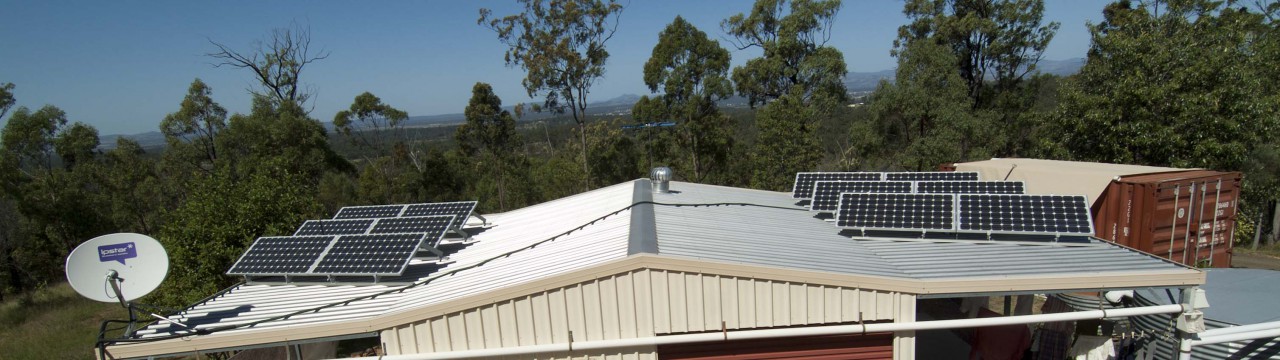
How about a quick tour for a preview of some of our different life support systems?  Solar power first.  There are 12 panels making up a 1.9 kW array feeding into a battery bank that lasts up to three days without sun.  The building was our home for nearly ten years, and has now been lined, insulated and fitted out as a study and TV room with a guest bed.  Much more comfortable than when we lived in it.  The container at the back is currently a storage area, but there are plans to eventually convert it into guest accommodation.  I’ve always been fascinated by the idea of using shipping containters as the basis for housing.

On the righ of the photo you can make out one of our water tanks. This one is “aquaplate”, but the others are mainly stainless steel.  The dish on the left is for satellite broadband internet access.  Our phone line can’t handle any but the lowest data transfer speeds and certainly isn’t up to delivering modern internet content.

Then there is the house, with its passive solar design. The tall windows and wide eaves on the north-facing wall allow winter sun to shine across half the width of the house at midday in mid-winter.  The heat of the sun is absorbed by the concrete and is returned to the interior during the night.  Lots more features of the house to talk about later, like the insulation and lighting.  And the whole story of our owner-building journey.

On the right you can see the first flush diverters coming down the corner of the wall.  These discharge the first flow from the roof and gutters to the ground, preventing accumulated dust and dirt from entering the storage tanks.

This is the smallest, lowest impact house we could build within the constraints of our space requirements, the design demands of bushfire safety considerations, and government building regulations.

We use composting toilets, both inside and outside the house.  Manure of any kind is too valuable a resource to waste.  Once full, the bin is moved to the back, stocked with compost worms and left to mature until the other bin is near full.  This can be up to 12 months, by which time the resting bin has produced about 150 litres of friable, rich soil ready to go into the garden beds.  In this photo the bin on the left is covered with shade cloth to stop it getting too hot in the summer sun.

Before we built the house we had a very productive greywater treatment system comprising a worm farm, a sand filter and a storage tank.  Not only did it produce water for the garden that was clean enough to store for 3-4 days without any smells, it also produced thousands of compost worms and lots of worm castings to fertilize the garden beds.  Alas, plumbing regulations do not allow such productive creativity, so now we are fully legal, and our greywater all goes to waste, literally.  It is discharged under the ground in an absorption area, out of reach of our gardens and fruit trees.

The loss of this greywater matters in our dry climate.  One of the solutions we are trying in order to save water is the use of wicking pots to grow vegetables.  In this method water is stored in the bottom of the pot, and wicks up through the soil to the root zone.  The only water that escapes is what is transpired through the leaves of the plants.  Depending on the size of the plants and the weather the water needs topping up only every four to seven days.

We also have small portable worm farms, producing useful quantities of worm castings and worm tea, and a worm farm that processes the discharge from our kitchen sink before it enters the greywater system.  At present we are thinking about designs for a vermiponics system (worm farms connected to flood-and-drain vege grow beds).  If these are successful they will become the precursor to a full-fledged aquaponics system, with native fish tanks connected to the grow beds, but that’s some way in the future.

Well, that’s a quick introduction to some of our life support systems.  I hope it has whetted your interest.  There will be separate posts on each of these systems as time allows.  Of course there are other systems that I haven’t touched on heree, including: a range of approaches to compost making, the wood-fired heating (for those few winter nights when the passive solar doesn’t quite overcome the cold), and the solar hot water. Those will be the sugject of future posts – possibly many posts, because most of our systems are in a process of ongoing development and improvement.