Coal Seam Gas and the Gatton Star Poll on Mining in the LVR

LVR Mining Poll in Gatton Star - results 13 NovWOW!  This is the score at 9.30pm on 13 November.  Three days ago, when I wrote the last post and pointed readers to the poll the ‘No’ vote was 84%.  Well done people.

If you know of anyone who might not have voted on this, please ask them to use this link to register their opposition to coal seam gas exploration or extraction in the Lockyer Valley Region:

http://www.gattonstar.com.au/polls/2014/11/06/do-you-support-mining-lockyer-valley/

Let’s keep these destructive activities out of the Lockyer Valley Region – not just the productive farmland in the valley bottoms, but the ridges and forested areas as well.  This industry is far too impacting to be allowed anywhere near our farms, homes, schools, businesses, or natural environment areas.

You can check on the latest poll figures here:

http://www.gattonstar.com.au/polls/2014/11/06/do-you-support-mining-lockyer-valley/results/

The Coal Seam Gas Meeting in Grantham on Sunday 9 Nov.

We went to the Lock the Gate / LVRC  /LVRC Ratepayers meeting on coal seam gas at Grantham yesterday.  A very well organised event, with a large turnout from the community and some very good speakers and a broad range of topics covered..  This can be seen as the first major step (I know there have been other initiatives) on the path to galvanising public opposition to coal seam gas exploration in the Lockyer Valley Region.  The organisers deserve our congratulations and thanks for their efforts to bring people together to hear the message.

There’s certainly not only already a large local opposition to the idea of even exploration for CSG in the LVR, but also existing connections to anti-CSG campaings elsewhere. Both are sure to grow rapidly.

Just an idea: maybe a local group could be called Lock Yer Gates?

One of the things that we found out at yesterday’s meeting was that there’s an online poll running on the Gatton Star website.

The question being asked is:  “Do you support mining in the Lockyer Valley?” which is kind of a dumb question in the sense that in general usage the term “mining” covers a whole range of activities from quarrying road base through architectural sandstone extraction to open-cut coal mining.  However I think that in the current climate we can take it as a proxy question for “Do you support coal seam gas activities in the Lockyer Valley Region?”

From the latter point of view I think that the current tally for the poll (84% No and 15% Yes) is likely to be unrepresentative of the views of the community.  But the poll isn’t closed yet.

Since there are likely to be those (conservative politicians and mining companies spring to mind) who will tout the result as reflecting community views on coal seam gas if it seems that we are divided as a community, I think that it is really important that as many as possible of us with strong “no” views to vote.  Other communities throughout the country have polled 90%+ against (probably with better-worded poll questions). We can do the same here.

Here’s the web address for the poll:

www.gattonstar.com.au/polls/2014/11/06/do-you-support-mining-lockyer-valley

The coal seam gas industry (and our political masters) need to be told loud and clear that there is no social licence whatsovever for CSG operations in the Lockyer Valley Region.

Please, spread this message among your friends.

Is there no end to the pasture grass assault on the Australian environment?

One of the things that really depresses me when I think seriously about the mangement of our 33 hectares of native bushland is the problem of pasture grasses gone feral.  Green Panic is the major problem here, but we have a number of others, including Rhodes Grass.  Both were introduced into Australia as pasture plants.

The Green Panic (Panicum maximum var. trichoglume) is still touted as a good pasture grass.  The story when it was introduced was that it would not spread and become a pest because it needs plenty of moisture and will not grow under shade. Did the agronomists not know about evolution? Did they not know that a grass often has weedy characteristics because it is inherently capable of rapid adaptation to different environments.

Just in case there are agronomists or botanists who were involved in the introduction of this wonder grass among my readers: We have a new variety of Green Panic – Lockyer Valley Green Panic.  It has adapted and evolved (surprise!) and now grows even on dry ridges and under semi-closed woodland trees.  And, like all Green Panic, it grows dense and tall when it isn’t grazed, so that it crowds out the native grasses and by the middle of summer when it has dried out it forms a near explosve compact mass of cellulose that will send flames into the tree canopy.  Where previously there was a carpet of low green Kangaroo Grass on the woodland floor, now in parts of the Lockyer Valley Region we have dense tall brown monocultures of Panic.  Kangaroo Grass is unusual because it has green growth at the height of summer, and with this and its short tussocks it not only makes for some of the most beautiful Australian woodland that I know of, it also burns cool and recovers fast. [sorry for the lack of photos, for the moment I can’t find any pics of our Kangaroos Grass areas].

One of my fondest dreams is that I will see the day when communities across Australia come together in a class action against government agencies and agricultural companies, claiming massive damages for the harm done to the Australian environment by non-native pasture grasses.  So you can see why I was very heartened to see an article in todays Australian edition of The Conversation about the harm pasture grassed do.

Here’s an excerpt:

Feed or weed? New pastures are sowing problems for the future

Weeds cost Australian farmers around A$4 billion every year — and they are likely to do a similar amount of damage to the environment.

In a new global survey published this week in Proceedings of the National Academy of Sciences, we show that new pasture plants, such as grasses, present a substantial weed risk.

And despite the risk, new varieties of plants that are known to be invasive are still widely developed and sold in Australia, with little regulation from government.

So, how can we tighten control to prevent the future spread of invasive plants?

Grasses out of control

African lovegrass was used to “improve pasture” in Australia for almost 100 years, but now it is a declared weed in four Australian states and the ACT. African lovegrass has been of little value in pastures, poses a substantial fire risk and threatens a range of native species.

Similarly, Gamba grass was widely promoted by the cattle industry and government in northern Australia, but is now listed as a Weed of National Significance. Gamba grass increases fire intensity five-fold, which transforms native woodlands into exotic grassland and increases the cost of fire management by an order of magnitude.

Introducing these pasture species was a big mistake that Australians will continue to pay for indefinitely. We face increased fire risks, increased management and weed control costs, as well as ongoing loss of our natural heritage.

Have we learned our lesson?

Not yet. Agribusinesses still develop and promote new varieties of species, which are known invasive weeds.

Our new survey of pasture plants reveals that over 90% of taxa developed and sold by agribusinesses are weeds somewhere in the world, and on average 30% are weeds in the country in which they are promoted.

In Australia, these species include Orchardgrass (Dactylis glomerata), Canary-grass (Phalaris species), Tall fescue (Schedonorus arundinaceus), and sub-terranean clover (Trifolium subterraneum). These species are all recognised weeds in Australia, and all promoted by agribusiness for pasture.

Inadvertently breeding super-weeds

These species have already spread throughout much of Australia. But new varieties of the same species can be just as bad, if not worse.

Although they belong to the same species, these varieties can be quite distinct from their parents – just think of the differences between dog varieties like Chihuahuas, Dalmatians and wolves.

The impacts of new pasture varieties in the environment can be substantial, as emphasised in a report “Weed risk set to rise”, to be published this week by the Ecological Society of Australia.

New varieties can be created by cross-breeding different varieties or different species. Another trick to create better performing plants is to manipulate the symbiotic bacteria and fungi that live inside the plants. Engineering plants in any of these ways can lead to varieties with higher reproduction, higher growth rates, better resistance to disease and higher tolerance of environmental extremes.

Unfortunately (but perhaps not surprisingly), these are the same characteristics associated with invasive species. New varieties of pasture plants are bred to grow great pasture, but at the same time, they are inadvertently bred to be super-weeds, perfectly-matched to their environment and planted widely across the landscape.

Producing enormous amounts of pollen and seeds, these new pasture plants can spread quickly and over vast areas, making them very expensive to control if and when they become invasive. So it makes sense to nip the problem in the bud.

You can read the whole article here.


Gasfields in the Lockyer Valley? – Lockyer Valley Farmers Forum

Queensland’s Lockyer Valley, which contains a significant proportion of Australia’s vegetable crop capacity, is located within 100 kilometers of Brisbane. Known as Brisbane’s salad bowl and host to the seventh richest and most fertile soils in the world, the idea of industrial gasfields here is unimaginable.

Come along and learn how the Lockyer Valley can be protected from gasfield invasion. Share this with your friends and neighbours and bring them along too.

SEE YOU THERE!

images.jpeg    Lockyer-Valley-1.jpg   lettuce_0.jpg

WHEN
November 09, 2014 at 11am – 1pm
WHERE
The PARK on DITCHMAN DRIVE
Ditchmen Drive
Grantham, QLD 4347
Google map and directions

A great information resource

In the process of researching for a post I’m planning on companion planting I came across a great information resource at the website of the University of Tennessee, Institute of Agriculture website.  They aren’t dealing solely with permaculture or organic farming, but much of the material is very relevant to those approaches.

I’ve edited the list of topics that their website links to, to make it a bit more relevant, but when you click on any one of the links below it will put you into their whole list of topics, so you can wander through it as you wish.

Companion Planting Compost Cover Crops
Crop Rotation Disease Management Fruit Production
Grower Resources High Tunnels Native Bees
Food Service Other UT info Pest Management
Seed Saving Soil Management Weed Management

Tips on bushfire preparedness

There’s a new post at the Helidon Hills Smokespotters website summarising some tips coming out of newly published research from some major wildfires in the western United States and from Ignite Change, a relatively new Australian blog on bushfire awareness.

If you are living in Australia with any kind of bushfire threat, this would be a really good time to start updating and upgrading your bushfire protection, and the links above might just give you some ideas that will increase your property’s survivability.

Other relevant posts:

Fire Danger & Weather Conditions:      My other blog is the website for the Helidon Hills Smokespotters, an informal community group with members located at over 20 locations around the Helidon Hills in the Lockyer Valley.  You can find out about the Smokespotter group here.  The group’s motto is: when it comes to bushfires, we are all neighbours.  Though the group […]

The Fire Danger and Weather Conditions Tab above

Living with and understanding fire risk     Those of us who live on rural properties face varying degrees of fire risk.  Most of us are aware of the risk in a general sort of way, and many of us take active precautions to reduce the risk to some extent.  Few of us, however, think about how the reasons for living where we […]
An unexpected bushfire      The weather last Friday morning was quite unusual.  In fact I was commenting on it at the time in a blog post I was writing over at the Helidon Hills Smokespotters web site.  The general feel of the morning said “Fire Danger”, even though the actual Forest Fire Danger Rating was only High (we have […]

Wind power is cheapest energy, EU analysis finds

A new report prepared for the European Commission shows that onshore wind is cheaper than coal, gas or nuclear energy when the costs of ‘external’ factors like air quality, human toxicity and climate change are taken into account.

The report says that for every megawatt hour (MW/h) of electricity generated, onshore wind costs roughly €105 (£83) per MW/h, compared to gas and coal which can cost up to around €164 and €233 per MW/h, respectively.

This was reported in The Guardian, in an article by Arthur Neslen on 14 October.  The following is excerpted from the article.

>>Nuclear power, offshore wind and solar energy are all comparably inexpensive generators, at roughly €125 per MW/h.

“This report highlights the true cost of Europe’s dependence on fossil fuels,” said Justin Wilkes, the deputy CEO of the European Wind Energy Association (EWEA). “Renewables are regularly denigrated for being too expensive and a drain on the taxpayer. Not only does the commission’s report show the alarming cost of coal but it also presents onshore wind as both cheaper and more environmentally-friendly.”

The paper, which was written for the European commission by the Ecofys consultancy, suggests that the Conservative party plan of restricting new onshore windfarms will mean blocking out the cheapest source of energy when environmental and health facts are taken into consideration. It has been suggested the Tory plan could be done through a cap on onshore wind turbines’ output, lower subsidies or tighter planning restrictions.

“Any plans to change policy for onshore wind must be looked at in the context of this report,” said Oliver Joy a spokesman for EWEA. “Investors need long-term visibility. ‘Stop-start’ policies as well as harsh retroactive changes can blindside investors, driving up the risk premium and cost of capital.”

….

Sustainability and resilience is also about your pension

You probably didn’t expect to see a post on pension funds in this blog, but if you think about it we all want to be able to get through our “third age” without having to think too much about where the money is coming from, and without being forced into unsustainable options just because of a lack of funds.

On Tuesday in attended the  one-day ‘Economic Growth, Climate Change and the G20’, conference hosted by the Asia Pacific Centre for Sustainable Enterprise at the Brisbane Convention and Exhibition Centre.  One of the best conferences I’ve ever been to for a lot of reasons.  Everyone was “on message”, the facilities were fantastic, the room held 250 people without being crowded or anyone not being able to see or hear the speakers.  But what really made it great were the members of the four panels and their moderators.  I’ve never been at a panel-type conference where the panel members were so knowledgeable and lucid in relevant fields.

One of the panelists in the session that addressed the question of how capital markets address un-burnable carbon (think “stranded assets”) was Dr John Hewson.

Dr. Hewson’s business career before entering politics in 1987, was as a company director and business consultant and included roles as Foundation Executive Director, Macquarie Bank Limited and as a Trustee of the IBM Superannuation Fund.  Dr. Hewson’s political career included 7 years as a ministerial advisor (to two successive Federal Treasurers and the Prime Minister) and a further 8 years as the Federal Member for Wentworth in the Federal Parliament. He was Shadow Finance Minister, Shadow Treasurer and Shadow Minister for Industry and Commerce, then Leader of the Liberal Party and Federal Coalition in Opposition for 4 years.  He has worked as an economist for the Australian Treasury, the Reserve Bank, the IMF.

And, most relevant to the topic of his panel at Tuesday’s conference, Dr Hewson is also the chair of the Asset Owners Disclosure Project (AODP), an independent global not-for-profit organisation whose objective is to protect members’ retirement savings from the risks posed by climate change.

A key activity of the AODP is an annual survey and assessment of the world’s 1000 largest pension funds, pertaining to their management of climate change risks and opportunities.  This results in published rankings to allow members, stakeholders and industry to see which funds are better than others at managing climate risk.  These funds currently manage in excess of US$52 trillion and of this high-carbon assets often constitute 50-60% portfolios, with low-carbon assets typically representing less than 2% (DB Climate Change Advisors, January 2010).

You can look up the AODP Climate Index of pension funds to see whether your super/pension fund is there and how it rates.  You can use the drop-down box at the top of the page to restrict the range of funds shown (e.g. Australia, or Asia-Pacific).  It’s interesting to see that six Australian funds are in the top-20 globally.

As a footnote, Australia’s Local Government Super (for local government employees and Councillors) ranked top of the 1,000 funds assessed last year, and second this year, for their climate-change-ready investment portfolio – while our Lockyer Valley Regional Council is still developing a climate change policy.


Growing Dragon Fruit from cuttings and looking after your growing plant

This post is a work-in-progress compilation of material on growing this delicious and low maintenance fruit.  I will edit it from time to time as I come across more/better material.

[Sunday night Oct 5: Have just revised the links at the bottom of this page – quite a few useful sites there now]

[October 6: added table of nutritional values of pitaya, added photos and associated text, added new links to source]

Our Dragon Fruit Experience

We started out with some cuttings of red dragon fruit in 2010 or early 2011.  They grew successfully in large pots, but we didn’t have anywhere where we could plant them out, so they stayed in the pots for ages, with some eventually extending roots through the bottoms of the pots and into the ground.  These plants are nothing if not hardy.

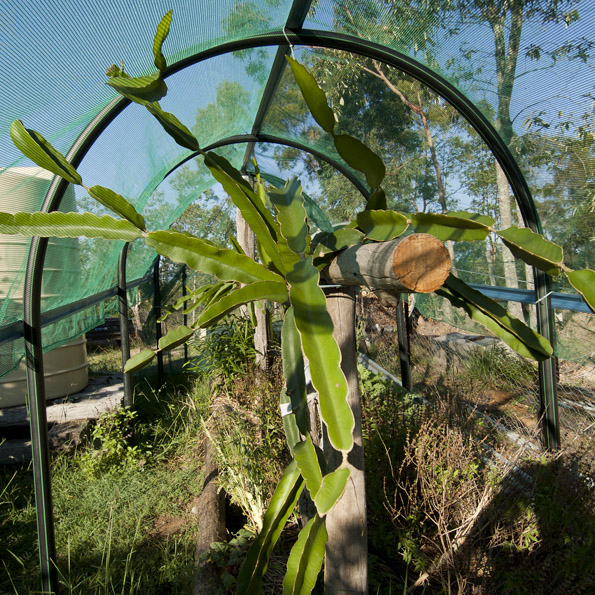
Three of them were planted out on a beam trellis in a shade tunnel in mid-2011 (the 30% shade cloth on these tunnels is extended only during the hotter parts of the summer).

DSCF3647_150212 crop_small

First dragon fruit bud – February 2012 – while the plant was still in the original pot

Two buds were produced in late summer 2012 – probably in late summer because the plants were not sufficiently established to flower earlier that summer.  Neither of these produced fruit.  In the 2012/13 summer we had two flowers and two fruit.

In October 2012 one-third of the floor or the shade tunnel was dug out to a depth of 200-300mm and filled with dead timber, including tree trunks, branches, twigs and leaves, and chip mulch from our annual firebreak clearing, then covered over with the soil taken out of the hole (or rather the two-thirds of the soil that remained after the rocks had been sieved out)  to make a modified heugelkultur/raised garden bed.  That’s the lush area in the background of the photo below, 10 months later.

P1060073_290713 crop_small

One of the dragon fruit on the trellis – late July 2013.  This shot gives you an idea of the post and beam trellis.  It actually recommended for red dragon fruit, but I fail to see why, and I know a commercial grower who has changed over from this to post and frame trellises.

In late July 2013, just before the photo above was taken, the remainder of the floor of the shade tunnel was turned into a modified heugelkultur bed.  The raised bed on top of the timber was a lasagne bed with layers of straw, poultry manure (including quite a few carcases), and compost.

By late December 2013, only five months later, the dragon fruit had responded dramatically.

P1060273_211213_crop_small

The same plant as above, but five months later (there is a second plant growing up the post in the background, but the branches here are from the one in the foreground).

We eventually had seven fruit from nine flowers on four plants from the 2013/2014 summer, harvesting the last of the fruit in May and June.  One fruit didn’t develop, and one was on a new plant growing out in “possum land” beyond the electric fence and was eaten by the possums before it was ripe.

DSCF4472_120414 crop_small

The same plant in mid-2014 prior to pruning

In hindsight it was really dumb to plant dragon fruit above a vegetable bed inside a rather narrow shade tunnel.  These things need to be able to grow as wide as they want, and they need to have a combination of old and new branches hanging down (fruit comes from both).  It just doesn’t work, and forgetting that the vines are there and standing up under one to get one of those small spines in the soft part of the ear is not fun.  As soon as we get an extension to the garden fenced we will be planting lots of dragon fruit there, from cuttings off these plants.

Propagating via Cuttings

While it is possible to propagate dragon fruit from seeds, it is along process and does not result in a vine with the same fruit producing properties as the parent.  With the cuttings you are getting a clone of the parent, and much more quickly.

You can make multiple stem cuttings from the one piece of stem, but focus on the lower and middle portions of the stem (away from the growing tip) to get the most robust material.  If you have an “intermediate” section of stem with narrow stem portions at each end, then it probably doesn’t matter where you take the cutting.

Try to use a stem that is a few inches in diameter (> 2 inches), but smaller stems will work – the danger is that the stem may dry up too much when being “cured” or before it produces roots in the pot. Thicker cuttings suffer less stress.

When you make a fresh cutting, it’s best to place it in a shady location for a week or more to allow the cut end to dry and “heal” to avoid fungal infections, before placing it into soil.  You may see roots starting to develop during this period, but it is not necessary to wait for roots before potting the cured cutting.

Thereafter, a good, well-drained potting mix will serve to encourage roots to grow.

Water once every one to two weeks and let the soil dry up, too wet can cause fungus attack.  Keep mulch away from the base of the plant to avoid introducing fungi and rot.

With filtered sunlight and warm temperature, the vine will grow a root first, then, once the root is established, new branches will sprout from the nodes.

When new growth appears (this may take as long as four months, depending on the weather and season) they are ready to plant in the ground in a sunny location.


Growing the Mature Plant

Dragon fruit need to grow up a trellis, but they need to be able to “hang” their side branches out from the main stem (or from a beam or frame on top of the trellis) in an arc.

Remove lateral growth until the stems reach at least a few feet up their support. Then you can prune the tips of the stems to induce multiple branching, and eventually, fruiting.

This cactus develops some pretty thick and heavy stems, so your support will need to ultimately hold quite a bit of weight. Use twine or bands of fabric to help attach it to the support, avoiding wires that can cut into the weighty stems.  Eventually the stems will grow aerial roots to grip onto the support.

5c29be08eea3ced720eb704e7bd9a518

A man inspects dragon fruit trees on a plantation in rural Cambodia. Photograph: Heng Chivoan/Phnom Penh Post: 30/7/12

This plant is very efficient because it can grow roots on any surface. It can also absorb water and nutrient through any surface. It can also utilize low light or partial shade but it grows better in full sun. BUT be careful when the plant is moved from low light to full sun – on very hot days the vine can sunburn easily.  Growth and fruiting are better in full sun (and the plant needs at least half a day of sun), but in the hotter part of summer I use 30% shade cloth.

Flowering, Pollination and Fruit Development

The main flowering is in summer and then fruit develop into autumn and winter, however the time taken to reach maturity depends on the size of the fruit, so from flowering to ripe can be as short as six weeks or, more usual, several months.

[Need to add more information here]

Feeding Your Dragon Fruit

Dragon fruit needs low nitrogen and high phosphorus in the soil, particularly as it approaches, and during, the growing and fruiting season.  They “hibernate” in winter in our climate.

Pruning

When your plant is at least one year old, strong and vigorous, and ideally having proven its ability to bloom and fruit abundantly (this may take 18 months to two years in our climate), you can begin to take stem cuttings.  Because the plant needs to be pruned once it is mature and has fruited (in order to produce many new side stems and therefore many fruit) you will have an opportunity every year to make cuttings from the pruned material.

It is on the new branches sprawling over the top of the support structure where most of the new flowers are produced, although flowers can pop-up anywhere on the plant.

The Nutritional Value of Dragon Fruit

Nutritional Value of Pitaya

Click on the table to go to the source at: Dragon Fruit: Nutritional Value, Health Benefits and Calorie Count for more information

 Some useful links

NT Government AgNote D42: The Pitaya or Dragon Fruit A four-page technical note on key aspects of cultivation.

NT Government Growing Note: Pitaya (Dragon Fruit) One-page note with some material not covered in above AgNote

Dragon Fruit Production Guide (Pinoy Bisnes Ideas) A lot of good information, some of it in more detail than the above publications.

Pitaya Growing in the Florida Home Landscape  One of the most complete sources I have found on growing dragon fruit.

Dragon Fruit (Pitaya) – How-to Guide for Growing   Includes a video on hand pollination.  A very good source of information on growing dragon fruit, with some information that I hadn’t seen elsewhere.  This is actually an Australian self-sufficiency website, and the author is based in South East Queensland.

Pruning Pitaya (Dragon Fruit) (Sub-tropical Fruit Club of Queensland Instruction with photos for pruning. Use the search box on this page “pitaya” for a huge amount of useful/interesting information on Dragon Fruit

Dragonfruit Cactus (Botanical Growers Network publication) Some of the information fills gaps in the above sources, or gives a different slant on some topics.

Improved Production Technology for Pitaya (Philippines Bureau of Agricultural Research) Check info on when to prune, time to first production and time from flowering to harvest.

http://dragonfruit.foodlywise.com/ An annoying site because of its strange links but there’s some good information if you can figure out how to follow them.

http://dragonfruit.foodlywise.com/how_to_grow_dragonfruit/growing_dragonfruit_commercially/growing_dragonfruit_from_cuttings/dragonfruit_stem_cuttings/  Covers several aspects of growing dragon fruit from cuttings.

http://www.vivapitaya.com/dragon-2.htm A selection of photos of dragon fruit growing in different circumstances – some ideas for supports, and indications of what healthy plants look like in the tropics.
Nicole Foss in Laidley, talking about threats and options

Went to the talk by Nicole Foss (the person behind The AutomaticEarth website) in Laidley on Saturday afternoon on the threats to Australia from the combination of excessive personal debt, over-leveraged banks, the approaching global limits to growth (including peak oil) and climate change.

This wasn’t some gloom-and-doom hand-wringing session.  Foss takes a solution-oriented approach and explored a range of choices available to people at the individual, family and community levels. She covered the alternatives, ranging across urban, rural, suburban retrofit, intentional community, eco-village – and summarised the advantages and disadvantages of each option. 

Along the way she offered Australia an outline of a “Plan-B”: stop basing the economy on feeding the Chinese demand for resources; stop trying to feed 60 million people (and destroying Australia’s soils in the process) instead focussing on food security for Australia into the long term; and replace the sense of complacency with a sense of urgency.

The talk was a logical follow-up to the presentation she gave at the Queensland Institute of Technology in early July, on her speaking tour with David Holmgren.

Nicole Foss, who sometimes writes under the name of ‘Stoneleigh’, is a Canadian sustainability, energy, and finance expert. She is best known for her works on her website, The Automatic Earth.  She was editor of the Oil Drum Canada website where she wrote on the connections between energy and finance.  She now lives in New Zealand.

The event was organised by SavourSoil Permaculture (a Laidley-based small business), and in my opinion made an important contribution to local understanding of the most significant issues facing us and the Earth and, most important, provided a window into the approaches we will need to adopt to ensure personal and community resilience. Thanks Michael, good to see people wiling to make such a contribution to the community.

Rafaele Joudry from Atamai Eco-Village in the north of New Zealand’s South Island (where Foss now lives) gave an overview of Atamai and its philosophy.