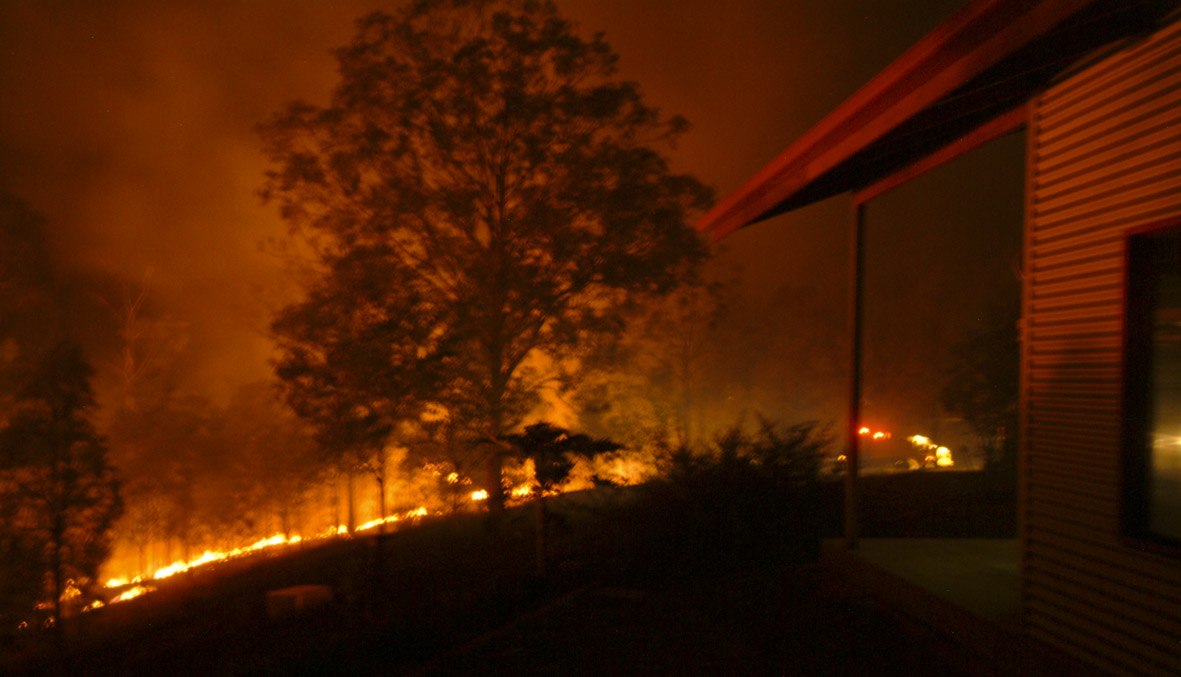
Living with and understanding fire risk

Why do we live here?  What are the risks?

Why do we live here, and how does that relate to the key fire risks and our perception of those risks?

Those of us who live on rural properties face varying degrees of fire risk.  Most of us are aware of the risk in a general sort of way, and many of us take active precautions to reduce the risk to some extent.  Few of us, however, think about how the reasons for living where we do and the things we value about our surroundings affect both the degree of fire risk we face and, often, the extent to which we act to mitigate risk.

Continually reviewing the values that lead us to live where we do, and the risks we face (whether from fire, flood, or just failures in our food production activities), is a part of ensuring sustainability and resilience in both our lifestyle / habitation  the communities in which we live.

The connection between bushfires and our landscape and community values is highlighted in the latest Fire Note (Life on the Edge – Living with Risk) from the Bushfire CRC (Cooperative Research Centre).  This Fire Note summarises some outcomes from the Social construct of fuels in the interface project 1 which was conducted by the Bushfire CRC uner one or their activity themes, Understanding Risk.

Part of the research involved working with property owners to understand what they value in their surroundings, how they perceive their fire risks, and whether these are related. It used the technique of “social-ecological place mapping” to assist landowners to understand what it is that they relate to their landscape

The second part of the research applied a model of factors affecting house losses in NSW bushfires (in much milder weather conditions than those leading to Victoria’s Black Saturday losses) to the 65 properties of the residents who did the place mapping, to calculate a relative estimate of their risk of loss to bushfire.

According to the model, the risk of loss increased: with increasing steepness of slope; where houses were closer together (seven metres apart – but this effect was minimal where houses were further (50 metres) apart (and of course this applies to the buildings on your property too); as the distance to the nearest water body (swimming pools, ponds, dams) increased; and when vegetation cover within the garden (within 20 metres of the house) was high.

The mean predicted probability of house loss for the 65 houses was 0.43, indicating a substantial potential risk should a fire occur (there was considerable variation among the levels of risk of the various properties).  Community and lifestyle values identified by the participants were found to be possible key factors influencing the relative risk of house loss.

There’s a lot more in the report than I can summarise in this short blog post, and I encourage you to read it and the associated reports which are linked here under the heading Key Resources You Should Know About.

This is the 129th Fire Note that the Bushfire CRC has produced. They make informative and compelling reading.  They can be downloaded here, from a list of titles with brief summaries of contents.

And on the home front, it’s time to review and update our fire strategies, and to make sure that they are well documented.  I’ll do a separate post on our strategies in a few weeks.

Lee Reich: unusual fruits, soil organisms, compost tea, moon planting and a lot more

Just a quick one to alert you to a very interesting new podcast on the Northwest Edible Life blog featuring an interview with Lee Reich.

Lee Reich: soil scientist, horticultural scientist, author [link to leereich.com]

Reich has graduate degrees in soil science and horticulture and has worked in plant and soil research with the USDA and Cornell University, before turning to writing, lecturing, and consulting.  He has written at least nine books as well as running an interesting blog.   Because of his educational, research and practical experience in two fields which are an important part of the basis of permaculture, a lot of what he says in this interview will be of interest.  Erica, the host of the Northwest Edible Life blog, has a lively and easy to listen to interviewing style that keeps the flow of ideas coming throughout the interview.

You can also download the podcast – which leads me to the topic of mp3 player programs.  I’ve found a lot of the programs available for Macs to be a bit of a pain in the neck – and I totally refuse to use iTunes because like a lot of Apple’s market oriented software it is just too focussed on data collection.  Then I just stumbled on the fact that if I stored an mp3 file in Evernote I could also keep comments about the content of the podcast in the same in the same Note, as well as using Evenote’s very functional mp3 player straight from the note.  In fact what I do is to store the file in my General Library folder, along with pdfs etc, then link an Evernote Note to that file.

Screen shot 2014-08-11 at 3.03.12 PMEvernote is available for Mac Windows phones and tablets.  I recommend it as a great place to dump information that will be useful one day, or to keep copies of receipts (e.g. for equipment with a warranty), warranties, manuals, etc.  My only problem with it is that it can be difficult to extract files from Evernote once they are saved into a Note, but I get around that by “attaching” files to Notes (and by keeping most of my technical notes in Devonthink Pro Office).


Nicole Foss and a Powerful Owl in the one evening!!

Just two quick bits of news.

First, Nicole Foss was on ABC Radio National’s Big Ideas earlier today.  I missed it but downloaded the mp3 of her talk – and it seems to be pretty close to the presentation she gave on her Australian tour with David Holmgren in July.  I gave my impressions of their Brisbane talks here.  It’s long (54 minutes) but the mp3 file downloads quickly, even on satellite broadband, and it’s definitely worth hearing, so set yourself up with a comfortable chair and a mug/glass of your favourite beverage and get ready to be informed by one of the best speakers I’ve heard.

The other news is that as I was coming in from the office tonight, just before 10.00pm, there was a male Powerful Owl calling from somewhere up behind the workshop.  You can find good recordings of their calls here.  This is the first Powerful Owl I have heard here in about four or five years.  In fact they were regulars during the drought, and seemed to move away once we started getting good rain.  The first sign we had of their presence was early in the drought, when we kept finding the tails of Sugar Gliders on the ground in the bush.  Sugar Gliders seem to be a favourite food of this species and they discard the tail because it isn’t much but bone and fur.  We’ve only seen a Powerful Owl here once, when it was sitting calling on a horizontal branch about 15 metres from where the house is now.  What a sight!!  The first thing that hits you is the size of the bird; these guys are really tall.  Then you see the feet, which look rather similar in their size and proportions to a man’s hand.  Let’s hope this one stays around.  I’ll be listening for it, and for a female call to signify that it has found a mate.

The resident Southern Boobooks (Mopokes) in a stand of Budgeroos just down in the gully kept calling while the Powerful Owl was calling – I’d have expected they might have been a bit intimidated by the sheer volume of the Powerful Owl’s call.

Renewable energy – some places promote it and shout it out!

I just had to share this.  It is so positive and encouraging.  Nice to be reminded that in other parts of the world they encourage the growth of renewable energy.

Here’s a shot of the renewable energy tracking on the website of the following group of companies:

Hawaiian Electric Company, Inc.

The image is updated on the company’s Renewable Watch page, and you can click on the image there to enlarge it.

If only our governments and power companies were so proud of the level of generation of renewable energy in Australia.

I found the link to the graphic in a story on Mother Jones on the way in which electricity demand in the USA is dropping year after year.  The total demand in 2013 was two percent below the 2008 level.  The reasons for the drop are pretty much the same as in Australia: higher prices pushing people to cut usage; more people and companies generating their own power, mostly via solar PV; and  increasing efficiency (of buildings and appliances).

Madeira Vine – a permaculture food plant, or a rampant and destructive invasive?

If you’ve been reading my blog for a while you will know that I’m very concerned about the encouragement of the use of invasive or potentially invasive species in permaculture (you can see where I’ve written on the subject here and here).

Now the folks at Milkwood Permaculture have thrown up a curly one – they’ve just posted on how Madeira Vine not only has edible leaves and tubers, but is widely eaten and cultivated in Japan, where it is known as “land seaweed” (okawakame)

Typical effect of unchecked Madeira Vine [from Milkwood Permaculture blog]

As they point out, Madeira Vine is an already “adapted, perennial, zero footprint and highly nutritious food plant” with the following characteristics which are desirable in a food plant:

  • “It grows without much assistance, is hardy and produces prolifically.
  • It requires minimal cultivation.
  • It dominates an area where it is planted (meaning far less weed control is needed)
  • It is spread only* by humans and by water flows distributing the bubils – an easy factor to contain with good design.”

The Milkwood guys are  planning on having it as a food plant in their garden.  They recognise that it is a potential problem, and will manage it by eating it and stopping it from spreading.

So, should we incorporate Madeira Vine into our permaculture food production?

My first question would be: Just how weedy/invasive is it really?

Madeira vine grows prolifically at rates of up to 1 m per week in high-light environments.  It produces large numbers of subterranean and aerial tubers that not only act as reproductive bodies, but also provide the plant with a carbohydrate source that enables it to survive through difficult times. As a consequence, Madeira vine can tolerate a range of adverse conditions including drought, snow and frost, and it has been found growing in areas as diverse as rainforests, riparian fringes, rocky outcrops and frontal dunes (source).  This same ability to tolerate adverse conditions also means that the tubers can survive for very long periods of time in suspended animation, before they experience the right conditions to shoot (source).

The vine reproduces through the proliferation of aerial tubers and also from rhizome (subterranean tuber) fragments that may be broken off (source).  The aerial tubers can persist for two to 15 years and rhizomes for five to 10 years, with tuber germination rates of up to 70 per cent (source).  Although Madeira Vine is widely believed not to set seed in Australia, up to 5% of dried flowers collected from southeast Queensland were found to contain germinable seed (see #Vivian-Smith et al, below).

Dispersal is believed to occur primarily* via human spread (cultivation for ornamental purposes, disposal of vegetative material and tubers, e.g. in green waste (source), or being spread by machinery and/or gravel during road construction).  However it also spreads downslope under the influence of gravity and water movement from ridges and down watershed, and via floods (source).

Saying that it is spread primarily by humans needs to be considered in relation to just how widespread it is, what a significant destroyer of habitats it is once established, and how extremely difficult it is to eradicate once established.  Here is how the Environment Australia weeds database summarises the facts about Madeira Vine:

Madeira Vine is a Weed of National Significance (WONS). It is regarded as one of the worst weeds in Australia because of its invasiveness, potential for spread, and economic and environmental impacts.

Madeira Vine has aggressive vegetative growth which competes with and replaces other vegetation, and is difficult to control once established. Its aggressive nature gives it the potential to smother other desirable plants. Its sheer weight is capable of breaking branches off trees, thereby reducing them to poles, potentially causing collapse of the rainforest canopy (ISSG 2006). It restricts light and thereby prevents germination of desirable native species (Harley undated).

Should we then include Madeira Vine in permaculture food production?  I think there are two things to take into account before making a decision on this.

First, the permaculture ethics of care for the Earth and care for people.  The potential impacts on the Earth from Madeira Vine escapes are obvious (see the sources and photo above) and well documented, as are its impacts on the people whose properties and amenity are impacted.

Second, based on an assessment of invasiveness and impact, Madeira vine was ranked 5th worst of1060 naturalised south-east Queensland plant species (#Batianoff & Butler, below).  How are you going to ensure that:

  • no seed is set, and neither seed nor tuber material is distributed by animals, or other agents of dispersal, including water (i.e. the area where you will grow it will never flood or be exposed to high volumes of water runoff;
  • everyone who works on your garden or caretakes for you while you are away is as careful as you would be not to allow any dispersal of aerial tubers, (fragments of) rhizomes or seeds;
  • before you move on, you will have somehow removed all aerial tubers and every last fragment of rhizome before you leave, or failing this, you have some guarantee that the next landholder is going to take the same careful management approach as you?

– – – – – – – –

*I consider the statement that it is spread “only by humans and by water flows distributing the bubils – an easy factor to contain with good design” to be dangerously simplistic for a number of reasons.  First, once a Madeira Vine has established itself in a vegetated area it does not sit and wait for humans or water flows to come along and move its tubers or rhizomes.  The tubers are spread naturally when they fall from the adult plants where they have climbed up and across the canopy (often a considerable distance) from where they originally grew. Second, anywhere that an established population of Madeira Vine grows over a waterway that even only occasionally flows, this will distribute the plant to any and all areas downstream.  Third, saying that it is spread “by humans” without mentioning the many ways in which human activity can spread the plant, or the very long viability period of the tubers, gives a very misleading impression of the ease with which human activity can (even unwittingly) result in spread.

Here is a rather more informative account of how it is spread:

The most common means of reproduction and spread is via asexual tubers formed on the roots and stems. Prolific numbers of aerial tubers are produced throughout the year, which drop to the ground when mature or in response to stress. Research indicates that aerial tubers can persist for two to 15 years and subterranean tubers for five to 10 years, with tuber germination rates of up to 70 per cent. In areas of heavy infestation, soil tuber densities are up to 1500 per m2. Madeira vine is also capable of shooting from sections of severed vine.

Dispersal occurs primarily via human spread such as cultivation for ornamental purposes, disposal in green waste, or spread by machinery during road construction. It can also spread via gravity and water movement from ridges and watersheds or during floods. Mammals and birds may also play a minor role in localised spread.
While seed production is believed to be rare in Australia, research indicates that up to 5 per cent of dried flowers collected from southeast Queensland contain germinable seed. It is speculated that seed set and germination may only occur under ideal environmental and seasonal conditions.

 Sources which aren’t linked above:

#Vivian-Smith et al, Alan Fletcher Research Station QLD Unpublished data (cited in this source)

#Batianoff, G.N. and Butler, D.W. (2002). Assessment of invasive naturalized plants in south- east Queensland. Plant Protection Quarterly 17: 27–34.
 

Is it possible to grow vegetables using no-till farming?

At various workshops and meetings I’ve often heard statements along the lines of “no-till approaches are all very well for broadacre cropping (e.g. grain crops), but no one uses them for vegetables” – to the point where I just assumed that there must be good reasons for not doing it.

Can it even be done, even if only by dedicated permaculturists willing to put in huge amounts of effort?  Well, yes it can, but not just through huge amounts of manual labour and on a small scale.  There are people our there successfully doing mechanised no-till vegetable production.  This article by Dr Mark Schonbeck on the Rodale Institute’s website tells the story.

Dr Ron Morse in a field of cover crops [Rodale Institute web site]

According to the article, Dr. Ron Morse, a professor of horticulture at Virginia Tech, in Blacksburg, Virginia has been working for more than two decades on soil-conserving systems for vegetable production.  This parallels efforts by Pennsylvania vegetable grower Steve Groff (in an article by Marni Katz) over the same period on his Cedar Meadow farm. The permanent cover cropping system that he has developed helped to eliminate tillage on 175 acres of pumpkins, tomatoes, sweet corn and other vegetable crops on his Cedar Meadow Farm. Not only has this approach reduced cultivation costs and improved yields and quality, it has also helped  manage the soil erosion from the farm’s sloping topography.

“You could not pay me to till my land anymore,” Groff says. “Soil erosion has gone from 15 tons per acre, per year, to almost nothing. Organic matter [in the soil] has gone from 2.7 percent 15 years ago to 4.8 percent this year, and yields have improved 10 percent.”

You can find a list of other articles about Steve Groff’s farm here.

Ron Morse (1999#) has attributed the progress and acceptance of no-till vegetable production in the US to advances in no-till planters, development of techniques for managing high residue cover crop mulches and the acceptance of (and improvements to) integrated weed management techniques.

However I think there are a lot of other factors involved, including: farmer attitudes to the “bottom line”, i.e. whether they are mainly profit-focussed or have an eye on the triple bottom line; farmers’ willingness to be different to their peers (i.e. operating outside the norm); and ability and willingness to deal with a different suite of pest problems arising from the use of cover crops.

No-till vegetable farming has been practised in Australia for around 20 years (e.g. Rogers et al. 2004#), but does not seem to have caught on widely.  However there was a study of seven trial sites at different latitudes in Australia (including one at Zeibarth’s farm at Laidley in the Lockyer Valley), published in 2006, that also reviewed a range of studies on the application of the approach in Australia.  Unfortunately it seems from a quick reading of the report that glyphosate was used to kill the cover crops at most if not all of the sites.  However, the report does include an assessment of the use of a combination of Organic Interceptor (a certified organic acceptable herbicide) and flame treatment, but concluded that only glyphosate gave acceptable long-term weed control – though clearly there are farmers in the other articles that I’ve provided links to here who are able to deal with this issue.

You can find a balanced and fairly comprehensive evaluation of the organic no-till approach here and here, providing you with a pretty comprehensive range of considerations to bear in mind when deciding whether to attempt an organic no-till approach to growing vegetables.

One thing to bear in mind though is that a lot of what has been published relates to large-scale vegetable production.  People who are looking to produce vegetables for family consumption with a surplus for bartering or giving away will be likely to have a different take on the pluses and minuses of the approach.  Steve Groff’s summary might be worth considering:

“… for the grower who does his homework, the no-till system offers significant advantages. No-till growers typically save money by reducing water use in irrigated systems, reducing cultivation equipment and fuel costs and minimizing inputs, such as herbicides and fertilizers.

In addition, Katz quotes Ron Morse who pointed out that growers often realize increased yields through soil moisture conservation and enhanced quality, particularly for crops that lay on the ground. At the same time, there are increased costs in equipment and seed for managing the cover crop.

“A grower has to be really careful to understand the system and do it right,” Morse notes. “It works if you do it right, and there are a lot of advantages.”

Unlinked Sources

# Morse, Ronald D. “No-till vegetable production—its time is now.” HortTechnology 9.3 (1999): 373-379.

# Rogers, G.S., Little, S.A., Silcock, S.J. and Williams, L.F. 2004. NO-TILL VEGETABLE PRODUCTION USING ORGANIC MULCHES. Acta Hort. (ISHS) 638:215-223


Midday wholesale price of electricity falls to zero in Queensland

An article by Giles Parkinson in The Guardian on 7 July reported that the wholesale price of electricity in Queensland fell into negative territory – in the middle of the day.  Apparently this has never happened in the middle of the day before. Here’s part of what the article reported:

For several days the price, normally around $40-$50 a megawatt hour, hovered in and around zero. Prices were deflated throughout the week, largely because of the influence of one of the newest, biggest power stations in the state – rooftop solar.

“Negative pricing” moves, as they are known, are not uncommon. But they are only supposed to happen at night, when most of the population is mostly asleep, demand is down, and operators of coal fired generators are reluctant to switch off. So they pay others to pick up their output.

That’s not supposed to happen at lunchtime. Daytime prices are supposed to reflect higher demand, when people are awake, office building are in use, factories are in production. That’s when fossil fuel generators would normally be making most of their money.

The influx of rooftop solar has turned this model on its head. There is 1,100MW of it on more than 350,000 buildings in Queensland alone (3,400MW on 1.2m buildings across the country). It is producing electricity just at the time that coal generators used to make hay (while the sun shines).

Yes, the wholesale price level around zero was due to the level of installation of rooftop solar PV systems by homeowners and businesses in Queensland.  But in reality it seems to me that the near zero pricecould more accurately be said to be due to the removal by the Queensland government of most of the feed-in tariff paid to solar PV producers – BUT …  there are still lots of solar PV owners on fixed term contracts and receiving reasonably high feed-in tariffs – so shouldn’t these tariffs have been reflected in the wholesale price when solar PV was dominating the market?  Or are there now so many recent solar PV installations that their low feed-in tariffs are dominating the market around the middle of the day?

Can anyone enlighten me as to how the near zero wholesale electricity price really came about?

Regardless of the confusion, it seems that solar PV is making its mark as a component of the State’s energy generation industry.  Are these low wholesale prices eventually going to be reflected in our electricity bills?

You can read the whole Guardian online article here.


Is a 100% renewable electricity supply possible in Australia right now?

Mark Diesendorf, Associate Professor and Deputy Director of the Institute of Environmental Studies at the University of New South Wales, has posted a detailed and convincing article in The Conversation this morning about the potential for a 100% renewable electricity supply in Australia.

His conclusion (with my underlining):

The renewable scenarios would be economically competitive with the fossil system either with a carbon price of A$50 per tonne of CO2 (reflecting part of the environmental and health damage from fossil fuels) or, in the absence of a carbon price, by removing the existing subsidies to the production and use of fossil fuels and transferring them temporarily to renewable energy.

That’s right: we could start implementing 100% renewable electricity generation RIGHT NOW, and with no financial burden on the economy, just a temporary shift of the political sacred cow of hydrocarbon fuel subsidies to the renewable energy sector.  In fact Diesendorf doesn’t say it, but there would be a significant positive impact on the economy from very significant increases in both temporary and long-term employment in the renewables sector.  And, you never know, when the renewable sector no longer needs the subsidy the government of the day may decide not to reinstate it for the hydrocarbon fuel sector.  Very big win for the economy and possibly the climate if that happened.

Could we do this with current renewable technologies, or would we have to wait for the development of some currently unproven approach?  It’s can all be done with today’s technology.  Here’s Diesendorf again:

“Using conservative projections to 2030 for the costs of renewable energy by the federal government’s Bureau of Resources and Energy Economics (BREE), we found an optimal mix of renewable electricity sources. The mix looks like this:

  • Wind 46%;
  • Concentrated solar thermal (electricity generated by the heat of the sun) with thermal storage 22%;
  • Photovoltaic solar 20% (electricity generated directly from sunlight);
  • Biofuelled gas turbines 6%; and
  • Existing hydro 6%.

So two-thirds of annual energy can be supplied by wind and solar photovoltaic — energy sources that vary depending on the weather — while maintaining reliability of the generating system at the required level. How is this possible?

It turns out that wind and solar photovoltaic are only unable to meet electricity demand a few times a year. These periods occur during peak demand on winter evenings following overcast days that also happen to have low wind speeds across the region.

Since the gaps are few in number and none exceeds two hours in duration, there only needs to be a small amount of generation from the so-called flexible renewables (those that don’t depend on the vagaries of weather): hydro and biofuelled gas turbines. Concentrated solar thermal is also flexible while it has energy in its thermal storage.

The gas turbines have low capital cost and, when operated infrequently and briefly, low fuel costs, so they play the role of reliability insurance with a low premium.”

“BASELOAD POWER!  You’ll need baseload power!”, I hear the coal and gas industries shouting.  Well, clearly such a system would NOT require baseload power in the form that they understand.

I like it too that he has addressed the bogie inherent in the use of biofuel powered gas turbines: the possibility that they will require unacceptable volumes of timber from forests or the allocation of unacceptable areas of food-producing farmland to grow the fuel to run them.  Keeping the gas turbines in reserve, to be used only for periods of a few hours a few times per year would mean that not only would fuel demand be low, but the fuel could be sourced from wastes over a longer period and stockpiled for later use.

Do we know whether it would work in reality?  How about on hot summer evenings, or on those cold, windless winter nights?  Diesendorf’s team used real figures from the National Energy Market (presumably the ones published daily by the Australian Energy Market Operator), to model many different mixes of current renewable energy technologies to come up with the proportions set out above.

 “Ben Elliston, Iain MacGill and I at UNSW have performed thousands of computer simulations of the hour-by-hour operation of the NEM with different mixes of 100% commercially available renewable energy technologies scaled up to meet demand reliably.

We use actual hourly electricity demand and actual hourly solar and wind power data for 2010 and balance supply and demand for almost every hour, while maintaining the required reliability of supply. The relevant papers, published in peer-reviewed international journals, can be downloaded from my UNSW website.”

 Read the full article on The Conversation.

Imported Weeds and Invasive Exotic Plant Species

The use of “weedy” species, together with the use of non-local species of unknown weediness, incites very heated debate in permaculture circles, inspiring a lot of name-calling and pseduo-science.  My own view is that the promotion of known invasive, or potentially invasive, species as part of the permaculture approach is highly irresponsible and arguments for their use are often couched in language that approaches the mysticism or spirituality that is supposedly “banned” in serious permaculture.  (You can see my views on the use of Leucaena here.)

Of course, the topic of invasive species overlaps with the consideration of “weeds” as an element of food productions activities.  I’m not going to go into that here, but the eXtension website has an excellent article on weeds in agriculture (An Ecological Understanding of Weeds) that incorporates both the negative and positive aspects of weeds in agriculture.  Well worth reading – much of it reads as if it was written by an well-informed permaculturist.  In fact the author, Dr Mark Schonbeck, is credited by the the Virginia Association for Biological Farming as combining “deep scientific knowledge, practical farming technique and policy smarts”.  I recommend googling his name – it will turn up a plethora of interesting and informative articles.

Dr Schonbeck’s article also deals with invasive species, under the heading of Imported Weeds and Invasive Exotic Plant Species.  Among other things this part blows out of the water the permaculture argument that for a species to become invasive in an ecosystem there must have been a vacant niche in the ecosystem.

Below is the text of that part of the article (with what I think are the really telling points underlined by me), but I really recommend you read the whole article for its information about the place of weeds in food production systems.  Remember that the weed/invasive species referred to are in relation to the US, though it is interesting how many are familiar to us in Australia.

Many of a region’s most problematic weeds are those that are not native to the region, or even the continent. These exotic plant species often grow more vigorously in their new habitat than they do in their area of origin, where certain soil organisms, herbivorous insects, climate patterns, and/or competing vegetation keep them in check. Kudzu (Pueraria thunbergiana), imported from Japan as a forage crop, is one dramatic example whose enormous vines can cover and kill large trees in the southeastern US. However, a small (4–18 inches) perennial weed called purple nutsedge (Cyperus rotundus), which has invaded the southern United States, causes much greater losses in cultivated crops (even sugarcane and coffee trees), and is considered the world’s worst weed (Holm et al., 1991).

Some of our major agricultural weeds were intentionally brought to the United States from overseas to provide food or forage. European colonists carried common lambsquarters (Chenopodium album) to the New World as a vital source of early season greens that prevented scurvy and other nutritional deficiency conditions. Common lambsquarters has spread around the globe and is now listed as the world’s 10th worst agricultural weed. Livestock farmers imported bermudagrass (Cynodon dactylon, 2nd worst weed), johnsongrass (Sorghum halapense, 6th worst), and quackgrass (Elytrigia repens, a major weed of vegetable crops in the northeastern US) to this country for their utility as forages. Other serious exotic weeds were first planted as flowers and other ornamentals, and subsequently spread from cultivated gardens into surrounding farmland and/or natural ecosystems. Still others arrived by accident as a seed contaminant in imported crop seed, feed grain, foods, bedding plants, or other materials.

Many exotic weeds have become “naturalized” over time, and are now part of a region’s agricultural weed flora that must be managed (not necessarily eradicated) to protect crop yields. However, some newly introduced plants growing in the absence of the natural enemies with which they evolved may spread unchecked, choking out native vegetation as well as invading pastures or cultivated fields. Imported weeds that threaten natural ecosystems and/or rangeland over wide geographic areas are designated invasive exotic plant species or invasive exotic weeds, and often become the focus of regional or nationwide coordinated eradication efforts. Examples include water hyacinth (Eichhornia crassipes) and purple loosestrife (Lythrum salicaria) in wetlands; Canada thistle (Cirsium arvense), musk thistle (Carduus nutans), spotted knapweed (Centaurea maculosa), and St. Johnswort (Hypericum perforatum) in rangeland; and autumn olive (Elaegnus umbellata) and tree-of-heaven (Ailanthus altissimus) in eastern deciduous woodlands. Classical biological control—the introduction of herbivorous insects or microbial pathogens that are natural enemies of these weeds in their native lands—has been used with considerable success to combat some invasive exotic weeds.

Arrival of a new invasive exotic weed on an organic farm is one instance that may justify efforts to eradicate the new arrival. Early detection—combined with an understanding of the ecology of the weed—is vital for successful elimination of the invader.

Edible and Useful Plants

Was just searching the internet for information on what is used to inhibit sprouting in onions (and potatoes) in Australia and came across a series of well written and informative articles on useful and edible plants by Penny Woodward.  Well worth having a look at.  She includes some unusual and interesting members of the onion family and herbs as well.  She has written a series of books (available for purchase through her website) which look interesting too.  Unfortunately she doesn’t have a subscription link to her blog, offering only advice on new material via Facebook and Twitter, neither of which I use.

Haven’t definitely nailed the anti-sprouting issue yet.  But I did discover that, like many fruits, onions can be stored for long periods before appearing in the shops.  It’s time we had a “harvest date” advice on fruit and veg.  It appears that the most common approach is some formulation of Maleic Hydrazide, often as Potassium Maleic Hydrazide.  I don’t have time to chase it up further right now, but it appears that while the potassium salt might be relatively harmless, one can’t say the same for Maleic Hydrazide, particularly in relation to its impact on aquatic organisms.  If anyone has detailed information on what is used in Australia, how it’s used, and what the impacts are please add a comment.

If you’re having any problems loading the new header photo please let me know.