Producing the staples

What do you eat?  I don’t mean a literal list of all the different varieties of plant and meat that you consume, but rather the main elements of your diet – the staples, as they are traditionally known.  These are food “eaten routinely and in such quantities that it constitutes a dominant portion of a standard diet” (Wikipedia).

Here on Black Cockatoo Ridge we can divide our main food items into six groups, not all which are staples in the normal sense, but we eat them at least every week, if not daily.  In rough order of volume consumed they are:

  • starchy roots (potatoes, sweet potatoes, pumpkin – I know it’s not a starchy root, but we often use it as a substitute);
  • grains/seeds (rice, beans, gluten free grains/seeds used as flour or in muesli – corn, rice, buckwheat, quinoa, chickpeas);
  • fruit (bananas, apples, melons, pawpaw, avocado);
  • meat (kangaroo, or when we can get a bulk order from a sustainably and humanely raised and slaughtered animal, beef, fish);
  • dairy products (milk and yoghurt);
  • leafy greens (pak choi, lettuce, broccoli); and
  • onion family (onions, garlic, spring onions).

Which of these do we produce ourselves?  Potatoes – very infrequently.  Sweet potatoes – just started harvesting our first (poor) crop.  Pumpkin – seasonal, and depends on whether the bandicoots and possums get to them first. Beans – seasonal, and I’m bad at succession planting, so the supply is intermittent. Pawpaw – we have one amazing tree that has kept us in pawpaws for the last few years. Garlic – seasonal, and not enough to last more than a few months.  Spring onions – constant supply using cut-and-come-again approach.  Pak choi – more or less continuous supply. Lettuce – very occasionally, due to pests and poor succession planting.

Given that our objective is to be as self-sufficient as possible, this is a pretty poor showing.  Not that this is by any means all we grow – the total list would probably be more than 30 species – but most could not form staple elements of our diet.  If we suddenly had to rely on our own production for our food supply we would probably be starving within a six months.  Even lasting that long would be mostly because we have a policy of keeping up to three months’ food supply on hand and this could be eked out with production from the garden.  That would give us a bit of a buffer during which we could try to ramp up our production of staples.  However given the work involved in bringing new garden areas into production and the need to find seed/breeding stock during a period when lots of other people were doing the same, it would be at best a precarious situation to be in.

How would you go if you suddenly found the supermarket shelves empty and unlikely to be re-supplied for an unknown period?

You don’t think that is a likely situation?  Supermarkets rely on a just-enough and just-in-time inventory system.  They generally have a 3-5 day stock of items on hand, and if there is an emergency situation the shelves will be cleared out of staples quicker than that.  If supplies cannot get through (roads blocked, fuel unavailable, civil unrest making roads untrafficable), then you could find yourself reliant on your own food stocks/production very suddenly and for a prolonged period.  Those of us who experienced the Lockyer Valley floods in 2011 will know what this feels like.

But for most of us, being self-sufficient in food isn’t mainly about emergency situations; it’s about having a supply of unadulterated food with a known history – e.g. no harmful chemicals, no exploitative or inhumane practices involved in its production, low food-miles to limit green-house gas emissions.

How does your garden stack up in terms of producing your staple foods, and how do you think you could improve the situation?

Permaculture Design Certificate

Sorry about another long gap in blog posts.  I just got back from doing a twelve-day Permaculture Design Certificate course in Kin Kin (on the Sunshine Coast between Noosa and Gympie) with Tom Kendall at Maungaraeeda, the permaculture centre that he and his wife Zaia run.  Fantastic experience.  After doing some research on available PDC courses (see below), I went to Maungaraeeda with high expectations – and they were exceeded.  Tom is a wonderful teacher, very warm, very knowledgeable, and very committed to ensuring his students get the most out of the course.

The course sessions are based on Bill Mollison’s book Permaculture: A Designers’ Manual  – Bill Mollison, one of the founders of permaculture, was one of Tom’s PDC teachers (the other was Geoff Lawton).  The sessions run for 72 hours over 12 days, and are given credibility by examples drawn from Tom’s long agricultural experience.  He grew up on an 11,000 acre wheat and sheep farm at Grasspatch, north of Esperance in Western Australia, which he took over after his father retired.  In 2000 he sold the farm and moved to the Sunshine Coast, where he bought the property that is now Maungaraeeda in 2005 and developed it as a permaculture-based operation

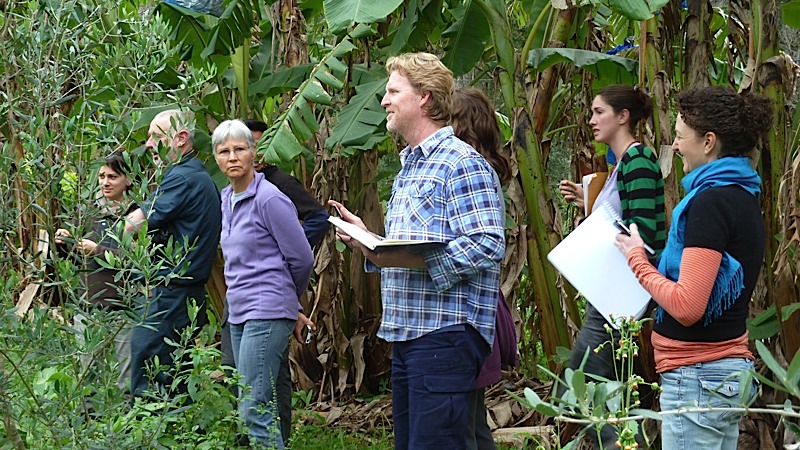
An outdoor class in the food forest

An outdoor class in the food forest.

Classroom sessions were frequently interrupted for practical activities, including several walks over the property while Tom explained specific permaculture features of the management.  It is a delightful setting, in a small valley just outside Kin Kin, with the house and food production areas down near the road, the grazing areas above that, and rainforest along the ridge-tops.

Tom in a fairly new food forest, surrounded by mostly support species.

Tom in a fairly new food forest, surrounded by mostly support species.

But Maungaraeeda isn’t just about Tom.  Zaia is in charge of Administration and Marketing, but in reality her role goes far further than that, and every aspect of the running of the place, from the first contact one has about enrolment to the mouth-watering meals, shows evidence of Zaia’s warmth and attention to detail.  From the moment I set up my tent on the lawns near the student dining area there was a strong feeling of “home”.

Tom and Zaia are supported by two long-term volunteers whose personalities and contribution to the running of the course added to the warm atmosphere.

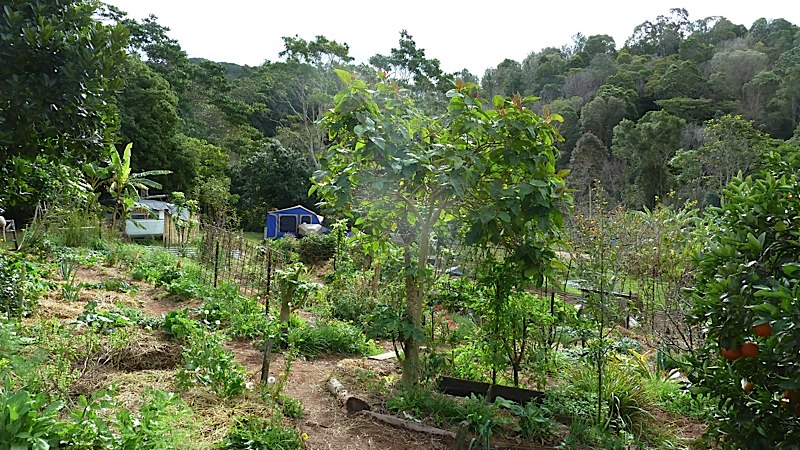
Part of the kitchen garden at Maungaraeeda.

Part of the kitchen garden at Maungaraeeda.

And then there were the other students (there were nine of us in all). All I can say about them is that I think I had the extreme good fortune to find myself among a group of amazing individuals from whom I learned a lot, and whose company I still miss now, five days after the course ended.  We parted with promises of keeping in contact and setting up a “class wiki” to share our permaculture experiences and I really hope that happens.

The class and Tom, posing behind a fruit tree we planted and surrounded with about 30 "support" species.

The class and Tom, posing behind a fruit tree we planted and surrounded with about 30 “support” species.

There was a choice of accommodation – byo tent, a dormitory bus, or cabins.  I took my own tent, and even though it rained for part of the time, and was often pretty cold at night, it was really comfortable – particularly after they lent me a camping mattress to keep the ground chill out.

One of the lovely cabins, or you could bring your own tent.

One of the lovely cabins, or you could bring your own tent.

I promised above to comment on how I came to decide on doing the PDC with Tom.  In fact I had been thinking of doing a permaculture course for a while, and realised about six weeks ago that there would be a window in my commitments around late June/July, so I checked out the courses that were available and not too far away from Southeast Queensland.  The three I found were: the one taught by Tom; one led by Geoff Lawton (but presented by seven named instructors plus unspecified others) at Geoff Lawton’s Zaytuna Farm; and another at Northey Street City Farm in Brisbane, also with multiple instructors.  Costs ranged from $1,230 to $2,585, with Tom’s falling in between.

After I’d looked at what information I could find about the three organisations and particularly the backgrounds of their instructors, there really wasn’t any option for me other than Tom’s course.  Courses with multiple instructors didn’t appeal at all.  Permaculture is a “package” and needs to be taught and understood as that, not as a series of topics.  Cost was an issue, but not nearly as much as value-for-money, and with Tom’s practical background and his very hands-on ongoing experience in setting up his own permaculture farm, plus the small class size (they limit classes to 15) the value was definitely there.

Did the course change my life?  Yes, and a lot more than I had expected – not in the sense of an epiphany or even a change of direction, but in giving me more confidence that I now have a good theoretical and practical grounding for achieving the goals we have set for our property; and the knowledge that I have someone I can turn to for advice in the future.  Not only that, but now, whenever I see any agricultural area, my brain immediately starts mapping out swales – I guess you could say that my “permaculture eyes” have been opened.

Now that's a swale - Tom has swales on his property ranging from this down to hand-dug swales through the kitchen garden

Now that’s a swale – Tom has swales on his property ranging from this down to hand-dug swales through the kitchen garden.

A couple of interesting web sites

In my meandering around the sustainable parts of cyberspace, from my seat near the fire on a damp and overcast day, I came across a couple of web sites that may be of interest.

The first was on urban farming.

MY HOME HARVEST copyAs the header says, My Home Harvest is about providing motivation and inspiration to the urban farmers of Australia.  But from what I’ve seen of the content it is going to inspire a wider range of people interested in sustainable food production that just urban farmers.

For example, the Expert Advice and FAQs tab currently leads to posts on:starting your own food swap; preserving kale, silverbeet and chard, a factsheet on edible weeds, and a pest-profile of the cabbage white butterfly.  There’s also a library of articles and resources, a range of discussions on the forum, and much more – including a diary of upcoming food, seed and produce swaps (ranging from Victoria to the Margaret River in WA.

This web site first launched as Swap Shuffle Share in January 2012 and the change to My Home Harvest was undertaken in April 2013 to better reflect the purpose of the project and to take into account the feedback received from members during the project’s first year of operation.  So it’s relatively new in this format and content is being developed and expanded all the time. Well worth registering to become a member and being involved in the journey.

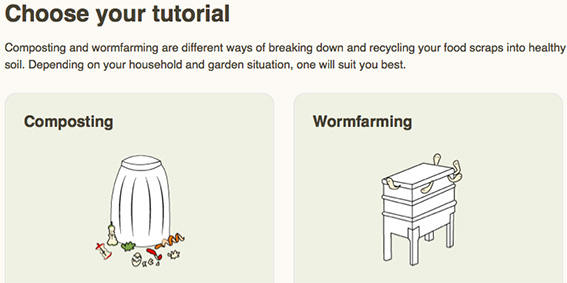
The other interesting find was on the Liverpool City Council’s web site – two very good tutorials, one on composting and one on worm-farming.

TUTORIALS copyThe tutorials are arranged in a series of simple steps, with each step presenting fairly detailed information, but in a format that makes it easy to take in.  Whoever designed these on-line tutorials really knows their stuff in terms of designing instructional materials.

Gluten-free muesli

P1050860_muesli bins_webOne of the difficult aspects of discovering that one has celiac disease or is intolerant to gluten is dealing with the sudden disappearance from the menu of a whole lot of types of food – no more bread, pastry, cakes, muesli – that most of us take for granted as part of life.

What can be a surprise is the difficulty of finding a substitute for a favourite breakfast cereal.  Clearly things made from wheat, oats, rye and barley are off the menu, but the nasty surprise is that so many cereals that don’t appear to be made from these ingredients contain gluten in one guise or another.  Things like glucose syrup – often made from corn, but might equally be made from wheat, sometimes changing from one month to another depending on which source is cheaper at the time.  Or caramel flavour – yep, often made from one of the gluten-containing grains.  Maltose – barley.  And on and on.

The nice thing nowadays is that a very significant market in gluten-free grain products has developed to meet the need, unlike even ten years ago when there was little available.

The ordinary supermarkets have some products from which we can make muesli, but it is a limited range, and often quite expensive, and supply can be uncertain, apparently depending on whether the shelf-space is wanted for some higher-profit line.  The ready-made gluten-free cereals are one of these higher-profit lines, often being ridiculously expensive.  They are of course “delicious”, probably mostly because of the sugar and salt they contain.

Health-food stores are another source of gluten-free grains and ready-made gluten-free muesli, but if you thought the supermarkets were expensive you’re in for some serious sticker-shock in most health food outlets.  I’ve long ago given up shopping there.

In Southeast Queensland we are lucky in that over the last few years Wrays# organic food outlets have been multiplying rapidly.  These franchises are committed to providing organic food at realistic prices – just as one example, we often buy very good organic potato varieties from Wrays cheaper than the no-name potatoes in our local Coles.  Wrays have a wide range of gluten-free products, including many potential muesli ingredients.

Ingredient Brand # In Lockyer Region area
Brown rice puffs Abundant Earth Coles (package says gluten may be present)
or Brown rice puffs Good Morning Cereals Wrays (more flavour)
Millet puffs Good Morning Cereals Wrays
Buckwheat puffs Good Morning Cereals Wrays
Rice flakes Lowan Wholefoods Coles
Quinoa flakes Coles Coles
Corn flakes Norganic* Coles
Shredded coconut Coles Coles
Dried fruit**, e.g.:
            sultanas
            currants
            apricots
            dates
            bananas
Any nuts you like

I found initially that if I just added one ingredient after another to a large mixing bowl, it was difficult to duplicate the proportions when I found a mix that we liked and wanted to make it again.  Then I hit on the idea of making it up in several two-litre clear plastic bins as in the photo above, so that the proportion of one ingredient to another was obvious from the visible layers.  Then it wasn’t too hard to more or less match the mix next time from memory.  Once the bins are full I pour them one at a time into a large bowl and mix thoroughly (by hand, it’s too loose to mix with a spoon) before pouring them back into the bin.

Be warned that this mix is pretty boring without the addition of the dried fruit, nuts, and/or fresh fruit, milk, yoghurt, honey.  But with them it’s as good as any commercial gluten-free muesli in my opinion, and you’ve been able to control the proportions of ingredients and the amount of sugar and salt in it.

You can also make a “porridge” from this mix by putting equal amounts of mix and milk into a saucepan and heating.  It’s an acquired taste.

Good luck with your muesli experiments.

_________

# my mentioning a brand or business does not constitute a recommendation, or a guarantee that the items do not contain gluten or are more suitable than an alternative brand.  As with all ingredients for a gluten-free diet, you will have to check the packaging, contents list, prices, etc. and make your own decisions.  These are the items that I use, and I am not aware of having experienced any adverse effects from eating these products.  Businesses selling these products are mentioned only because I know that the products are regularly available there in the Lockyer Region area (including Toowoomba).  I may be willing to mention other locations where these products are available provided prices are comparable to the locations listed here.

* contains sugar and salt

** be aware that many dried fruits contain preservatives such as sulphur dioxide.

Why climate change is not an environmental issue

This video was brought to my attention by mikestasse over at Damn the Matrix.  It makes a very important point: climate change is a national security issue, not an environmental issue.  There are no trade-offs to be made between “the environment” and economics/development in regard to climate change. This is about the future of human civilization and quite likely the habitability of the Earth for both humans and many of the species currently existing.  Climate change not only doesn’t respect borders – extreme climate change, which is where we are headed now without major and quick action, will make national borders meaningless and destroy national economies.

It is edited and narrated by Ryan Louis Cooper and inspired by an article by David Roberts.

Gluten-free corn-bread recipe

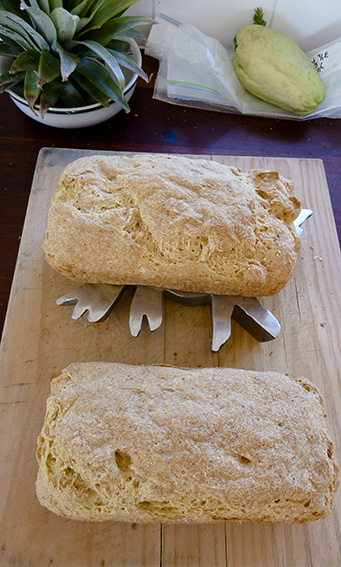
P1050862_GF bread loaves_web

I know that there’s no obvious connection between gluten-free cooking and sustainability, but I think that the more we can take charge of our own health and diet, the more sustainable our lives, and society generally, will be.

We have had to develop our own collection of recipes, and frequently to invent recipes that suited our diets.

This gluten-free corn bread recipe is also egg-free and dairy-free, and if the yeast is replaced with baking powder it can be yeast-free too.

Some people at a workshop on simple living I attended last weekend asked me for this recipe, so I thought maybe I’d start an irregular feature of gluten-free food posts.  This first recipe can be found  here.  Good luck with it.

The two-day workshop was organised by the Citizens of the Lockyer with funding from the Lockyer Valley Regional Council, and run by Rhonda Hetzel from Down to Earth blog.  Rhonda is an inspiring speaker and generated a real buzz in the group, with lots of discussion and sharing of experiences and ideas.

Moringa oleifera – a definite candidate for our food forest

This morning I was reading an update from the Evolution in Motion Team about developments at the Permaculture Demonstration Farm at Phnom Katch Phkar in Battambang Province in western Cambodia and came across a mention of the Moringa tree – also known as the Drumstick Tree, Kelor Tree (Pokok Kelor in Indonesia), and a whole lot of other names.  I’d read about this tree before and been impressed by its many uses, but in thinking about species for our food forest it had completely slipped my mind.

Leaves of Moringa oleifera (source: http://www.burmanbioenergy.com)

Well, one thing led to another, as it does when you start reading something on the internet, and I came across a very useful report on the Moringa tree (scientific name Moringa oleifera) in Australia put out by Biosecurity Queensland in 2010.  The report is actually a weed risk assessment of the species (they find it presents a low risk), but contains the most useful summary of information about the species that I’ve found.  The report is available as a pdf file here.

I’ve taken the liberty of putting their description of the uses of Moringa (they call it the Horseradish Tree) below.  There’s a full citation at the bottom of the quote, but the following is from pages 14 and 15 of Navie and Csurhes (2010).

>>Moringa oleifera has been used for such a wide variety of purposes that it has been described  as a ‘miracle tree’. It is grown in many parts of the world as a ‘vegetable tree’, with the roots,  leaves, flowers and fruit all being used for food (Lu & Olson 2001). The leaves are probably  the most widely used part, being compared to spinach in appearance and nutritional  quality (Papillo 2007). Because  M. oleifera produces leaves during the dry season and  during drought, it is seen as a particularly useful green vegetable in developing countries  when little other food is available (Folkard & Sutherland 1996). Its leaves and pods have  considerable nutritional value, yielding many vitamins and minerals (Soto 2006), and the  leaves can be eaten either cooked or dried (Papillo 2007). The fruit, or ‘drumsticks’, are  cooked like green beans and have a similar flavour to asparagus (HDRA 2002). In India, they  are grown commercially for this purpose and are canned and exported to other parts of the  world (Papillo 2007). The green seeds, which are much like peas, and the surrounding white  material in the fruit can be removed from mature pods and either boiled or fried (Price 2000).

The roots have a pungent taste and are used as a substitute for horseradish, hence the common  name ‘horseradish tree’. However, the root bark has to be scraped off, as it contains two  alkaloids and the toxin moringinine (Price 2000). The flowers and immature fruit are used to  flavour curries (Qaiser 1973) and the gum in the bark is also used to season food (HDRA 2002).

Several parts of the plant are also used in native medicines and folk remedies for the  treatment of ear, eye and bronchial complaints, skin infections, fevers, stomach ulcers,  diarrhoea, syphilis and nervous disorders (Qaiser 1973; Price 2000; EcoPort 2007). For  example, the juice from the leaves is believed to stabilise blood pressure, the flowers are  used to cure inflammations, the pods are used for joint pain, the roots are used to treat  rheumatism, and the bark can be chewed as a digestive (Papillo 2007). This is just a small  selection of the wide range of ailments for which  M. oleifera has been promoted as an  effective medicine (HDRA 2002; Fahey 2005). It has also been widely described as having  antibiotic properties and being a cancer preventative (Fahey 2005). Few rigorous scientific  studies have been conducted to confirm these reports; however, a compound contained  in the flowers and roots, pterygospermin, has been found to have powerful antibiotic and  fungicidal properties (Price 2000).

It is also highly prized as a fodder tree in developing countries, where its leaves are fed to  cattle, sheep, camels, goats, pigs, poultry and donkeys (RBG Kew 1999; HDRA 2002). The  branches are often lopped for fodder, and animals are also known to browse the bark and young  shoots of this species (Qaiser 1973; HDRA 2002).  Moringa oleifera is used as a green manure in  developing countries, where it is said to significantly enrich agricultural land (Price 2000).

The wood is a good fuel for cooking and other purposes (HDRA 2002), and yields a blue dye  (Duke 1983). Woodchippings can also be used to make a good quality paper (HDRA 2002).  The bark can be used as an agent for tanning hides (Duke 1983; Soto 2006) and can also be  beaten into a coarse fibre that can be used to make rope or mats (HDRA 2002). The viscose  resin that is exuded from the bark is used in the textile industry (HDRA 2002).

The crushed leaves are also used as a domestic cleaning agent in developing countries,  being employed to clean cooking utensils and even walls (HDRA 2002).  Moringa oleifera also  provides nectar to honey bees for a long period of the year (ICRAF 2001; HDRA 2002).

Moringa oleifera has also been employed for erosion control in areas where strong winds and  long, dry spells occur simultaneously (ICRAF 2001). Because it grows very quickly it is often  planted as a living fence or windbreak in developing countries (HDRA 2002; Papillo 2007). In  Australia and other parts of the world it is also cultivated as an ornamental or for shade and  shelter (GRIN 2007).

However, the seeds are probably the most useful part of the plant. The oil that is extracted  from them, which is sometimes known as ‘ben oil’, is used for a wide variety of purposes  (Qaiser 1973; Stanley 1982). They also contain a powerful flocculant, which is used for  clarifying turbid water in developing countries (Lu & Olson 2001).

The seeds contain about 35–40% oil. This oil is of excellent quality, similar to olive oil, and is  slow to become rancid (Price 2000). It is used as a fuel for cooking purposes and burnt for light  in developing countries (HDRA 2002). It is also used in perfumes, as a lubricant in watches  and other fine machinery, and for making soap (Qaiser 1973; Stanley 1982; Price 2000).

The press-cake remaining after oil extraction has been shown to retain the active ingredients  for coagulation, making it a marketable commodity as a flocculant. It can be used as a quick  and simple method for cleaning dirty river water in developing countries (HDRA 2002). In  fact,  Moringa oleifera has been compared to alum in its effectiveness at removing suspended  solids from turbid water (Papillo 2007). It can also be used to harvest algae from waste  water, currently an expensive process using centrifuges (Price 2000). The press-cake also  contains high levels of protein and makes and excellent stockfeed or a good fertiliser for use  in agriculture (HDRA 2002; Brockman 2007).

In Australia, and other parts of the world, the greatest potential for this species is currently  thought to be in its cultivation for the production of biofuel. Yields of about 10 metric tonnes  of pods per hectare per year are thought to be achievable for this species (Duke 1983). It has  been suggested that this would equate to between 1000 and 2000 litres of biodiesel per  hectare per annum (Brockman 2007). Very high yields of oil have already been produced in  overseas situations, but it has not yet been widely trialled in Australia (O’Connell et al. 2007).  However, trials were recently initiated in south-western Western Australia and at Carnarvon,  and are also planned for the Pilbarra region (Low a& Booth 2007; SWCC 2007).

It is particularly desirable because it is a very low water-use crop and may be cultivated  on marginal land (i.e. in semi-arid areas, on poor soils and in saline areas) (Soto 2006;  Brockman 2007; SWCC 2007).  Moringa oleifera is being grown commercially on at least  one farm at Bowen in northern Queensland. The vegetable products of this crop are being  supplied to consumers in southern Australia, no doubt largely those from expatriate Asian  communities (Soto 2006). Production of these vegetable products in this region is about 35  tonnes per hectare per year (Soto 2006).

In other parts of the world,  Moringa oleifera is most commonly and quickly cultivated by  cuttings. Ideally, these should be taken from healthy branches containing hard wood in the  rainy season and be between 0.5 and 2 m in length (HDRA 2002). Frequent pruning of the  growth tips of cultivated plants will maintain and increase leaf growth and control the height  of the tree, making harvesting of the leaves and fruit easier (HDRA 2002).<< Source: Navie, S. and S. Csurhes (2010).  Weed Risk Assessment – Horseradish Tree, Moringa oleifera. Biosecurity Queensland, Brisbane. pp.14-15.  The references for the publications cited above are in the report here.

Cut seeds

Seeds of Moringa oleifera (photo: Aravind Sivaraj, Creative Commons Share Alike)

Some Useful Links

Wikipedia entry:  http://en.wikipedia.org/wiki/Moringa_oleifera

Gallery of photos (Indonesian):  http://ms.wikipedia.org/wiki/Pokok_Kelor

Gardening Australia Factsheet:  http://www.abc.net.au/gardening/stories/s1345822.htm

Growing and cooking tips:  http://www.daleysfruit.com.au/Herbs/horseradish.htm

Additional information:  http://www.newcrops.uq.edu.au/newslett/ncnl9192.htm

A really good slideshow:  http://www.treesforlife.org/sites/default/files/documents/Moringa%20Presentation%20%28General%29%20screen.pdf

Overview facts:  http://www.treesforlife.org/our-work/our-initiatives/moringa
DIY Composting toilet with worms

We decided from the outset that we were going to have a composting toilet.  There were a number of reasons for this, principal among which were that we didn’t want to waste an extremely valuable resource (humanure), and that we don’t have sufficient water to operate a flushing toilet.

The first model that we built, and which we used for more than ten years, was based on one of the 200L barrels used for shipping olives.  These barrels are usually available from places that recycle poly barrels.  The only reason that we stopped using this model was that it gets to be a bit of a chore to move a 200L barrel full of poop when the time comes to change it over.  It was taking me about half a day to undo the connections, replace the full barrel with an empty one, and re-connect it – and I always seemed to put off the change-over until it became urgent (i.e. a very full barrel) and that always seemed to coincide with another urgent priority.  Of course you could always install two 200L barrels side by side (both plumbed to drains and the air vent) and simply move the seat from one to the other, instead of changing over the barrels.  I’ll describe the new system which uses a 60L barrel in another post.

The basic principles of the design we adopted are: a) air is drawn down through “the mass” in order to keep up a supply of oxygen to the composting process and to remove smells through the bottom of the barrel and up to a high vent; b) a sufficient mass builds up to start and maintain an efficient composting process; and c) worms can be introduced to the mass while the toilet is in operation to promote the production of a rich compost loam.

A rich loamy compost with lots of happy worms

The final product – a rich loamy compost with lots of happy worms (the bits of straw don’t indicate that it is not fully composted – the straw was a top layer to help keep the mass from drying out)

In order to reduce the amount of text required, I’ll use photos to illustrate the construction of the unit.  Here’s a view of most of the components associated with the barrel.

Internal fittings and outside connections

Internal fittings and outside connections

In the background is the barrel with, on the left, a connection for extracting air from under the mass, and on the right, a drain for liquids.  The connections are made up from standard plumbing fittings.  In the left foreground is the base which supports the mass, made up of a circular section of 25mm galvanised mesh resting on some sections of plastic pipe – in the centre is some 225mm stormwater pipe (got it cheap as an offcut at the local irrigation supplies place), and some offcuts of 90mm stormwater downpipe (these dimensions aren’t critical, your pipes can be larger or smaller).  These are bolted together with galvanised 6mm bolts that have lasted for ten years, though they are now unrecognizable under a layer of rust.  You can also use reinforcing mesh supports  instead of the pipe sections as in this post on the Milkwood Permaculture site (though this gives a smaller space under the mass). This unit goes into the bottom of the barrel (after the drainage fittings are connected).

In the right foreground is the unit for drawing air down through the mass.  The vertical components are 50mm pipes with many holes drilled in them to facilitate air exchange with the mass (you could use polypipe for this – it’s more flexible and cheaper).  These are bolted onto a short length of 225mm stormwater pipe.  Note that the vertical pipes extend down past the 225mm pipe – the distance they extend downward is the same as the height of the stormwater downpipe lengths under the galvanised mesh on the left. These “legs” go through holes cut in the mesh (visible in the photo), so that the 225mm pipe section sits on top of the mesh.

The photo below shows the two units sitting in the barrel.  Short lengths of polypipe have been inserted into the tops of the vertical pipes to extend the aeration height.  The top ends of these extensions will be pulled to the sides of the barrel just under the top lip and fastened with wire loops through holes in the barrel.  If they aren’t pulled to the sides they tend to snag toilet paper as it is dropped into the barrel.

All components in barrel

All components in barrel

When the barrel is in place and ready to be used a layer of newspaper is placed over the mesh and then a thick layer of straw (we use barley straw) is put on top of that.

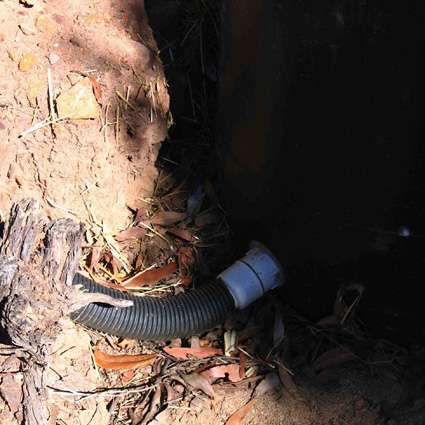
The photo below shows the detail of the air outlet.

Air outlet detail

Air outlet detail

There are four parts to this connection.  A male/male connection is screwed into a hole cut in the side of the barrel with an appropriately sized hole saw (keep it close to the bottom, but not so low that it will be lower than the liquid drain) so that the thread protrudes inside the barrel.  A connector (i.e. with internal thread) is screwed onto this inside the barrel so as to clamp the fitting onto the wall of the barrel.  Before tightening this I’ve put some bathroom silicone into the space around the connector on the inside and outside of the barrel to make a good seal.  Reaching to the bottom of the barrel will almost certainly require getting your head and at least one shoulder into the barrel – not easy to do.  I once rolled some distance down the hill with my head and part of my upper body inside the barrel!  The fitting on the outside end of this connection has various names.  My local plumbing supply calls them “dress flanges”.  Anything will do that will fit into the flexible pipe shown in the photo below.

I won’t show the details of the liquid drain.  It’s the same principle as the air outlet, but with appropriately sized fittings, and as close to the bottom of the barrel as you can place it.  Just make sure that the connection between the pipe coming out of the barrel and the drain to take the liquid away is easy to connect and disconnect. After a lot of frustration I settled on camlock fittings (you’ll have to ask your local hardware or plumbing supply place what these are as I don’t currently have a photo of one – there are some details on these fittings here).

Air outlet with flex pipe

Air outlet with flex pipe

The flex pipe can be difficult to source in our area.  Most places sell this pipe with many slots in it for use as a greywater distribution pipe but we need it without any holes.  In the end I got mine from an agricultural machinery parts supply place that sells it as a spare part for seeding machinery.

This pipe is connected to a vertical vent pipe (another length of 90mm stormwater downpipe).

Bottom of vent pipe

Bottom of vent pipe

The fittings here should be pretty obvious.  The reason for the Y-junction at the bottom of the vent pipe is to allow condensation or rainwater to be drained out (in practice it seems to collect here and then evaporate without needing any intervention).

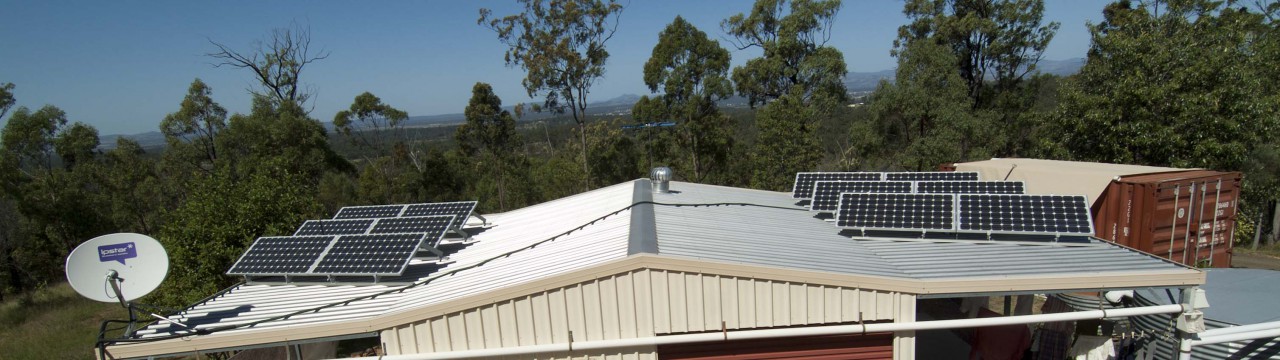
At the top of the vent pipe you’ll need a sewer vent whirlybird. They’re available from plumbing supply places.  You can get one to fit onto 90mm or 100mm stormwater pipe, but I added a short length of wider pipe at the top and got a whirlybird that would fit onto that.  The top of the vent pipe (or all of it) can be painted black so that the sun heats the air in the pipe and starts it moving upward, assisting the whirlybird to draw air down through the mass in the toilet.  The wider pipe at the top just provides a larger volume of air to be heated – I’m not sure whether it makes any difference or not.

Whirlybird on top of a section of wider pipe

Whirlybird on top of a section of wider pipe

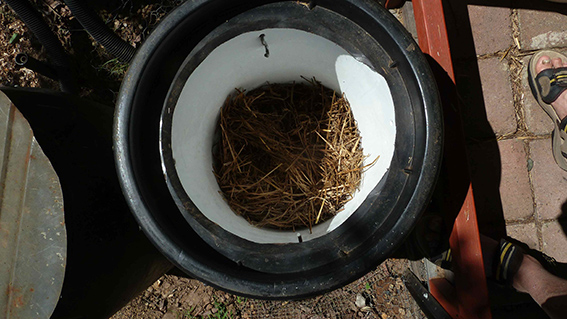
That’s about it, apart from putting a seat on top of the barrel.  I used the screw-down flange that holds the top of the barrel in place (photo below) and just trimmed a bit of the edge of it at the front to allow well endowed males to use the toilet without incurring any risk.  Ignore the white insert in the barrel, this is part of a trial of  new approach that doesn’t allow for composting in the barrel but removes the need to wrestle with a full 200L barrel when full.  I’ll describe it in another post.

Top on barrel

Top on barrel

The seat base in the photo below is made from two layers of marine ply.  The top layer is large enough to sit over the top of the barrel and to carry a standard toilet seat.  The lower layer (not visible here) has the same size hole as the upper layer and is glued and screwed to this.  It is just large enough to fit into the screw-on top of the barrel without too much free play.  In this way the seat stays in place without moving around when you sit on it, but can be easily lifted off the top of the barrel.  This doesn’t have to be marine ply, but since it was going to be out in the weather for years I thought it was worth the extra cost.  You can see the toilet seat to the left of the photo and in the lower photo – it came from a recycled timber yard.

Seat base

Seat base

Seat_webHere’s a shot of the two barrels in place.  The “resting” barrel on the left finishes composting while the barrel on the right fills (you can’t really see it because it’s covered with shade cloth – the photo was taken in summer and the shade cloth is needed then to keep the barrel from getting too hot for the worms).

Two barrels in place

Two barrels in place

Once the barrel is about one-third full we add some compost worms from one of our worm farms to it and cover them with a layer of damp soil.  At first we doubted that they would tolerate this environment, but they take to it readily and by the time the barrel is full it has a good population of worms and a lot of the mass has already been broken down by them.

With just the two of us using it the barrel takes six to nine months to fill.  In fact in the later stages the mass is reducing in volume, as a result of the composting process and the actions of the worms, just about as fast as we are adding volume to it.

There aren’t any special precautions to take with this type of toilet, apart from making sure the mass is damp enough to keep the composting going – we keep a spray bottle near the toilet, but seldom need to use it.  People who are taking antibiotics should refrain from using the toilet in case the antibiotic residues affect the composting process, and no non-compostable material (e.g. cigarette butts, tampons) should be put into the barrel.

When the full barrel is first moved to the resting position we put a layer of kitchen scraps on top and cover it with damp newspapers.  This encourages the compost worms that are already in the barrel to come to the top and start work on the top layer. If the worm population isn’t obvious in the top layer within a couple of weeks we add more compost worms.

The resting barrel has a liquid drain and a flexible hose connected to it, but the latter is mostly to keep critters from getting into the bottom section of the barrel.  I always intended to connect this to the vent pipe but never got around to it, and in the end it didn’t seem to matter.  In fact increasing the air flow might have dried out the mass too much.  Keeping the top of the mass damp is one of the few management measures that the resting bin requires.  We generally cover it with a thick layer of wet newspapers or hessian, and try to remember to add water to this occasionally.

You can wait for all of the mass to be composted and then empty the barrel just before changing it over with a new full barrel, but we have found that the worms population will be larger and work more effectively if we regularly take off the top layer of composted worm castings.

I’m happy to answer any questions about this system or to give advice on construction.

Leucaena leucocephala – a tale of ongoing stupidity – or is it dishonesty?

What, you may ask, is Leucaena leucocephala?  And why a blog about it in relation to sustainability in the Lockyer Valley?

Well, first let me admit that this is a bit of a “vent”, as they say.  It is also a reminder that misleading and stupid advice by government agencies is not something that was invented recently.

In the early ’80s I came back from the Northern Marianas Islands, where I’d been working on archaeological surveys to trace the history of the Chamorro people who were suspected of having been on the islands for up to 2000 years.  The Marianas are a group of about 15 islands in the northwest Pacific Ocean, southeast of Japan and about half way between Hawaii and the Philippines.  Only three of the islands are permanently inhabited: Saipan, Tinian and Rota.

Up until the Second World War the Marianas were under Japanese control as part of the South Pacific Mandate granted by the League of Nations.  They’re now a Commonwealth in Political Association with the United States of America, though why anyone would want such an association is beyond me.

What’s this got to do with Leucaena or sustainability?  Well … read on.  The islands of the Marianas were part of the chain of island “stepping stones” utilised by the US on its path to the eventual conquest of the Japanese mainland.  Some of the most violent battles of the World War II were fought there.  Saipan and Tinian were bombed, shelled and fought over until they were, across large areas, bare cratered earth.  The battles were so fierce that when I was there you could pick up about ten bits of shrapnel or actual bullets per square metre on parts of the bare limestone on the coast of Tinian.  There were larger bits of bomb casing sticking out of some of the few remaining trees, and in places bits of war debris, including sometimes aircraft parts, were mixed in with 2000 year old archaeological layers.

When the war finished the nearly denuded islands of Saipan and Tinian were in danger of literally having most of their topsoil washed into the sea in the wet season.  The surviving Chamorro people were at risk of losing the agriculture which was the basis if their existence.  Rota was spared invasion and destruction because it had no strategic value, lacking major Japanese fortifications or areas where airstrips could be built.  The troops stationed there were cut-off and left to starve until they surrendered, so the island was spared the destruction visited on Saipan and Tinian.

So what to do?  The quick, and as it turned out “dirty”, solution was to bomb the islands with huge quantities of the seeds of Leucaena leucocephala, a fast-growing member of the Mimosa family (like our Acacias) that originated in Central America.  They got the seeds from the Philippines where it had become naturalised and was widely distributed.  Leucaena is very well adapted to the tropics and sub-tropics.  It grows in dense stands as a small (up to six metres or so), whip-stick tree which produces seeds prolifically.  The stands are often so dense that nothing else can grow under them.

Leucaena grows in dense stands

Prolific seed production by Leucaena

Having done field work on Rota, Tinian and Saipan I had seen both the original lush, tropical vegetation of Rota, which luckily had not needed post-war soil stabilisation and is rich in species and wildlife, and the widespread, mono-species stands of Leucaena across Tinian and Saipan with very little wildlife.  The farmers on those islands spent a lot of their time in controlling the Leucaena regrowth, often to the point that agriculture became uneconomic, and in the towns it was even a pest in the lawns, growing faster than the grass.  Clearly the species was a mega-weed.

Arriving back in Australia, one of the first things I read in the newspaper was about how the Queensland Department of Primary Industries was promoting the planting of Leucaena as a cattle fodder, ideally adapted to tropical and sub-tropical areas with poor soils and monsoonal rainfall patterns.  Unbelievable!

Very concerned, I phoned the DPI to find out more and to share my observations of what Leucaena can do to the environment.  The agronomist I spoke to heard me out, then said that this might be the case in places where the seed was distributed willy nilly across the landscape, but I had to understand that what DPI was advocating for Queensland was “controlled” use of Leucaena in pasture – where it would never grow to seed-bearing stage because it would be grazed off before that.  Seriously.  Like the cattle were going to be in the paddocks the whole time, never turning their backs in case a plant set seed?

I was under the impression that Leucaena was being introduced into Australia at that time (remember this was before the internet and Google, and I’m not an agronomist), and that perhaps they really didn’t believe that it could become a pest.  But according to the UN Food and Agriculture Organisation (FAO) Leucaena had been introduced into Australia in the late 19th century and it was naturalised in parts of northern Australia by 1920.  So there should have been plenty of evidence that it was a very potent pest species.

Despite this, during the 1970s and early 1980s, Leucaena was being touted around the world as the ‘miracle tree’ because of its worldwide success as a long-lived and highly nutritious forage tree according to FAO, and the Queensland DPI were right there on the bandwagon and not about to listen to any contrary views.

Fast forward to the present:  According to the Biosecurity Queensland Factsheet on Leucaena it is “A very troublesome weed of waterways and roadsides in tropical and sub-tropical regions. It is also found in open woodlands, gardens, parks, waste areas, disturbed sites and on coastal foreshores and offshore islands.” and is “… widely naturalised and relatively common in the coastal and sub-coastal districts of northern and eastern Australia. It is most common in south-eastern, central and northern Queensland and in the northern parts of the Northern Territory. Also present in the coastal districts of northern and central New South Wales, in the coastal districts of Western Australia, on Christmas Island and on the Cocos Islands”.

So we come to the Lockyer Valley.  Try keeping a careful watch on the roadsides in the Valley, as well as between Toowoomba and Brisbane, including along Mt Crosby Road if you take that route into Brisbane – there’s no doubt that Leucaena is well and truly established in Southeast Queensland.

In fact, the Queensland Department of Agriculture, Forestry and Fisheries (DAFF) is now warning that “Unless heavily grazed or otherwise controlled, it is able to rapidly spread to adjacent areas”.

And this wasn’t bleeding obvious in the early 1980s to anyone who wanted to take more than a narrow, rose-coloured view of the species?  Give me a break.  Was I the only person who had noticed that it was a very noxious weed?

The cat, as they say, is now out of the bag – though in this case, given the number of other highly environmentally impacting species that have been introduced or promoted by government agencies across Australia, it might be more appropriate to say that Pandora’s Box is well and truly open.

Has anything changed?  Well, Leucaena is now well recognised as a problem here in Australia.  But is it really?

The Australian Government, through the Australian Centre for International Agricultural Research (ACIAR, which funds and advises on a lot of our foreign aid policy and projects) is running a website called Tropical Forages: An interactive selection tool, in partnership with the CSIRO, the Queensland Government and a number of other organisations.  This website advises that Leucaena “Will not normally spread under grazing as cattle relish young seedlings.  Some thickening up of grazed stands has occurred in eastern Australia where leucaena is left ungrazed during the growing season for provision of autumn feed.”  Is my 1980s agronomist friend now working in Australia’s international aid industry?

This ongoing level of ignorance and stupidity is beyond belief.  I hope to see the day when there will be major legal class actions in Australia against government agencies for the massive damage done to our environment and economy as a result of the lack of proper consideration of plant introductions.

Ghost Snake

I was watering “the grove” the other day – an area with a range of canopy layers between the outdoor toilet and the workshop – when a slithery movement on a grapefruit branch beside my head caught my eye and got my pulse racing.  Seen briefly out of the corner of my eye it was definitely “snakey”.

Well it was “snakey” – the tail of a snake, moving on the branch.  But this was no ordinary snake.  It was pale and translucent and stretched back into the gloom under the dense canopy.

Definitely no ordinary snake. This was a ghost snake.

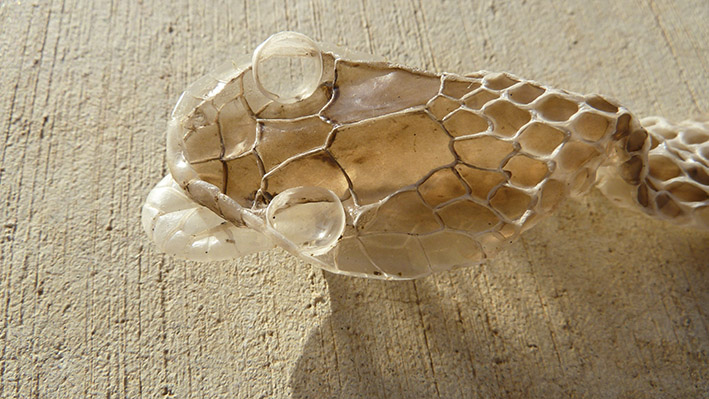
P1050523_head_webThe complete skin of a Green Tree Snake (Dendrelaphis punctulata)  was stretched along the branch, then up to another branch and along that, with the head at the far end.  As the light breeze moved the branches the tail moved backward and forward on the branch near me, looking at first glance as if it was alive.

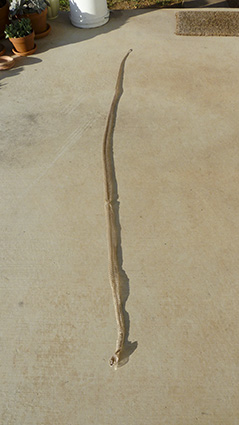
It’s a pity I didn’t think to get the camera at the time, but it was getting dark and I still had chores to do.  The next morning we gently gathered the skin from the branches and laid it out on the porch – all 1.75 metres of it (they grow to two metres).  Apart from a small tear in the middle it was undamaged, leaving us wondering how on earth the snake got out of the old skin.

P1050522_full skin_web

This is the longest Green Tree Snake we’ve seen and we’re pretty sure this one is an old friend that has been around here for ten years or more, first making our acquaintance when it took to sunning itself on the kitchen sink on winter mornings.

We see it regularly, most recently when it decided that the top of the “resting” composting toilet bin was a lovely place to soak up some warmth from the composting process going on in the bin.  When we got too close it relocated into the top of the bin – even warmer, and no pesky humans – and no, it doesn’t smell (I’ll do a series of posts on our composting strategies in the near future).

This snake frequently climbs up the toilet vent pipe to the “whirlybird” ventilator on top and then through it and down into the pipe to look for Green Tree Frogs inside.  Usually it’s only the grandfather Tree Frog that has been around nearly as long as this snake, and the snake has no chance of getting its mouth around that massive frog.  That doesn’t stop it trying though, and we are alerted by the frog’s distress calls as the snake struggles to get its jaws open around the frog’s head.  The end result is that the frog gets scratches on its back from the snake’s fangs and the snake is moved on by us.

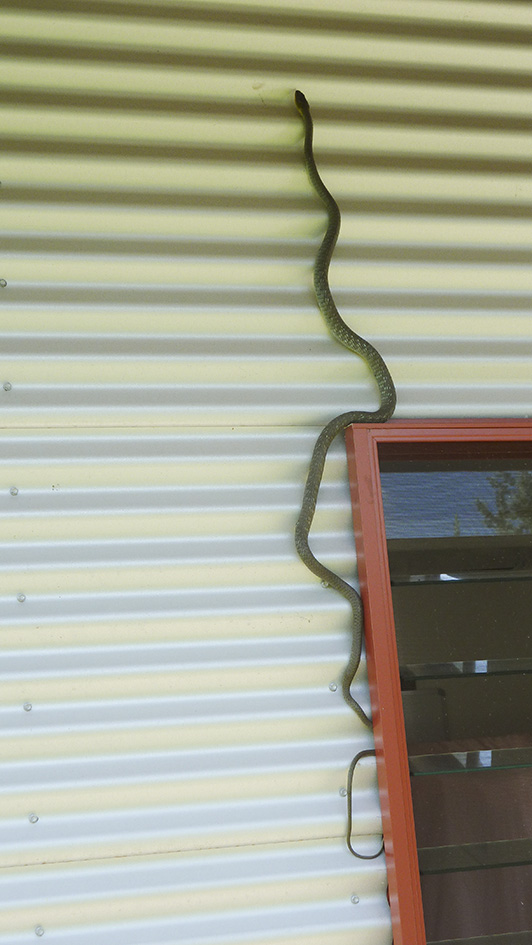
This is probably the same snake, trying to climb the wall of the house two years ago (you can see the post about that here).

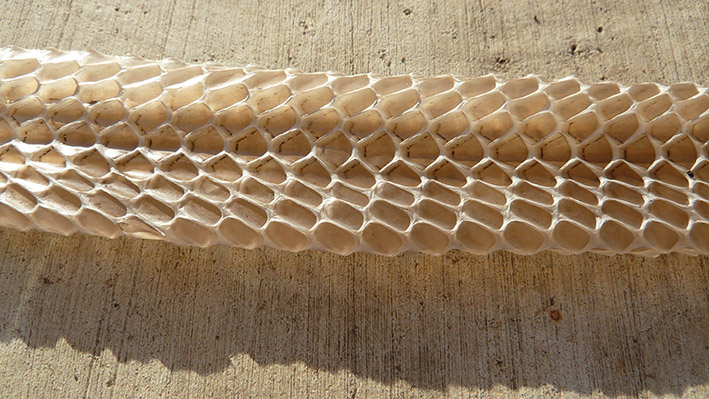
Back to the skin; its a fascinating thing of great beauty.  The scale pattern varies along the body, and from the top to the underside.

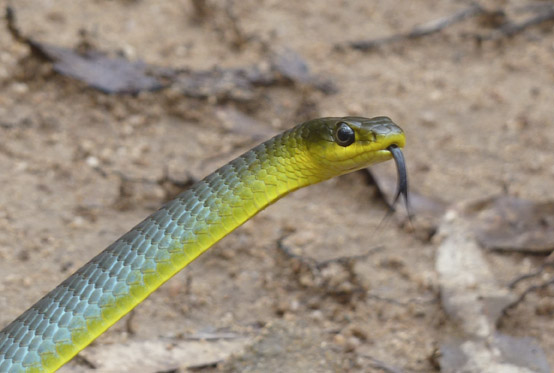
P1050525_scale pattern1_web P1050526_scale pattern2_webAnd here’s what the real living Green Tree Snake looks like.  This isn’t our old friend but one that I saw down near the creek a year or so back.

P1020209_crop_head_webThese snakes are harmless, and generally not at all aggressive.  The blue colour between the scales is a threat display and only appears when the snake expands its body make itself look larger and to expose the blue skin between the scales.  This one raised its head to get a better look at me (I was crouching beside it to get a better angle to photograph it) and trying to “smell” me with its tongue.

You can find more about this species on the Queensland Museum website and Wikipedia, and quite a bit about its ecology at Critters of Calamvale Creek.