An unexpected bushfire

The weather last Friday morning was quite unusual.  In fact I was commenting on it at the time in a blog post I was writing over at the Helidon Hills Smokespotters web site.  The general feel of the morning said “Fire Danger”, even though the actual Forest Fire Danger Rating was only High (we have six levels of Fire Danger Rating – Low/Moderate, High, Very High, Severe, Extreme, and Catastrophic).  Over the space of half an hour the temperature had climbed a few degrees C, while the Relative Humidity had dropped about 10%.  This was largely caused by strong dry winds coming in from the north.  On the Smokespotters blog I’d finished the post with a plea to the Smokespotters group members not to be lulled into a false sense of security just because 5,000ha in the southern Helidon Hills had been burned out in a fire in late October – there was still about 30,000ha of bushland unburned.

I haven’t posted anything on that fire yet.  Dealing with the fire took up a whole week, then putting everything back in order here and getting our lives back on track (not to mention recovering from the exhaustion from the previous week) took another week.  But I will post something about it  soon.

Having finished the Smokespotters blog post I took a break for lunch.  Our kitchen bench is by a window that faces south, looking across the western half of our forest down to Lilydale Creek, the Lockyer National Park and the back parts of the blocks of two neighbours and up to a distant ridge.  While we were making lunch there was no sign of smoke, but 15-20 minutes later when we had eaten and came back to clear the bench the view that greeted us was of a dense area of boiling smoke in the vicinity of the Creek.
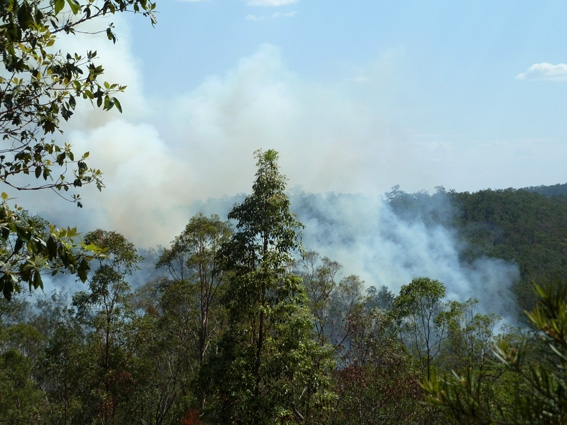
A “zoomed” photo of the fire about 30 minutes after we first saw it, and less than an hour after it started. It now has two clear “fronts”, one driven by the wind and burning strongly in the distance and the other, closer, burning into the rocky bed of Lilydale Creek

My immediate impression was that someone must have lit this.  There is nothing there other than bush, much of it with dense Lantana, and a dam with a water pump at the back of one neighbouring property.  I jumped into my fire-fighting gear (thick canvas jeans, a heavy cotton shirt, and a thick cotton hat) while Hanneke phoned the neighbours whose house was nearest to the fire to alert them and then emergency services on 000 and the local Rural Fire Brigade.  The neighbours were already on their way to investigate.  Like us, they had seen smoke where ten minutes before there had been nothing.  Thinking that they might need help, and also that I might find the ignition point, if not someone who had lit the fire, I grabbed my camera and a Rakhoe (a very effective fire-fighting tool, long-handled, with a wide hoe blade on one side and a coarse rake on the other) and headed toward the fire.

Luckily for me it had burned down into the rocky bed of Lilydale Creek and I was able to cross into the burned area where the fire-front had gone out on against the creek bank.  Navigating largely by the locations of the fire fronts (about 80m on each side) and the slope of the land I came to the neighbour’s fence, luckily at a point where a small section of the fire had burned out against their track, allowing me to cross into the unburned area.

I spent the next couple of hours helping to put out spot fires and checking for embers in and around the house and workshop.  The wind had picked up even more, and there were “floaters” of burning bark and leaves dropping fifty metres or more from the fire front.  We were lucky that they had done a lot of work preparing their property for the fire season, with a number of tracks acting as containment lines, and wide areas of short, mowed grass around the house.  Even so, with the flames periodically blown horizontal by the wind, the fire was easily jumping tracks three metres wide.

In the 38 degreeC heat, low humidity and dry winds patches of grass and leaves which had been extinguished with water were re-igniting within 5-10 minutes.
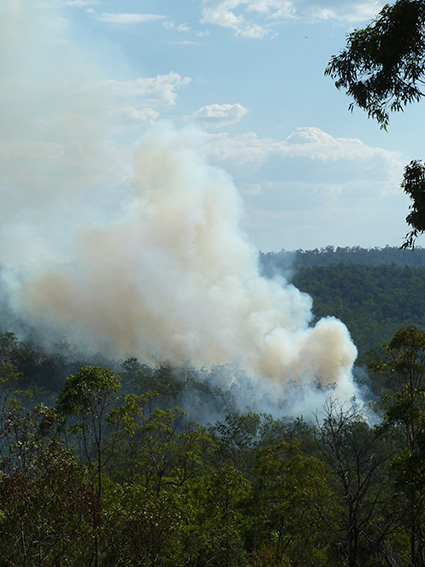
A small section of the fire front about two hours after it started. This was directly up-wind of the neighbours’ house, but by this time there was a fire crew on hand.

No fire trucks were able to reach us for around an hour because it was too dangerous for them to drive through the flame and smoke along the narrow access track. Two volunteer fire-fighters did make it through on foot to check that we were alright.  It must have been a hellish trip through the dense smoke and wind-driven flames.

Two other houses were in the line of the fire after it swept past us, but being closer to the road they were more easily accessible by emergency crews and no damage was done to them.  By the time I was able to get a lift home with one of the neighbours it was late in the afternoon.  On the way, we discovered that the fire had burned about 400 metres against the wind to our access track, and was being monitored by the crew of a fire truck so as to prevent it from getting across into a large area which we had kept the October fire out of.

Arriving back home I discovered that the fire was also making its way up into some areas in the National Park which I hadn’t realised had escaped the October fire.

4.45pm – the fire has burned into the National Park to the south of our place

As the fire near the creek-crossing burned along the edge of our track it set alight the bark of a couple of very tall Angophora trees.  These are a distant relative of the eucalypts, and this particular species has a thick, cracking and highly flammable bark that can burn for hours.  The fire raced up these, reaching a height of 25 metres or more in minutes.  Then, for hours burning flakes of bark fell from high in the canopy, breaking up as they fell and drifting with the wind with the potential to land across the track in unburned areas.  By this time there were eight or ten fire crews scattered around the area, so we asked one of them to come in and hose down the tree.  Of course, even with the pressure from their pumps the jets from their hoses could not reach more than half way up the trees, but at least this reduced the risk quite a lot.  In addition they covered the potential drop zone on the other side of the track in foam to reduce the chances of ignition there.

Burning bark of an Angophora on the edge of our track – this shows only abut two-thirds or less of the height to which it was burning.

We arranged for one of the fire crews who were going to stay in the area mopping-up to keep an eye on this  during the night and we drove down to check it ourselves every couple of hours until midnight.

In the end it seems most likely that the fire had started somewhere along Lilydale Creek, from a burnt log or dead tree that had been quietly smouldering since the October fire nearly three weeks before, and had flared up in the high temperatures, low humidity and strong winds that day.  The same thing had happened a couple of months before in another part of the Hills, and in both cases there had been more than 60mm of rain since the earlier fire.  In fact, parts of this fire were still smoking 36 hours later, after more than 100mm of rain had fallen in a four-hour period.
Pumpkin greens

Part of our pumpkin management is to pinch off the growing tips once a runner has reached a certain length.  This forces them to put out additional branches, providing  more sites for flower production.  We then use the tips as a vegetable, either steamed or stir-fried.

Fresh pumpkin growing tip

However every year we have self-sown pumpkins coming up in garden beds or anywhere else that we use our compost.

“Rogue” pumpkin seedlings

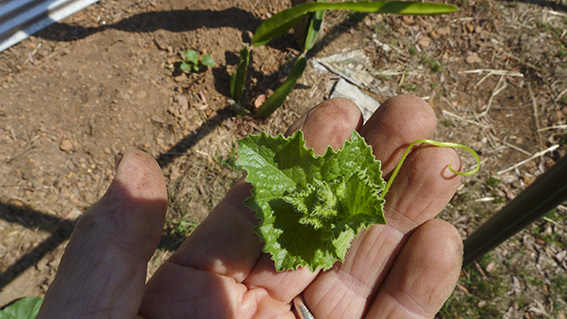
Until now we have just weeded these out, though sometimes we move them to where they can usefully grow or pot them up to give to friends.  This morning I was doing something else in the garden and my eye was caught by the sight of a fresh, bright green new pumpkin leaf.

New pumpkin leaf

Curious, I picked it and ate it.  Delicious!  Fresh, sweet, full of flavour.  Wow.  I would not have suspected that a leaf that size would be tender and sweet.  We now have a new vegetable, and wherever possible the volunteer seedlings will be left in place for a while so we can harvest the young leaves.

We have a new variation on pinching the tips off the pumpkin vines to promote flowering.  Meg McGowan suggested restricting each vine to one square metre – she finds it promotes much more productivity.  We are trying it this pumpkin season.

Not sure whether climate change is really happening in Australia?

If you feel uncertain whether climate change is happening in Australia (as distinct from just climatic variability) then the ABC’s Catalyst program has just released a report that you should see.  The climatic data is set out in detail, using 100 years of Australian weather records in most cases but relying on  high quality data sets identified by the Bureau of Meteorology.


The title of the report is Taking Australia’s Temperature, but in fact it looks at a range of parameters, not just temperature:

  • (temperature: maxima and minima, changes to annual temperature cycles;
  • precipitation – rainfall and snowfall: regional increases and decreases;
  • sea level: changes since the 19th Century (1841 in Tasmania, 1897 in southwestern Western Australia); and
  • sea temperatures: changes and specific warming events.

For an evidence-rich, bias free (in my opinion at least), easy to understand, Australia-relevant presentation of the data you can’t go past this report.

This is a blog about living sustainably in the Lockyer Valley Region, so why am I posting on climate change in Australia?  Because being able to live sustainably does not depend on only local factors.  Everything we do happens in, and is influenced by, a wider context.  If we are not aware of and up-to-date with that wider context there is a good chance that it is going to frustrate our efforts to live sustainably.  That’s one reason.  A better reason is that climate change is very difficult to discern at local scales.  Relying only on what we observe in the Lockyer to make up our minds on climate change is not reliable.  Put simply, you can’t arrive at a valid conclusion if you rely only on local observations – or on data over very short time scales.

Lockyer up with the best in Australia on level of solar PV power installations

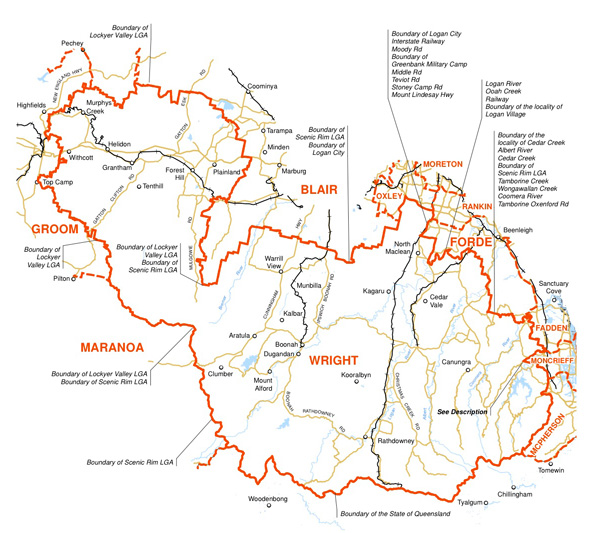
A new report by Sunwiz has revealed that the Federal electorate of Wright (containing all or most of the Lockyer Valley Region) has the highest number of domestic solar power installations (solar PV plus solar hot water) of any Federal electorate in the country.  SunWiz has performed an analysis of Clean Energy Regulator data as of 1 October 2012 to identify the top solar electorates.

The electorate of Wright has a total of 26,417 installations, made up of 16,420 solar PV and 9,998 solar hot water systems.

Of course, raw figures on the number of installations in an electorate are not particularly meaningful, given that there is some variation in household numbers per electorate (though electorates generally have populations of around 150,000).  The percentage of households with solar installations (known as “penetration”) is a much more useful number, both for comparison and for revealing the level of uptake of renewable energy at the household level.

Wright figured 6th in level of penetration of solar PV (out of 150 electorates) with a penetration level of 20% – one in five dwellings (the national maximum was 23%) and 15th in solar hot water with 12% – one in eight (national maximum 21%).

The electorate of Wright encompass an area stretching from the western Gold Coast through the rural areas left out of the more urban electorates between Logan City and the NSW border, before curving northwest to include the Lockyer Valley Region west of Ipswich. As well as the western edge of the city of Gold Coast, Wright includes the towns of Beaudesert, Jimboomba, Boonah, Gatton, Laidley, Hatton and Helidon (ABC 2010 election web site).

Given its location, Wright may not be what you would think of as a particularly Green electorate, and it isn’t, though there was a significant swing to the Greens in the 2010 election.  Conservative parties (LNP, ALP and Family First) – yes, I’ve identified the ALP as a conservative party – got over 80% of the vote.  The voting pattern in that election was:

How does the Lockyer Valley Region fit into this solar power picture?

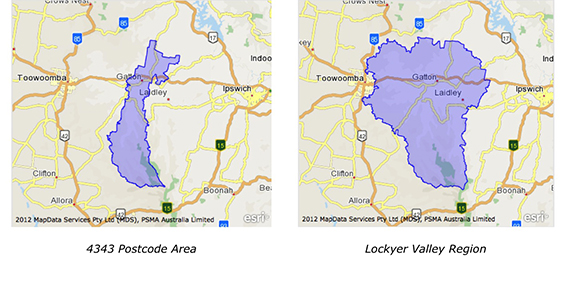
Census records for the Lockyer Valley Region do not include solar PV installation data.  However it doesn’t seem unreasonable to take the 4343 postcode area as a proxy for the Region.  As can be seen from the map below, it clearly takes up a significant proportion of the Region.

The Sunwiz analysis is based on postcode data (their methodology is explained at the foot of the web page reporting their findings), but understandably in a national report they do not provide the separate postcode data.

The Clean Energy Regulator’s web site includes detailed data on “small generation units” (= solar panel installations) for each postcode area.  In the 4343 area 677 units had been installed as of October 2012, with a total generating capacity of 2,012 kW.  The total is likely to be higher than this because the data is based on registration for Renewable Energy Certificates, which can be done up to 12 months after installation.

There were 3,610 occupied private dwellings in the 4343 postcode area at the time of the 2011 Census.  This suggests a “penetration” of solar PV power of 18.7%.  However, solar power is seldom installed on apartments, flats, and similar, and is much more likely to be found on private houses, of which the Census recorded 3,190, leading to a penetration level of 21.2%.  It seems fair enough to say that the solar PV penetration level in the 4343 postcode area is between 18.7% and 21.2%, and that the level for the Lockyer Valley Region is probably in this range.  (There were 11,900 private dwellings, and 11,200 occupied private houses recorded in the Region in the Census, so the 4343 figures represent 30.3% and 28.9% respectively of these totals. Seems like a pretty good sample).

What this means is that the penetration level for solar PV power installation in the Lockyer Valley Region (around 18.7-21.2%) is clearly of the same order as that for the larger Wright electorate (20%) and close to the highest penetration rate in the country (23%).

The Soup Kitchen is open again

Following the bushfire (more on this later) that burned out about 80% of our bush 13 days ago, there is very little food for the our wallaby population.  As in the 2009 fire, we have set up a “soup kitchen” to tide them over until enough grass comes through to feed them.

The menu is simple: water (we always put out water pots for them because it is very dry here on the sandstone ridge), pony pellets, and racehorse-grade lucerne (alfalfa).  They much prefer the pony pellets over the lucerne, which is OK with us as the pony pellets cost $10 per bag, while the top-grade lucerne is $10 per bale wholesale and would not last as long as a bag of pony pellets if they decided to eat it.  Any leftover lucerne will make good mulch for the garden.

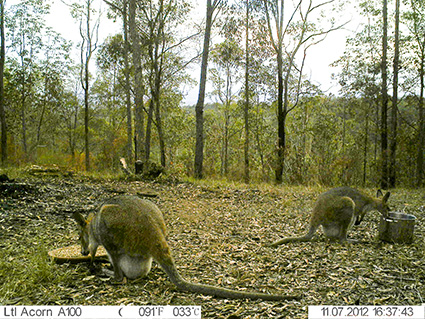
It’s hard to know how many wallabies we are feeding. They come and go for much of the day and all night, but there are four feeding stations, and there are sometimes 3-4 animals at each at the same time.  Probably nearly half of the females coming to the food are carrying well advanced joeys in their pouches.

Female Red-necked Wallabies at a feeding station

We set up a couple of camera traps (trail cameras) to check whether we are also feeding pigs and deer, but so far there aren’t any signs of them at our feeding stations.  We can see by their tracks that they are moving through our property from the National Park (also burned out) to get to the stone-fruit orchard next door.  The windfall fruit lying on the ground there are a favourite of the pigs, and the succulent leaves on the trees  attract the deer.  Our pony pellets and lucerne probably can’t compete with either of those.

One thing we did discover was that at a certain age the young male Red-necked Wallabies get around in a group.

A “gang” of young males takes over a feeding station.

In addition to checking for feral animals, the camera records provide us with great entertainment in the form of interactions between the wallabies, confrontations they have with possums, and views of joeys (baby wallabies) hanging their heads/tails/legs out of the pouch.

Wallaby vs Possum stand-off

Even the possums get possessive about the feeding stations sometimes.

Mother Brush-tailed Possum defends the feeder (and her young one) from an interloper

Some surprising things get into the camera trap images.  The data on the bottom right of the photo shows date (ddmmyyy) and time.

A bat zooms over one of the feeding stations – possibly a Flying Fox (one of the Megachiroptera).  Its image is distorted by the relatively slow shutter speed.

There is “green pick” coming up already in the burnt areas, and some of the wallabies are starting to feed there, though it would be hard work for a mother with a large joey in the pouch or “at-heel” to get enough of this to sustain herself and the joey.  Some of the females will have a joey at-heel but still getting milk from the mother, another in the pouch, firmly attached to a nipple, and another in the early stages of gestation, and their nutrient needs will be even greater.

We’ve had 69mm of rain since the fire went through, so the grass should come back relatively quickly.  We plan on starting to gradually reduce the food we supply in the next couple of weeks.

One more reason we love living here

This is the morning view to the west from our access track alongside the house a couple of weeks ago.  The sun was coming through a break in a huge fog bank to the east.

The msit is lying in the valley of Lilydale Creek and its tributaries.  Our western boundary runs along the top of the first ridge (with the light on it).  Beyond that is all Lockyer National Park – around 9,000 hectares of it, and no fence between us and the Park.  In that direction there isn’t another house for maybe 10 km.  We heard a Koala calling from somewhere down in the first gully (below the dark foreground trees) a couple of nights ago.

For those who have seen the Helidon Hills Smokespotters web site, the smoke in the page title photo on that site was from a large bushfire that had just crossed into this catchment at the top right of this photo.

Birds in September

Twenty-nine species of birds this month.  As usual, probably nowhere near the total that were somewhere on the block, but unless we have time get down into the gullies regularly there must be a lot of species that we miss.

Funny how the count is generally in the high twenties, even though the actual species recorded varies from month to month.  There are the “stayers”, such as the Buff-rumped Thornbills, White-throated Honeyeaters, Eastern Whipbirds, Pied Currawongs and Rainbow Bee-eaters to name just a few.  However I suspect that even among some of these, it isn’t the same birds staying throughout the year.  For instance, even though the White-throated Honeyeaters are seen in every month, in some months there are birds present which clearly have  broader white band around their nape than the usual individuals.  A migratory sub-species?

Apart from the arrival of the Channel-billed Cuckoos (or to be precise, the first calls for the season – they may have arrived earlier and just not been calling), there were a few other highlights. The first territorial challenge calls of the Tawny Frogmouths for the season, for instance. This call had me baffled for years.  It’s a very low-pitched, “pumping”, oom-oom sound. So low-pitched that sometimes I think that I feel it more than hear it.

I couldn’t find a description of the call anywhere and no one I described the call to could come up with a reliable identification of the species. Then a few months ago our friends Richard and Kathryn Johnson were here and I played a recording of the call to them.  They burst our laughing.  Richard and Kathryn have lived with Ed, a flightless Tawny Frogmouth for more than 30 years, since he came to them as part of Kathryn’s wildlife rescue and recovery work in Townsville.  Apparently Ed’s presence in wild Tawny Frogmouth territory elicits territorial calling duels with exactly this call – sometimes with the wild bird standing on top of Ed’s cage and both of them calling at top volume.

Now that we know what the call is we can actually “census” the Frogmouth territories in our neighbourhood, because once one starts up the birds with neighbouring territories will start calling too.  This kind of very low frequency sound carries for a long distance on the night air.

Tawny Frogmouths (photo: Alan Grimes)

By the end of September the Eastern Yellow Robins weren’t coming around the garden nearly as often as they did in August.  We’d see them perced sideways on trunks in lookout-mode, or working their way through the foliage in search of insects, but now we generally only hear them in the dawn chorus and they are probably spending their days in the (slightly) damper gullies.

We didn’t see any Jacky Winters this month, though our records show that they can be seen here in most months and they were very common in August.

September Wildflowers

We recorded six species of wildflowers this month.  Nowhere near the total that were flowering on our block, but we have been just too busy to get around all corners of the bush, and when we were out and about there just wasn’t time to make a note of what was flowering.  Certainly, though it’s now officially Spring, the number of flowering species was way fewer than in August.

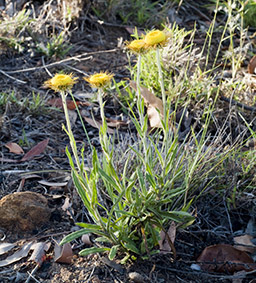
The noteworthy species were the Dogwood (Jacksonia scoparia) and a kind of everlasting daisy (Coronidium oxylepis subspecies lanatum).

The Dogwood has flowered prolifically this year, and it’s only at this time of year that the sheer numbers of this understorey species become apparent. In angled sunlight their flowers light up the shadows in the bush like yellow fairy-lights.  When they come up in the “lawns” around the buildings we generally leave them because of the wonderful spectacle they make when they flower.

We hadn’t realised until this year that the Red-necked Wallabies eat the flowers of this species, reaching up with their front paws to pull a flowering branch down within reach of their mouths.  Steve and Alison Pearson, in their book Plants of Central Queensland, say that the aborigines collected pollen from the flowers.

The name Dogwood comes from the smell of the smoke when this plant is burned green.  You’d think someone nearby had stepped in something nasty.  Though they don’t burn readily when growing scattered in the bush, a heap of recently cleared Dogwood burns fast and very hot.  I’ve got the burn scars to prove it.

Coronidium oxylepis

The everlasting daisy we have here doesn’t seem to have a common name, though I have seen it referred to once as the Woolly Pointed Everlasting, which seems to be a compilation of its main features rather than a real common name.  Until recently its Latin name was  Helichrysum collinum.

The last few years have seen an amazing population explosion of this species in the groundcover of the drier ridges on our place.  At this time of year they are very popular with a wide range of insects, butterflies and skippers.

In our part of the Helidon Hills the flowers of this species have a crown of brown/golden pointed bracts surrounding the flower, but in more northerly areas in the Hills I’ve seen them with silver bracts.  Maybe a different sub-species?

Right on time!

We heard the first Channel-billed Cuckoo (Scythrops novaehollandiae) of the season today – 19 September.  In the eight years in which we have recorded their first calls they have occurred on September 7th (1 year), 19th (2), 20th (2), 21st (1), 22nd (1), and 24th (1).  Pretty punctual for a bird that has flown all the way from its winter quarters in southern Indonesia, the Bismarck Archipelago or New Guinea.

These are spectacular birds, unmistakable because of their size, large bill, and the cruciform outline in flight, not to mention their raucous calls.

When they first arrive it is like greeting old friends.  For a few weeks they are more or less discreet, not often heard or seen, but after a while they become more obvious, calling frequently and being chased in mad dashes in and out of the trees by other large birds which are their unwilling hosts.

Eventually they engage in night-long calling sessions, well and truly wearing out their welcome, particularly as they seem to prefer to hold their meetings on ridge tops (our house being situated on a prominent one).

To judge by the species which react to their presence they probably parasitise the local Pied Currawongs, Magpies and Crows.

[photo: Aviceda, from http://en.wikipedia.org/wiki/File:Channel-billed_Cuckoo_Sep07_kobble.jpg creative commons licence]

Let’s take a walk around our systems

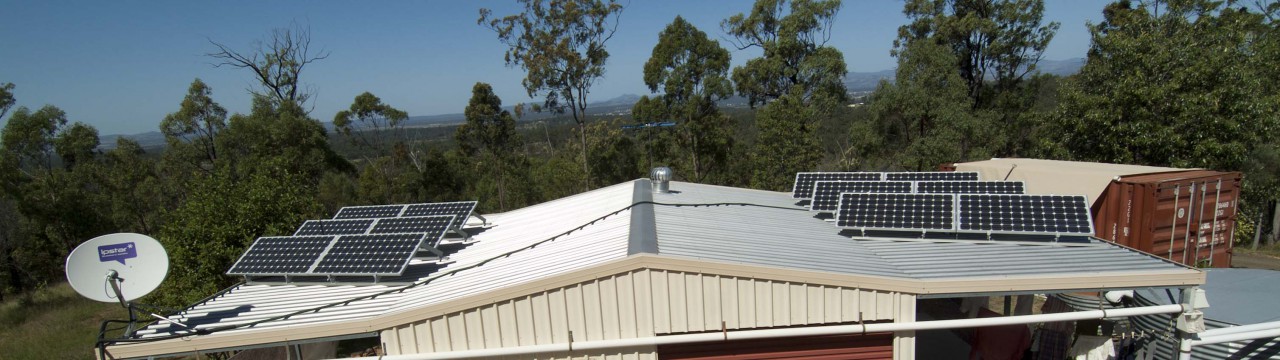
How about a quick tour for a preview of some of our different life support systems?  Solar power first.  There are 12 panels making up a 1.9 kW array feeding into a battery bank that lasts up to three days without sun.  The building was our home for nearly ten years, and has now been lined, insulated and fitted out as a study and TV room with a guest bed.  Much more comfortable than when we lived in it.  The container at the back is currently a storage area, but there are plans to eventually convert it into guest accommodation.  I’ve always been fascinated by the idea of using shipping containters as the basis for housing.

On the righ of the photo you can make out one of our water tanks. This one is “aquaplate”, but the others are mainly stainless steel.  The dish on the left is for satellite broadband internet access.  Our phone line can’t handle any but the lowest data transfer speeds and certainly isn’t up to delivering modern internet content.

Then there is the house, with its passive solar design. The tall windows and wide eaves on the north-facing wall allow winter sun to shine across half the width of the house at midday in mid-winter.  The heat of the sun is absorbed by the concrete and is returned to the interior during the night.  Lots more features of the house to talk about later, like the insulation and lighting.  And the whole story of our owner-building journey.

On the right you can see the first flush diverters coming down the corner of the wall.  These discharge the first flow from the roof and gutters to the ground, preventing accumulated dust and dirt from entering the storage tanks.

This is the smallest, lowest impact house we could build within the constraints of our space requirements, the design demands of bushfire safety considerations, and government building regulations.

We use composting toilets, both inside and outside the house.  Manure of any kind is too valuable a resource to waste.  Once full, the bin is moved to the back, stocked with compost worms and left to mature until the other bin is near full.  This can be up to 12 months, by which time the resting bin has produced about 150 litres of friable, rich soil ready to go into the garden beds.  In this photo the bin on the left is covered with shade cloth to stop it getting too hot in the summer sun.

Before we built the house we had a very productive greywater treatment system comprising a worm farm, a sand filter and a storage tank.  Not only did it produce water for the garden that was clean enough to store for 3-4 days without any smells, it also produced thousands of compost worms and lots of worm castings to fertilize the garden beds.  Alas, plumbing regulations do not allow such productive creativity, so now we are fully legal, and our greywater all goes to waste, literally.  It is discharged under the ground in an absorption area, out of reach of our gardens and fruit trees.

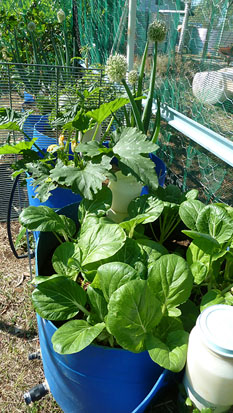
The loss of this greywater matters in our dry climate.  One of the solutions we are trying in order to save water is the use of wicking pots to grow vegetables.  In this method water is stored in the bottom of the pot, and wicks up through the soil to the root zone.  The only water that escapes is what is transpired through the leaves of the plants.  Depending on the size of the plants and the weather the water needs topping up only every four to seven days.

We also have small portable worm farms, producing useful quantities of worm castings and worm tea, and a worm farm that processes the discharge from our kitchen sink before it enters the greywater system.  At present we are thinking about designs for a vermiponics system (worm farms connected to flood-and-drain vege grow beds).  If these are successful they will become the precursor to a full-fledged aquaponics system, with native fish tanks connected to the grow beds, but that’s some way in the future.

Well, that’s a quick introduction to some of our life support systems.  I hope it has whetted your interest.  There will be separate posts on each of these systems as time allows.  Of course there are other systems that I haven’t touched on heree, including: a range of approaches to compost making, the wood-fired heating (for those few winter nights when the passive solar doesn’t quite overcome the cold), and the solar hot water. Those will be the sugject of future posts – possibly many posts, because most of our systems are in a process of ongoing development and improvement.