A DIY Compost Thermometer for under $30

I’ve just “upgraded” my compost thermometer.  Previously it consisted of a digital cable-probe thermometer taped to a length of reinforcing rod.  Simple, effective, and awkward to use, and risking breakage of the thermometer and the probe.

DSCF4747_overview_small

Overview of the new compost thermometer

The new model is made almost completely from bits and pieces lying around in the workshop, things from Reverse Garbage in Brisbane, or cheap “off the shelf” parts from plumbing supply shops, supermarkets, or eBay.  The shaft length is 880mm, plenty long enough for reaching into a 1 cu.m. or larger compost heap.

DSCF4750_side view_small_skitch

Side view of the top of the thermometer showing the main components

The thermometer itself is housed in a plastic kitchen container from the local supermarket – cost about $2.  It’s held onto a short length of threaded 25mm PVC water pipe (cost about $3.50 for a 300mm length from Masters Hardware, and I’ve still got the remainder with a threaded end to use for another project) with a 25mm conduit saddle clamp (cost $0.65 from hardware). This screws into a threaded PVC “T” (from my plumbing spares box – cost maybe $2.50) that is closed off on the other side with a 25mm bung (also from my plumbing spares box and not really necessary).  The T joins the shaft via a 25mm nipple joiner (only used in order to achieve a join with the blue part of the shaft – cost maybe $2.00).  The internal diameter of the nipple didn’t quite match the blue part of the shaft, so I cut off a short section of rural polypipe (from a huge heap of off-cuts) and hit it with the heat gun to slip it over the blue shaft.  No glue needed.  The piece of blue PVC conduit came from Reverse Garbage in Brisbane (cost maybe $0.70 – Reverse Garbage is a fantastic place to browse.  I always come away with things I didn’t even know I needed until I saw them).
DSCF4757_screen in case_small

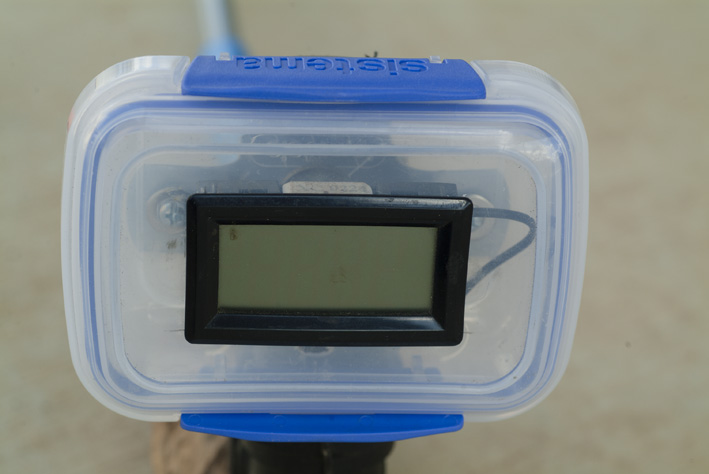
Thermometer screen unit inserted into cut-out in the top of the case

The main thermometer unit with the digital screen on the front is made to be inserted into an instrument panel, so the black “flashing” around the screen is a few mm wider than the main housing, to hide the edges of the cut-out.  On each end of the main housing there is a “lug” which pops past the end of the cut-out to hold the unit in place. I carefully measured the main part of the thermometer housing and marked the outline onto the top of the case, then cut it out using a drill and a hacksaw blade.

Using this waterproof kitchen box helps to keep moisture and dirt from getting onto the back of the thermometer when using it around compost piles.

I got the thermometer from Jaycar in Brisbane years ago for $14.95.  They haven’t had them in stock for quite a while, but you can buy these on the internet or on eBay.  Make sure the cable length is long enough, and that there is an on/off switch (if you want one).  Good idea to check the range too, though the range we are interested in for compost-making is usually within the range of this type of thermometer.  Oven/barbecue thermometers are generally way overpriced and not easily adapted to something like this.

DSCF4763_back of case_small

Conduit saddle clamp holding the case to the short section of threaded pipe.

The case is held onto the threaded pipe with a 25mm saddle clamp made for clamping conduit or water pipe onto a wall. The short bolts I had in my “odd nuts & bolts” box needed large washers because of the large holes in the clamps.  On the other side I used large washers inside the case to spread the force so as not to crack the case.
DSCF4760_inside case_small_skitch

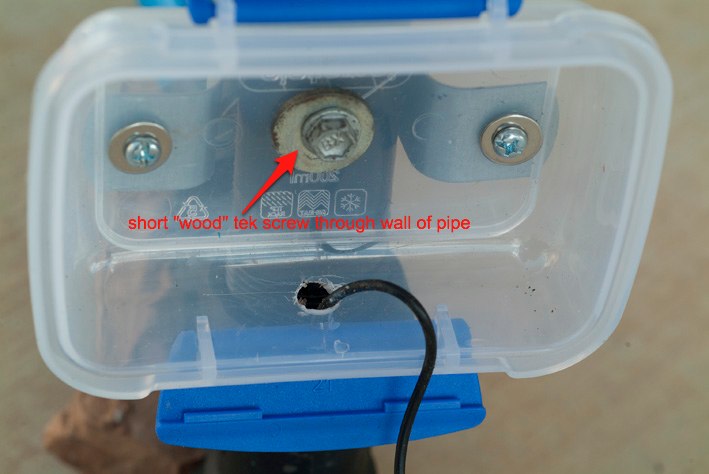
Mounting the case onto the pipe

Because the clamp isn’t tight around the pipe I put a Tek screw (wood thread, not metal) through a hole drilled in the base of the case and into the wall of the pipe.  This needed a largeish washer under the head of the Tek screw so that the pressure of tightening the screw didn’t crack the case.  The hole where the cable exits the case could be sealed with silicone, but I’d be wary of causing condensation inside the case.

DSCF4759_back of meter_small

The back of the thermometer when it’s mounted in the lid of the case.

It’s really easy to pop the lid off the case to press the on/off button on the thermometer.  This prolongs the life of the battery, but I’ve had a couple of similar digital probe thermometers that don’t have on/off switches lying around for months, with the display constantly “on” and their batteries haven’t gone flat yet – you could always take the battery out between uses (store it in the case) if battery life is an issue.  Note the possibility of leaving the probe in the compost heap and recording the maximum and minimum temperatures over a period.

DSCF4761_cable entry_small_skitch

It’s necessary to find a way to get the probe down the shaft of the thermometer

Depending on how you mount the thermometer case on top of the shaft there are many ways of getting the probe on its cable to the other end of the shaft.  I chose to drill a hole in the “T” above the shaft and drop the probe down there.  You need to make sure that if there are any joins in the shaft they do not stop the probe from passing.  I could have (and probably will) put some silicone over this hole – mostly so that if anything snags the cable it doesn’t transfer the strain to the cable-probe join.

DSCF4754_probe_small_skitch

The probe housing on the end of the shaft

The end of the shaft is a metal section that looks like it was once a short, snap-on leg for a piece of equipment (from Reverse Garbage).  The “snap-on” end is crimped to just the right size to fit into one of those disposable applicators that come with silicone tubes (or glue, or gap sealant, etc. etc.) for use in caulking guns.  I cut off the tip of the applicator so that the opening was just wide enough for the probe to be squeezed through, then filled the space behind it with wall panel glue, putting some around the end of the shaft to hold the applicator on.  In theory this should hold the probe securely in place when it is pushed into the compost heap.  I forgot that the glue I used needs contact with air to harden, and putting the applicator straight onto the shaft before the glue was dry meant that it dried very slowly.  I gave the probe a testing “wiggle” a few hours after I’d put the glue in, but the glue was far from dry so that there is now some movement in the probe.  Dumb!  That doesn’t really matter, since I’ve always used a length of conduit to make a hole in the compost heap to insert the probe, so I’ll just keep doing that.  The applicator was free, and the glue was already in the workshop.

It’s not shown in any photos, but I’ve found a bit of communication cable conduit that has just the right internal diameter to slip over the shaft, and fit firmly around the rural polypipe at the top.  This is longer than the shaft, so it protects the probe when the thermometer isn’t being used.
DSCF4765_in compost_small

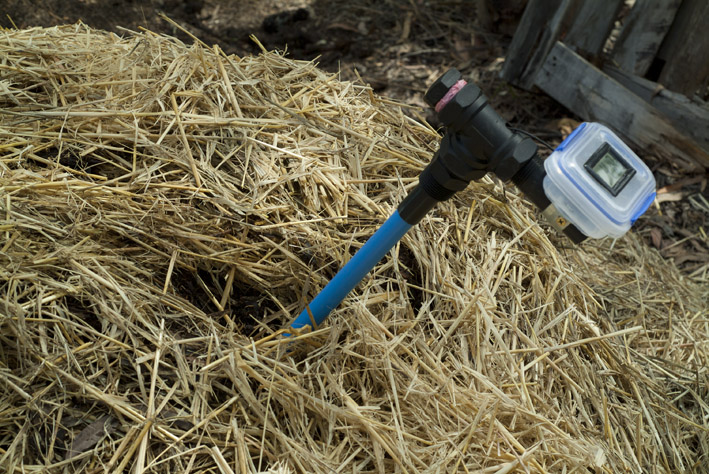
The compost thermometer in use.

DSCF4768_screen_small

First reading!

The thermometer takes longer (1-1.5 minutes) to reach a steady reading than it did previously, probably because part of the probe is inside the end of the shaft.  This compost heap was reading 54 degC before I gave it its second turning yesterday (about two weeks after the heap was made).  It’s already back up to 46.2 degC, and might get into the 50s though it has already had a high temperature phase in the first week.  I’ll be happy if it sits in the 40+ range for a while.  You can see details of the making of this heap here.

So there it is.  A compost thermometer for less than $30, depending on how much you can make use of “found” and recycled items.

How does it compare to other compost thermometers?

First, it can measure compost temperature, probably at least as accurately as any other compost thermometer.

Second, with the digital thermometer I used it is possible to stick it in the heap, turn the readout on and leave it there for days or weeks, giving a constant reading of temperature as well as recording maximum and minimum temperatures (I haven’t tried this yet, but the function buttons are there on the back of the case).  I haven’t seen a commercial unit which has these functions.

Third it probably isn’t as robust as commercially available compost thermometers, but if it is treated carefully it should last well.  And, at this price I wouldn’t be too unhappy if I had to replace the thermometer unit or a part of the housing or shaft.  If I’d bought a commercial compost thermometer and it broke I’d be very unhappy because of what they cost.

And that brings me to the fourth consideration – cost.  You can get a compost thermometer in Australia from Agricultural Solutions for AUD$160.  A friend of mine bought one recently and he is happy with it, and I’d assume there are others out there for around the same price.

Until at least the middle of 2013 you used to be able to buy a compost thermometer from the Permaculture Research Institute (Geoff Lawton’s organisation) for AUD$294.72 via the online shop on the Permaculture News website.  However that unit no longer appears in the products listing.  It was built like a truck, with an analogue dial like an old fashioned oven thermometer and surrounded by a steel “wheel” grip, but functionally it was still a thermocouple in a shaft probe with a readout – that’s all.  I had some discussion via email with Craig Mackintosh (the PRI website editor) about the price/value issues with that unit, after he rejected a comment I’d submitted to a posting which promoted it and linked to their shop.  I’d described the unit I was using at the time (an early prototype of this one) and it’s very low cost, and in the email exchange Craig asserted that “There is no comparison between the two probes you’re speaking about.”  Well, no, at least not in terms of price.

So there are other units out there, and you can buy one of them off the shelf much easier than making a unit like the one described above, if that suits your available time and resources.  But the option does exist to make a fully functional compost thermometer for a very low cash outlay and at the same time recycle some resources.


Economic growth in a finite world – the stupidest oxymoron you could imagine

I’ve just finished reading Enough is Enough: Building a Sustainable Economy in a World of Finite Resources, so I’m pretty ‘primed’ in terms of statements urging “economic growth” as the solution to the world’s economic ills.  One thing the book has made me realise is just how often we are bombarded with the mantra of economic growth, and how much it is seen by politicians, conservative economists and the media as the only way to achieve social, industrial and political goals.  And if you combine references to the need for economic growth with the media’s fascination with economic indicators such as GDP and stock market indices, it’s really clear that we are on an economic growth express train.

I’d always been of the view that targeting economic growth is the lazy policy option, believing that we can have a fair, effective and comfortable society without growth – it would just take a lot more brain-power than the average policy formulator is willing to apply.  However reading Rob Dietz and Dan O’Neill’s book convinced me that a steady state economy is the only way forward, though I felt that there was little chance of there being any kind of mainstream movement toward this approach before it is too late.  How often do you even see or hear the term “steady state economy”?

Well, an article in today’s edition of The Conversation might indicate that we are going to hear about it a whole lot more in the near future.  It’s an important opening to a conversation that the world has to have now (and should have had long ago).  I hope it won’t spoil the story if I tell you the author’s conclusion: Climate stability demands nothing less than a wholesale economic shift – moving beyond growth and into a culture of consumption based on sufficiency. Or as Dietz and O’Neill say: Enough is Enough.  Read the book next.

Reblogged from The Conversation:

A newly released report called Better Growth, Better Climate draws the seductive conclusion that “we can create lasting economic growth while also tackling the immense risks of climate change”. But while…

Economic growth is incompatible with the rapid emissions reductions that are now necessary. AAP Image/David Crosling

A newly released report called Better Growth, Better Climate draws the seductive conclusion that “we can create lasting economic growth while also tackling the immense risks of climate change”.

But while the report, spearheaded by former Mexican president Felipe Calderón and UK climate economist Nicholas Stern, wisely points out the importance of efficiency improvements and renewable energy, it fails miserably to back up its core message.

The fact is that the world has a finite carbon budget, and we’ll blow that budget – sooner rather than later – if economic growth remains our objective.

Carbon budgets

The fundamental weakness of the new report can be shown by considering the implications of the world’s carbon budget, a notion that has entered the vocabulary of climate science in recent years. This concept refers to the maximum carbon emissions that can be released into the atmosphere if the world is to avoid dangerous climate change.

Although the science underpinning the carbon budget is increasingly robust – and has been built into the modelling of the Intergovernmental Panel on Climate Change (IPCC) – scientists, politicians, and the broader public have been slow to recognise its radical socio-economic and political implications.

The unpalatable truth is that, for developed nations, continued economic growth as conventionally measured is incompatible with climate stability. Indeed, a safe climate requires that we now need a phase of planned economic contraction, or “degrowth”.

The prospect of deliberate economic contraction will strike most people as an outrageous proposition, but the numbers below speak for themselves. My research has focused on this need to power down our energy-intensive economy if we are to avoid blowing the carbon budget.

This does not simply mean producing and consuming more efficiently and shifting to renewable energy, necessary though these changes are. It also requires that we produce and consume less – a conclusion that few dare to utter. Fortunately, the extent of wasteful overconsumption in the developed nations means that degrowth can actually be in our own interests, if we manage the transition wisely.

Degrowth and the carbon budget

To set our carbon budget, we have to answer three initial questions:

  1. What temperature rise above pre-industrial levels should we be aiming to avoid?
  2. What risk of exceeding this temperature limit are we prepared to accept?
  3. How should the resulting global carbon budget be distributed between nations?

In order to unpack the economic implications of carbon budget analysis, I draw on the seminal work of climate scientists Kevin Anderson and Alice Bows, whose analyses are based on the following answers to the above questions.

1. Temperature

The world should aim to keep warming below 2C relative to pre-industrial levels. This threshold has been reaffirmed in recent international climate negotiations, including at Copenhagen and Cancun, so it represents an agreed goal.

Nevertheless, in recent years evidence has indicated that many ecosystems are more sensitive to increases in temperature than previously thought, meaning that 2C might not be a “safe” threshold after all. Many scientists, not to mention the small island states, argue that a 2C average rise in global temperature would be extremely dangerous, and that 1.5C or less would be more appropriate. Far from being a radical goal, 2C is actually a moderate one.

2. Risk

Because the future effects of further carbon emissions are complex, they can only be expressed in terms of probability. For the purposes of this analysis, we’ll aim for a carbon budget that gives us a 50% chance of avoiding 2C of warming. Given the dire consequences of exceeding the 2C threshold, the precautionary principle really demands a far higher probability of success than 50%, but let’s stick with this for now.

3. Distribution

Developing countries (known in UN climate negotiations as “Non-Annex 1 countries”) deserve a greater per-capita share of the global carbon budget, primarily because they are home to billions of people who still live in poverty and because these nations are less responsible for historic emissions.

Nevertheless, a stable climate calls for ambitious assumptions about when developing nations’ emissions should peak and begin to fall. Anderson and Bows assume that non-Annex 1 nations will peak in emissions by 2025 and then decarbonise at an unprecedented rate of 7% per year.

Such ambitious emissions cuts would also benefit developed (“Annex 1”) nations, because less of the global carbon budget would be consumed by the developing nations.

The carbon budget for the developed nations is calculated by subtracting the developing nations’ budget from the global budget. In order to keep to this budget, developed nations must reduce emissions by 8-10% each year in absolute terms (rather than per unit of economic productivity) over the coming decades. (For more detail on this calculation, see here.)

These numbers were formulated in 2011. Since then global greenhouse emissions have continued to increase, so these emissions-reduction targets should be regarded as a bare minimum.

The economics of cutting carbon

We can’t make such deep emissions cuts while still growing the economy. In his landmark 2006 review, UK economist Nicholas Stern calculated that decarbonisation of more than 3-4% is incompatible with economic growth. He noted that emissions reductions of more than 1% per year have historically been “associated with economic recession or upheaval”.

We can decarbonise our economic activity progressively by moving to renewable or low-carbon energy systems, and by producing goods and services in more energy-efficient ways. But this takes time – probably decades. Also, don’t forget that renewable energy systems themselves require energy to build.

We can’t cut emissions by 8-10% per year – as the carbon budget says we must – purely through energy efficiency and renewable power, especially if we expect to keep growing the economy while we do it. Significant emissions reductions will require us to use considerably less energy. And because energy use and economic activity are intimately related, less energy means less production and less consumption.

Beyond economic growth

It therefore follows that developed nations should immediately begin a strategy of planned economic contraction, with less energy and resource use. This “radical” conclusion follows logically from the moderate assumptions stated above, and it contradicts the widespread assurances that maintaining a safe climate is compatible with continued economic growth.

It is even harder to reconcile climate action with economic growth when you consider that the assumptions above are too moderate anyway. If we were to decide on limiting warming to 1.5C instead of 2C, with a higher chance of avoiding that threshold (say 80% or 90% instead of 50%), then that would render our carbon budget even smaller – or already used up.

Climate stability demands nothing less than a wholesale economic shift – moving beyond growth and into a culture of consumption based on sufficiency.

The conclusions drawn by the Better Growth, Better Climate report seem to suggest, however, that disciples of growth are still not ready to let go of their god. They will continue to insist blindly that we can “green” capitalism and grow ourselves out of our ecological crises.

Moving to a stable, post-growth economy is a complex, challenging and confronting prospect for many people. Success is unlikely, admittedly, but it is even more unlikely if we don’t have the courage to face the facts.

As thousands prepare to rally in New York and around the world ahead of next week’s United Nations climate summit, we need to challenge ourselves to transcend growth fetishism and see the world with fresh eyes.

Turning the compost heap for the first time

Back in late August I described the process of putting together an 18-day compost heap.  That heap was made on August 26.  When I measured the temperature on August 30 it was just over 50 degC.  I suspected at the time that the temperature had been higher during the four days in between, because of the amount of green vegetable matter used, but I couldn’t be sure of this.

On September 5 I turned the heap for the first time, but before turning it I checked the internal temperature – 52 degC – still within the thermophilic phase of composting(1) where composting is at its most rapid and is bacterially dominated.  The thermophilic phase occurs around 40-65 degC and at these temperatures pathogens and weed seeds will be killed, but “heat loving” organisms will thrive.  Above 70 degC it is necessary to start thinking about reducing the temperature so as to avoid death of the beneficial composting organisms.  This heat is being produced by the metabolic processes of the organisms doing the composting, so it is good to see that they have been hard at work for a week or more.  The fact that it is progressing so well indicates that, during the time I wasn’t taking measurements, the temperature didn’t get into the 70+ degC, or at least not for any appreciable time.

P1060746_050914_just started_small

Part way into turning the heap. It looks a long way away from the original heap, but that’s caused by the camera lens. In fact it is a comfortable reach from one to the other with the long-handled manure fork.

The first surprise was the extent to which the original heap had subsided – it was right up to the top of the frames in the background. I should have expected this, for two reasons: first, the green material was pretty coarse, so there would have been a lot of air spaces in the heap to compact down under the weight of the overlying material; and second, that green material made up a large proportion of the heap, and once it started to break down there would have been a lot of water released, thus reducing its volume.  It is still well above once cubic metre, which is roughly the size required to reach and maintain hot composting.

You can see that a lot of the drier/harder materials have only started to break down, but what isn’t so obvious is that the vast majority of the original green material is difficult to identify – this is after 10 days of composting (in true 18-day compost procedure the first turn would have been after four days, but I did warn in the earlier post that this would be “more or less” 18-day compost).

What is important, but not obvious from the photo is that the heap generally had a good water content, though of course the outer layers (and in this case the bottom layer too) were on the dry side.  I had a hose handy to water both the working face of the old heap and the new heap whenever I came across material that was too dry.  A heap at this stage is too wet if you can squeeze water out of a handful of material, and too dry if a hard squeeze cannot produce any “cohesion” of the material (it doesn’t have to produce wet clumps, just some cohesion resulting from its wetness).  If in doubt, a bit too dry is way better than too wet, because too wet leads to anaerobic processes.

P1060752_050914_fungused chip mulch on top_small

The edge of the new heap as it grows. Key things to note are: (a) the mix of fine and coarse material, (b) that some of the material is loose and dry (I need to water the heap before adding more), and particularly (c) the fungus-matted material on top of the heap.

The first thing I noticed was that there is quite a bit of woody and dry leaf material.  The woody stuff is expected because of the use of coarse mulched tree material from under the power lines in the area.  The bigger bits of this won’t break down fully in an 18-day cycle, but they will during the later “maturing” phase of fungal-dominated composting.  Among these larger components was a matrix of fine material well on the way to becoming compost; this would have derived from the green vegetable waste and the matured broiler manure.

The second thing, and this was a bit of a surprise, was that the 20cm of chip mulch base which had been in the bin for a couple of weeks before I made the heap had become fungus-matted, rather like tempeh (the Indonesian fungus-impregnated soya bean delicacy).  You can see where I’ve thrown this material onto the top of the new heap in the photo above.  Clearly the temperature at the bottom of the heap had not gone high enough to kill off the fungi but was within the mesophilic range (25-45 degC) where fungi are encouraged.  Here’s a close-up of that material.

P1060754_050914_fungus matted detail_small

Fungal-matting of some of the chip mulch which had been on the bottom of the original heap.

This material provides a lovely base of fungal inoculation of the heap, so I made an effort to include it in as many layers of the new heap as possible.  I did worry a bit about the possibility of “matting” of these clumps into impervious layers, rather like paper tends to do in a compost heap if you add too much in one layer and make it too wet.  All the more reason to spread it through the new heap as much as possible.

That reminds me – it is very important when you are making or turning a hot compost heap to keep it “fluffy”, i.e. to incorporate as much air as possible, because without air the (aerobic) organisms you want to do your composting can’t survive.  They will be replaced by anaerobic(2) organisms, and where these dominate they produce intermediate compounds including methane, organic acids, hydrogen sulphide and other substances. In the absence of oxygen, these compounds accumulate and are not metabolized further – many of them have strong odours and some are phytotoxic (poisonous to plants(3)).  One of the things I like about my long-handled manure fork is that it is very easy with a flick of the wrist to turn a forkful upside down as I throw it onto the heap, thus loosening it up as it falls.

P1060762_050914_closed heap_small

Putting the loose straw cover onto the heap to keep it from drying out while still allowing air to circulate.

So that’s it.  With the heap covered with a thick layer of loose straw it can sit and do it’s thing until the next turning.

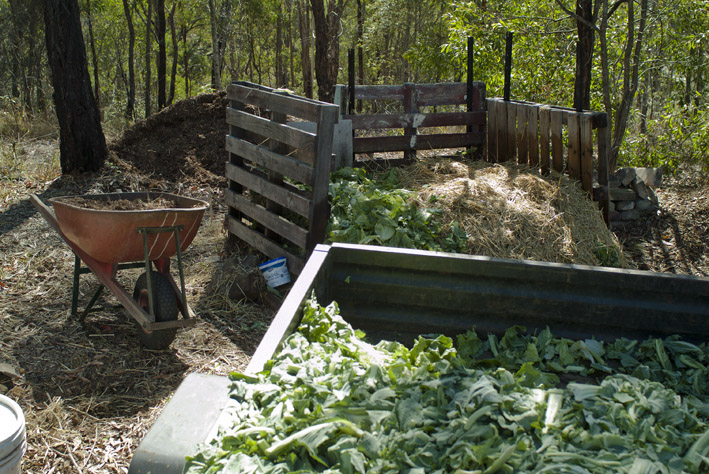
The open area in the back of the above photo is where I can turn the car when I’ve got a trailer behind.  In the background are the sections cut out of an old water tank that had been through a bushfire.  These now hold maturing broiler manure and horse manure.

(1) There are many good sources of information on the stages of composting and the factors affecting the process.  For a quick overview of the main points you can go to the Cornell Composting web page.

(2)  Misra, R.V., R.N. Roy and H. Hiraoka (2003). On-farm composting methods.  Land and Water Discussion Paper 2. FAO, Rome.  [This publication has details on many composting techniques, including a number of anaerobic methods.  You can download the whole document here].

(3) Brinton, W., & Trankner, A. (1999). Compost maturity as expressed by phytotoxicity and volatile organic acids. In Orbit-99 Conf Proceedings, University Bauhaus Weimar. Retrieved from http://www.solvita.com/pdf-files/voa_eu2.pdf [Gives some idea of the potential for composts to become phytotoxic and the compounds involved].

It must be Spring

DSCF4777 copy_crop_small

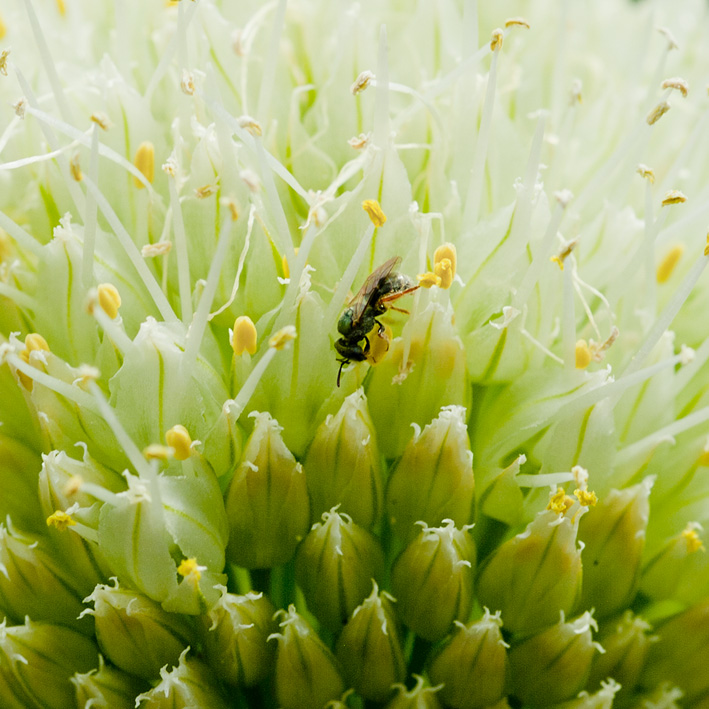
Native bee (Tetragonula carbonaria) on a Radish flower. Note the full pollen sacks on its hind legs.  These radishes have taken ages to actually get to the flowering stage (with bulbs now the size of small pumpkins) but with the help of these bees we look like getting plenty of seeds.

I was out in the vege garden early yesterday morning and suddenly realised that I was seeing far more bees than I had for a long time.  It was early enough that the native bees greatly outnumbered the European honeybees.  Our social native bees get up much earlier than the foreigners.  I think it was Tim Heard (“Mr Native Bees” in this part of the world) who first put me onto this at one of his one-day workshops.  Whoever it was told the story of the researcher who was looking into the pollination of the vast Macadamia nut orchards in northern New South Wales and discovered that by the time the European honeybees had got out of their (expensively rented) hives, the Macadamia flowers had already been pollinated by local native bees.

The bees I was watching yesterday were Tetragonula* carbonaria, one of more than 2,000 species of native bees in Australia, and one of only ten social species among the Australian native bees.  We also regularly get Blue-banded Bees (Amegilla cingulata) in our garden (a solitary species), and I’m sure there must be many more that I haven’t noticed yet.

There were a lot of flowers for them to choose from because I’m letting a lot of things go to seed, like Loose-leaf Lettuce, Radish, Amaranth, Ceylon Spinach (can you stop it from going to seed?), and a whole range of Asian Brassicas.

DSCF4787_crop_small

Working hard in the jungle world of a Spring Onion flower (the bee’s colours may be a little off – I was pushing the image to its limits in early morning light and using a hand-held camera)

You can find useful links to information about Australian native bees here.  If you are interested in the reasons for the recent change of the name of the Trigona genus (to which our small native bees used to belong) to Tetragonula there’s an account here, with links to even more information.


Spring maintenance in the vege garden

Lots of action in the vege patch over the last few days.

DSCF4700_7 Sept 2014_Skitch

Part of the trellis-side bed in the Second Hugelkultur Shadehouse

Today was pretty typical.  Realised first thing this morning that I finally had to do something about the way the Mugwort was starting to smother the Sugar Snap Peas on the trellis in the 2nd Hugelkulture Shadehouse.  Four cuttings of Mugwort were planted behind the trellis on the southern side of this shadehouse as a temporary home, until I had a place where they could be planted out.  But so far I haven’t got any of the future food forest area fenced off, so there’s still not a permanent place to put the Mugwort.  And now it has gone mad with the increase in temperature as Spring comes on strong here is Southeast Queensland.

I now see that I can make use of the Mugwort behind the trellis, because I’ve seen how it can be pruned to provide a windbreak and groundcover, and the ongoing prunings will provide masses of green mulch.  That is, providing it doesn’t prove to be alleopathic.  I have my suspicions about it – the Cassava and Lemongrass it was planted near haven’t been looking very healthy, though that might be just because neither of them likes Winter very much.  This is the first year I’ve grown Cassava, and it went from rampantly healthy in late Summer to near-dead by the end of Winter, but perhaps, like Comfrey, it just doesn’t do well in Winter.

You can’t see the Mugwort growing behind the trellis because I’ve pruned it back fairly heavily, but you can see the thick layer of Mugwort prunings in the bottom left of the above photo.  This extends behind the trellis up past the Lemongrass, and this is from an original planting early last Summer of only about six or seven stems of Mugwort.  Lovely thick, soft branches and leaves that will probably break down quickly.  Nowhere near the right conditions for “chop & drop” – the evaporation way exceeds rainfall lately, so I gave it a good wetting, then covered it with a thick layer of barley straw to make sure it breaks down before it loses too much Nitrogen.

The Ceylon Spinach in the background is climbing up the Pigeon Pea.  I showed a Bangladeshi friend around the garden a few days ago and his eyes lit up when he saw the Ceylon Spinach, Amaranth, Curry Leaf trees (in pots), and Luffas – all things he knows from Bangladesh.  So I’ve potted up some Ceylon Spinach to give him, along with one of the Curry Leaf trees (which are also waiting for the food forest to be fenced so I can plant them out).

The Tatsois in this bed, like all the Brassicas in the garden, are flowering furiously.

Tatsoi.  You can see the flower stems just starting to develop.

Tatsoi. You can see the flower stems just starting to develop in the top right corner of the phots.

I’m letting some of each of the Tatsoi, Bok Choy, Pak Choy, Gai Laan and Choy Sum go to seed so I’ll have supplies for next year. Same with the Loose-leaf Lettuce.

The other thing on the agenda for today was to renovate one of the Kangkung wicking pots.

01042013P1050516_Kangkung_Wicking Pot_small

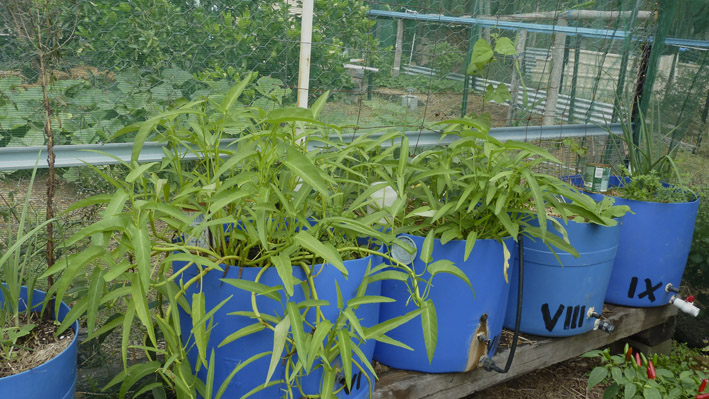
Wicking pots – they’re numbered so I can note treatments applied to different pots.

This is what they looked like in April last year (2013).  The two on the left are growing Kangkung (Water Morning Glory – Ipomoea aquatica), which is an Asian vegetable that generally grows beside drainage ditches or ponds.  It has hollow stems that can float on water, from where they put down long roots to the muddy bottom – but they grow well in wicking pots too, providing the nutrient is kept up to them.  These ones produced well until late Summer, when the heat got to them (probably combined with my failure to add sufficient compost to the top of the soil in the pot – it was just too crammed with stems to be able to get to the surface of the soil).  With Spring coming on I need to totally renovate them now if they are going to be productive into Summer.  This means emptying them out and refilling with new soil.

You can see this longer post for detail on the construction of these wicking pots.

DSCF4693_Sept 7 2014_Wicking Pot

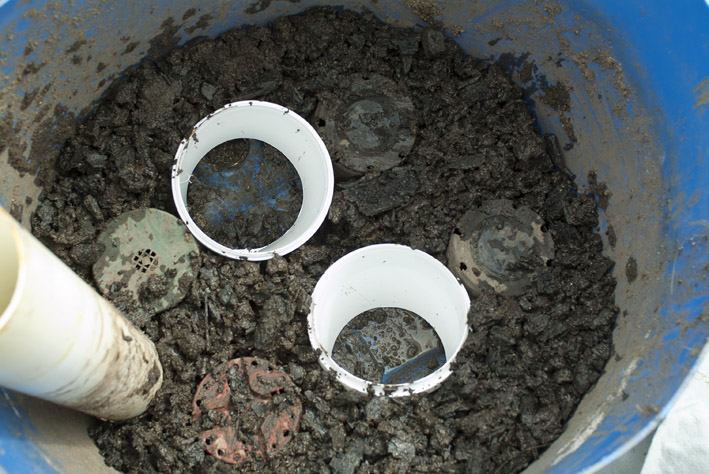
Internal arrangement. Two 2 litre yoghurt buckets with the bottoms cut out to allow soil into the water layer, and four empty flower pots, upside down, to create voids for water storage. The black material is charcoal from the previous set-up.

I decided to modify the design slightly by allowing the soil to penetrate down into the water reservoir, to promote wicking when the reservoir level is low.  This idea came from two sources: first, Roman and Jana Spur’s wicking broccoli box design (which I mentioned here), and an article on Gardening Australia last month about some blue-barrel wicking planters for the Town Camps in Alice Springs.  The soil will fill the yoghurt buckets after the geotextile is put over the charcoal.

DSCF4695_Sept 7 2014_Wicking Pot

The geotextile has been laid over the charcoal layer at the same height as the overflow drain hole, then coarse sand has been poured into the yoghurt buckets.

I used coarse sand to fill the buckets instead of the soil mix I will use for the top layer because I have a thing about trying to avoid large amounts of nutrients getting into the water reservoir ever since my experience with sulphides forming in the bottom of my first wicking pots.

The remainder of the pot was filled with my usual raised bed soil mix, since it holds water extremely well but also drains easily when saturated.

DSCF4713_070914_Sept 7 2014_wicking pot_small

The rejuvenated wicking put, with the “survivors” of its previous incarnation given a new chance. The “jam tin” is covering the water filling pipe to keep mosquitoes out.  You can see what this wicking pot looked like 12 weeks later here.

In a couple of months this should be a good crop of Kangkung, and one of the great things about Kangkung, apart from that it’s easy to grow and tasty, is that the more you harvest it, the more it grows.


Abbott and Co. trying to buck global trends on renewable energy adoption

The world as a whole has already exceeded Australia’s Renewable Energy Target of 20% of the country’s electricity coming from renewable energy by 2020.  The rest of the world is ahead of us and increasing its proportion of electricity coming from renewables, but Abbott and Co. [Australia’s Prime Minister and his Conservative government] would have us believe that the move toward renewable energy is a bad thing, and are going all out to dump the Renewable Energy Target.

The following is re-blogged from The Guardian.  It is part of the article Renewable Energy Capacity Grows at Fastest Rate Ever

Wind, solar and other renewable power capacity grew at its strongest ever pace last year and now produces 22% of the world’s electricity, the International Energy Agency said on Thursday in a new report.

More than $250bn (£150bn) was invested in “green” generating systems in 2013, although the speed of growth is expected to slacken, partly because politicians are becoming nervous about the cost of subsidies.

Maria van der Hoeven, the executive director of the IEA, said governments should hold their nerve: “Renewables are a necessary part of energy security. However, just when they are becoming a cost-competitive option in an increasing number of cases, policy and regulatory uncertainty is rising in some key markets. This stems from concerns about the costs of deploying renewables.”

She added: “Governments must distinguish more clearly between the past, present and future, as costs are falling over time. Many renewables no longer need high incentive levels. Rather, given their capital-intensive nature, renewables require a market context that assures a reasonable and predictable return for investors.”

Hydro and other green technologies could be producing 26% of the world’s electricity by 2020, the IEA said in its third annual Medium-Term Renewable Energy Market Report. They are already used as much as gas for generating electrical power, it points out.

But the total level of investment in renewables is lower now than a peak of $280bn in 2011 and is expected to average only $230bn annually to the end of the decade unless governments make increasing policy commitments to keep spending higher.

The current growth rate for installing new windfarms and solar arrays is impressive but the IEA believes it is not enough to meet climate change targets, triggering calls in Brussels from green power lobby groups for Europe to adopt tougher, binding targets.

You can read the whole article here.


Courses at Northey Street City Farm

I’ve just received the list of courses at Northey Street City Farm in Brisbane for the rest of the year.

Two bits of good news:

First, they are offering some of their Permaculture Design Course elements as one-day courses.  Apparently people who aren’t enrolled in the full PDC can sign up for individual courses.  I haven’t seen this before, so maybe it is a new initiative by Northey Street, but anyway it is very welcome.

You can see the details of the PDC elements here, and you can sign up for individual one-day parts of it here.  The courses available as one-day workshops are:

  • Trees in Permaculture (5th September)
  • Understanding & improving your Soil (12th September)
  • Water in Permaculture (26th September)

All are full-day courses, 9.00am to 4.30pm, and cost $85 or $65 for a health care card holder.  Better get in soon if you want to attend, they are likely to be very popular.

The second bit of good news is that Tim Heard is going to do a one-day Native Bee Keeping course at Northey Street on 13th December.  Price is the same as the PDC workshops.

I attended Tim’s one-day course when he ran it in Ipswich earlier in the year.  Here’s what I said in an email to a friend:

“The workshop was fantastic.  The best workshop I can remember.  Tim Heard is not only very much a theoretical and practical expert on native bees, he’s a gifted teacher.  So much information for me to think about and digest, but I know I learned a huge amount.

“Apart from a lot of information on the types and evolution of stingless bees, design and management of hives, he split two hives in front of us, taking time to make sure everyone saw what he was doing and understood why he was doing it, and also used the hives to illustrate all the things to be aware of.  He also harvested honey from one hive (with a double honey top) while we watched”

You can book for this course here.  You won’t regret it.

Starting a batch of 18-day (more or less) compost

I just spent a morning putting together a batch of compost.  Four hours of solid work, from getting the green waste that is the basis if this batch to capping it off with a fluffy cap of straw.

The green waste came from a vegetable packing shed, where I had to line up with all the farm utes picking up a load of cattle feed (we’re in a drought, despite the reasonably good rain in the last couple of weeks).

Having heard figures of up to 40% of horticultural production being rejected because it does not meet supermarket specifications for colour, shape, size, etc., I had always imagined that there must be a huge amount of green waste going to landfill from packing sheds.  It isn’t true, at least not here in the Lockyer Valley.  Some of the big farms that have their own packing sheds also have their own cattle herds, and these get first call on the green waste.  The others generally make it available to the public, and from what I’ve seen very little or none goes to landfill.  The farmers are eager and grateful to have this source of animal feed.[*see additional note below]

When you think about it, these farm animals are eating better than those of us who shop at supermarkets.  Picking of the vegetables commences early in the morning, and the green waste starts coming out of the packing shed around 7.30am.  There might be a bit of waste from the previous afternoon in the first few bins, but from then on it is all stuff that has been picked on the same day – and goes straight from there to the farm or, in my case, straight to the composting organisms.  If you buy vegetables from the supermarket they have gone from the field to the packing shed, to the market or to the supermarket chain distribution centre, generally on the same day, and from there to the supermarket – you will be getting it two or three days after it was picked if you are lucky.

I have a friend who works in a packing shed who takes pride in the work she does to select, trim and pack the vegetables she works on.  When she sees the same vegetables in the local branch of the supermarket her shed supplies her feelings are frequently somewhere between outrage and insult because of the difference in quality she sees compared to when it left her hands.

Anyway, back to the green waste.  Lettuce and cauliflower trimmings today, with a bit of broccoli.  Two bins are tipped into my trailer by the forklift operator, and I quickly move aside to park and cover my load so others can be served.

Back home, reverse the trailer up to the compost production bins (not easy to do in the tight space between stockpiles of horse manure, poultry manure, chipped tree loppings, chip mulch from our firebreak clearing, and sand/silt from the drains on our two kilometres of access track, as well as the last batch of compost.  Set up the water pump and hoses and get out the tools.

DSCF4682_compost veg on woodchip_small

Starting the process

The first layer is already in the compost bin: about 20cm of chip mulch from a tree I had to cut out of the firebreak, covered by a layer of the coarse compost materials from the last batch.  It’s been lying there under a layer of straw for a week or two, and with the rain we’ve had the composting process in the chip mulch is probably well started.  A thick layer of green waste goes on top of that, then a layer of chipped tree loppings that has been stockpiled since last July and is just starting to get fungal strands through the lower parts of the heap.

P1060044_Energex chipmulch_120713

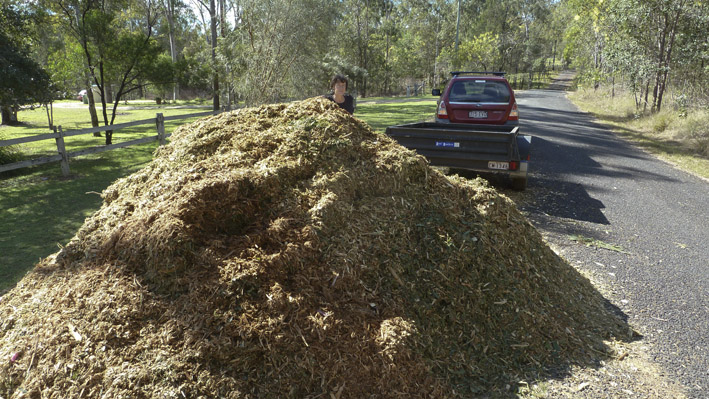
The mountain of chipped tree loppings from under the power lines. We shared it with one of our neighbours and still got eight trailer loads – a full day’s work to move it all.

I wet that layer thoroughly, before adding more green waste and then a layer of decomposing barley straw from a spoiled bale that I’d put behind the compost bin a while back.  That’s wetted down too.  More greenwaste and then a layer of months-old broiler droppings.  In truth, the broiler droppings were always more wood shavings than manure, with a good dash of spilled feed and water, but now they look decidedly woody.

DSCF4687_compost-trailer-chip heap_small

The growing compost heap, and the chipped tree loppings stockpile in the background

I’m kind of wary of broiler droppings because of the short time the birds are on it, leading to a poor ratio of wood to manure, and not much breaking down of the woody material before I get it.  This weathered stuff looks like 80% wood shavings, but I notice that a lot of the woody material is quite soft, and is in a matrix of very fine dark, damp material that might already be compost.  Nevertheless, if I was really intent on making 18-day compost I wouldn’t use broiler droppings, weathered or not.  But I’m not a great fan of the strict 18-day process.  In my experience after 18 days the result can look like compost, but it never smells like it – you know that rich, earthy, good-compost smell?  Doesn’t happen for me in 18 days, even when temperatures and moisture content are all perfectly aligned.  I wonder how often it happens for others.

What I have seen is that the longer an 18-day compost is left to “mature” the better it gets, with more life in it, and generally after three weeks or so of maturing it suddenly gets that earthy smell like forest litter.  From then on it just gets better still, and eventually (if I leave it long enough) has a network of fungal hyphae extending through it.  Not that I always leave it to the fungal stage, and at times I start harvesting the finest sieved component before it smells right, if I’m desperate to make some potting mix or a seedling bed.

DSCF4688_compost-trailer-old heap_small

The last, partly used, batch of compost on the right – covered against the rain over the last few days

Back to today’s compost.  From there on it’s just a repetition of the same layers and watering, until the green waste load is used up and the compost bin is full.  Then it’s topped off with a thick layer of fluffed up barley straw (to keep it the sun off it while allowing air circulation) and I get out an old tarp to leave beside the bin in case I see heavy rain coming.

Just to make me feel good I measure the dimensions of the heap and take a final photo.  Volume of the heap: 2.28 cubic metres.  That will drop quickly in the next couple of weeks as the heap settles and water is driven out of the lettuce and cauliflower waste, but it should produce at least 1.5 cubic metres of good compost.

DSCF4692_compost-final heap_small

The finished compost heap

Finally I make a note of the date and give the heap a code on the whiteboard in the workshop, where I will record the temperature of the heap from time to time.  What I want to see is that it gets into the 50-65 degC range for at least a few days, and that it doesn’t go into the 75+ degC region for more than a short period, otherwise I’ll have to turn the heap at that stage to drop the temperature.  Then, once it has done about a week in the 50-65 range I’ll turn it when it’s convenient.  After that, once it drops to around 40 degC (not lower) I’ll turn in every few days to a week, making adjustments to water content and the time between turnings to try to keep it above 40 for two or three weeks.  After that I’ll make sure the last turning has moved it to a place where it won’t be in the way of the next batch or other work, and just keep an eye on it’s progress and of course, the smell.

By the way, do you see the fork in the last photo?  That’s a manure fork, with four tines rather than the three in a pitch (hay) fork.  The tines in the manure fork are closer together, and they are fatter as well as having a bend (or a significant curve) so it’s easier to push them under things on the ground.  Pitchforks are all very well for throwing sheaves of hay onto haystacks, but I find that they don’t pick up the shorter, looser material like compost ingredients or manure very well.  And they’ve (finally) started to become available in Southeast Queensland – at Mitre10 and Trade Tools if you’re looking for one.

* More thoughts on waste in the vegetable production system:

It’s difficult to get a good idea of the level of real wastage in the fruit and vegetable production system.  A Bush Telegraph episode on ABC Radio National on 14 July gave a figure of “$10 billion worth of food” wasted annually by “Australians”, but this isn’t broken down beyond “food”.  Later in the same article they quote figures of “between 20 and 40 per cent of fruit and vegetables grown” being rejected before they reach the shops “because they don’t meet supermarkets’ high cosmetic standards and specifications”.  However I suspect that there are different rates for fruit and vegetables going to landfill.  For example, any fruit with large seeds (avocados) would be unsuitable for stock food, for instance, as are whole potatoes, because of the risk of choking.  Apart from what is diverted to stock food at the farm or packing shed, some of the “unsuitable” fruit and veg goes to charities for distribution to low income families.

What I’m not sure about is whether fruit and vegetables grown under contract to the big supermarkets is prohibited from being sold as a condition of contract.  I’ve heard this said, but haven’t been able to find any evidence one way or the other.  It would be interesting to know.

It would also be very interesting to see a detailed breakdown of the different destinations for rejected fruit and veges.

A tour of the vege garden

In this post I’m going to give you an overview of the food garden areas, with a few “before & after” progress shots – starting with this shot of our first garden (it’s roughly where the porch is now on the plan below – middle right edge).

013_First Garden

First garden, 4 November 2006, in a section of an old tank.  Eventually we had three tank sections in a clover-leaf garden.  We were living in the shed at the back, which is now our office, TV room, library, etc.

Veg Garden - Skitch markup

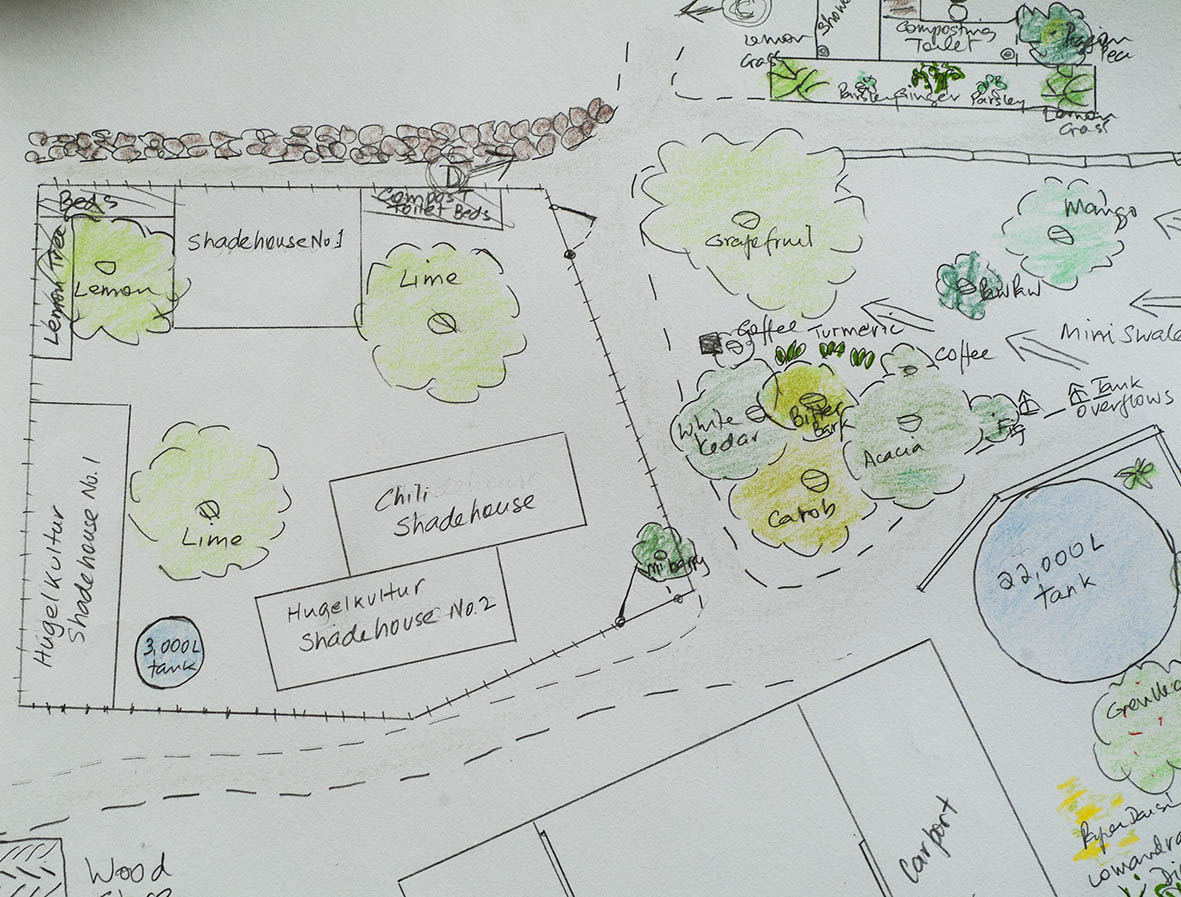
A section of the plan of our infrastructure on Black Cockatoo Ridge

Our current main food growing areas are: the Veg Garden, The Grove, and the Path Garden (left to right on the map above).  North is slightly left of up (the house is pretty much E-W), and for a scale, the widest (E-W) dimension of the Veg Garden is 13m and it is 11m N-S.

The area from the house to the Path Garden is more or less flat, but then drops away steeply, so the Path Garden is sort of a terrace.

A_P1050949_Path Garden_small

Looking west toward the outside toilet (in the ugly shadecloth structure)

DSCF4448_Path Garden Sweet Potato_small

Sweet Potato crop in western end of Path Garden – early April 2014

Anything we grow in the Path Garden must be either unappetising to the wildlife or secure behind some kind of barrier – hence the collar on the paw paw tree and the net tunnel over the sweet potatoes.  The sweet potatoes were growing in an area of around two square metres, though the foliage spreads much further, and yielded 9.5kg despite months of dry weather.

DSCF4449_The Grove_small

Looking West into The Grove

The Grove is a small area that we never planned to become part of our productive garden. It had a Carob tree, and an unidentifiable citrus tree when we arrived.  The citrus didn’t even flower for about 10 years, then when we pruned it one wet year it suddenly burst into flower and yielded 70 pomelo/grapefruit type fruit – absolutely delicious. When I was plumbing in the water tanks for the house I decided to run their overflows into a series of mini-swales that drain into and through The Grove.

DSCF4321_Turmeric_small

Turmeric (early Autumn before they died off in Winter) and a Coffee bush peeking in on the right

Friends gave us a couple of Coffee bushes, so we needed a shady place for them and The Grove seemed just right, and they’ve thrived ever since.  Now they’ve been joined by Turmeric and a Mango tree.

No time to go into the details of Fanya Juu terracing now (a later blog post) but here’s the area where they are being developed.  This was taken from photo point C in the map above.

C_P1050952_Fanya Juu_small

Looking West from the outdoor toilet. That’s the Veg Garden on the left

I always regarded this area as too steep to do anything with, even though it has a really good aspect, but when I came across Fanya Juu terracing I decided to give it a go.

P1060556_04032014_Fanya Juu_small

First terrace partly constructed

It’s a long way from complete, and doesn’t get very high priority, but whenever I feel like a bit of a work-out I dig some more swale or haul more rocks for the terrace wall.  That’s Queensland Arrowroot growing on the terrace – a great potato substitute requiring very little care and attention.

OK, now let’s go into the Veg Garden.

Veg Garden Map_DSCF4676_small

That’s the Veg Garden on the left, behind a tall fence with an electric tape on top to keep the possums out

This area was totally unplanned from the outset.  When the house construction started we were suddenly faced with the problem of disposing of the spoil from the foundation excavation, so some of it was dumped here.  Then came the problem of what to do with the Lime and Lemon trees that were in the way.  No time to think about it, so the back-hoe operator dug them up one at a time and carried them in the bucket to this area, dug a new hole and “planted” them.  They thrived!  And that gave us the “constraints” for later planning of shadehouse locations.

You can see Shadehouse No.1 in the photo above of the Fanya Juu location – it’s an old temporary carport someone gave us when the cover had perished.  Here’s another view from in The Grove.

300_Garden_P1030412_First Tunnel_small

First shadehouse. The rocky drop beside it gives an idea of the stony nature of the fill that was dumped here

Here’s the location of the next shadehouse as it was in June 2010.

Garden June 2010_P1010212_250610_Location_small

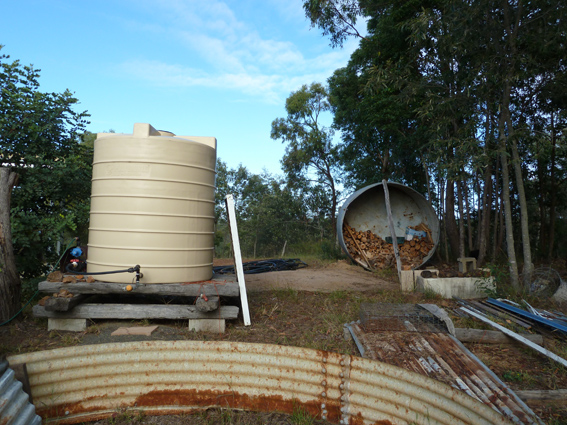
The tank IS vertical – the photographer wasn’t. The First Hugelkultur Shadehouse was constructed about where the sheet of iron is to the right of the tank. That’s our firewood store at the back.

Making an above ground mound of wood and covering it with soil in typical hugelkultur style would result in a very dry bed in our climate, so we dug the base out 300mm deep (about 1 foot), and filled it with old wood, branches, leaves, poultry manure and chip mulch.  Then the rocks were sieved out of the soil that had been removed and it was put on top of the base in alternating layers with straw and poultry manure.  We did about two metres of the floor of this shadehouse in October 2012 as a trial.

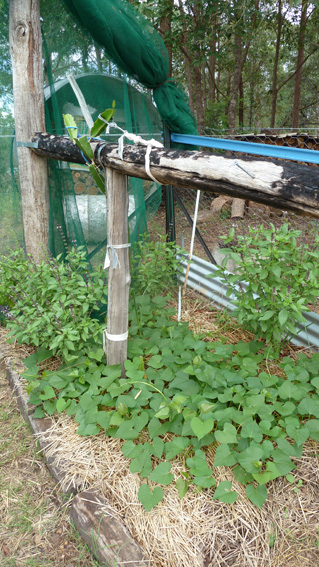
01042013P1050514_Heugel_Sweet Potato_smallThis is what the first crop of Sweet Potato and Thai Basil looked like  – with a young Dragon Fruit just peeking over the log trellis.

The plants in this area remained green while others in the garden were drooping from lack of water, so we decided to extend the hugelkultur treatment for the full (5m) length of this shadehouse.

It has been very successful, with continued “drought resistance” and crops of Kale, Gai Laan, Silverbeet, Ginger, Dragon Fruit, Baby Broccoli, Flat-leaf Parsley and Radish.  After 18 months the soil level has dropped by up to 200mm in places, presumably as a result of the rotting of the wood underneath (that’s what is supposed to happen), so I’ll be topping it up with fresh soil in the next couple of months.

Our success with this approach inspired us to try it again with Hugelkultur Shadehouse No.2.


P1020108_100814_Hugelkulture No 2_small

Hugelkultur Shadehouse No.2 in early August 2014

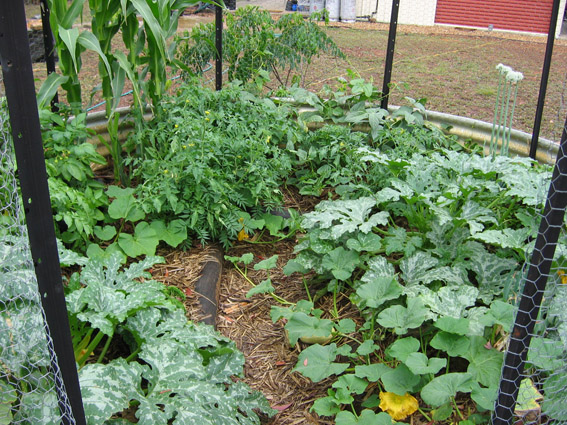
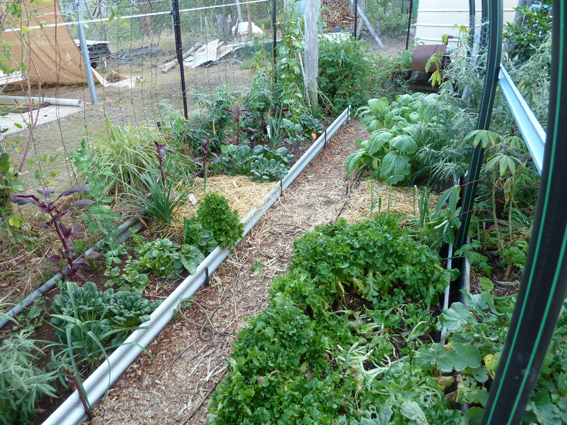
This has been even more productive than No.1, if that is possible.  In this photo there are: Loose-leaf Lettuce, Aibika, Spring Onions, Bok Choy, Brazillian Spinach, Cassava, Cherry Tomato, Ceylon Spinach, Tat Soi, Sugar Snap Peas, Clumping Leek, Amaranth, Mugwort and Perpetual Coriander.

After the massive effort in digging out two shadehouse bases, each five metres long and two metres wide, I thought it might be time to try some simple raised beds.

P1060236 (1)_101213_Chili Tunnel_small

The Chili Shadehouse in mid-December 2013

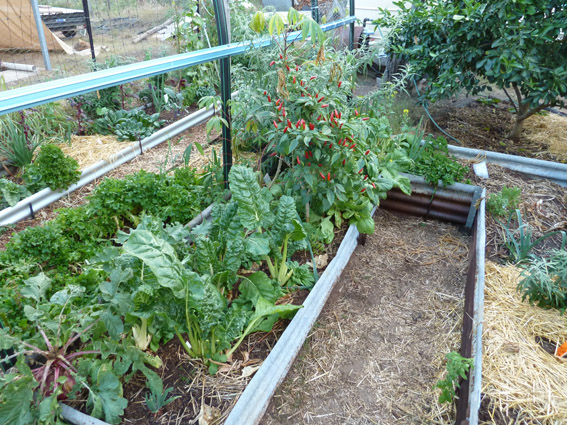
The Chili Shadehouse is “grafted” onto the previous  shadehouse because space in the enclosed Veg Garden is now in short supply.  Its raised beds are sitting on rocky fill, and the “soil” is all “manufactured” because, as you are probably starting to gather by now, we don’t have much actual soil on top of the ridge.  Or anywhere else on the property for that matter.  The recipe for the soil is: 9 parts of sand and silt out of the drainage gutters on our access track; 3-4 parts of fine sieved compost; and 3 parts of chipped matured horse manure.  It makes a rich, well drained but water absorbent, “fluffy” loam.

P1020110_100814_Chili Tunnel_small

Chili Shadehouse in early August this year

This gives some idea of how productive this shadehouse has been.  There are Radish (left to go to seed), Silverbeet, Corn Salad, Chili (growing madly, hence the name of the shadehouse), Pak Choy, Curly Parsley, Brazillian Spinach, Greek Basil, Clumping Leek, Mugwort, Cassava and Aibika.  A month or so before this photo I’d harvested Turmeric and Kipfler Potatoes from the empty areas you can see on the right of the above photo.

And, finally, these are the beds across the front of the Chili Shadehouse.

P1060657_end of Chili Tunnel_small

End of Chilli Shadehouse

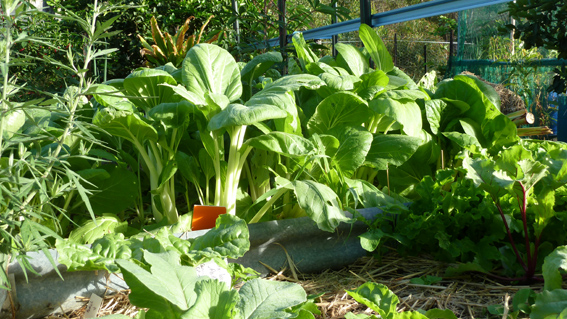
In late May this year these two beds had Bok Choy, Pak Choy, Beetroot, Silverbeet, Radish, Corn Salad and Loose-leaf Lettuce.  With the exception of the Silverbeet that has all been harvested and I’m about to start Spring planting in these beds.

I’ve left out the Lemon Tree Fence Beds and the Composting Toilet Beds (I’ll leave the explanation of that name till another time).

I hope you’ve enjoyed the tour.


A refreshingly different approach to food forests

I’ve just been reading a post by Tom at Sustainable Veg with the intriguing title: A Forest Garden Without the Forest.

It first caught my eye because of my scepticism about permaculture “food forests” as an efficient use of land for producing our daily meals.  I’m not talking about the food forests that surround hamlets and households in Southeast Asia and other parts of the world.  I’ve had a lot of contact with these, and in general these food forests are fruit, leaf and herb production areas, often with some poultry, and which also provide shade to cool the area around the house.  Their production supplements the range of day-to-day basic foods from more distant wet or dry rice areas or upland gardens.

My scepticism relates to the tendency of many permaculture followers to focus the majority of their production efforts on food forests dominated by fruit trees of one type or another.  And there seems to be a common belief that if it doesn’t have a food forest, then it isn’t permaculture.  Permies coming into a new garden will frequently ask “where’s your food forest?”.  Of course, many people with food forests also have “kitchen gardens”, but even so, there is often a serious over-allocation of area and effort to the food forest, out of all proportion to the negligible volume of “staples” produced there and the generally low productivity per unit area.

As Tom says in another post: “Billions of people need feeding … (w)e can be an alternative, organic movement but we need to produce carbohydrate, protein and vitamin dense food, in large amounts…” (I’m not suggesting here that Tom shares my views on food forests – to be honest, I don’t know).

A view of part of Tom’s garden – click on the image to go to a gallery of photos of the garden

Tom’s describes his back garden (he also has an allotment) as “a productive, organic, kitchen garden with substantial amounts of perennial vegetables, some annual vegetables and five dwarfing fruit trees”.  But he also calls it a forest garden, and refers to his techniques as forest gardening, and for good reason.

His reason for classifying his approach as forest gardening is that he is concerned with the ecology of the garden and of the soil, and therefore uses many of the techniques of forest gardening, while stopping short of trying to create either a closed tree canopy or a climax forest situation – not least because he doesn’t have the space to grow more trees without shading out his vegetables.  Nevertheless he has adopted an impressive array of permaculture / food forest techniques –

I’ll don’t want to spoil the pleasure of reading his post for yourself, but in summary these are the forest gardening techniques he uses:

  • Vertical stacking, with three diverse layers of plants, in association with individual fruit trees.
  • The use of support plants, with half the area of his garden devoted to these, but with the difference that he composts the prunings from the support plants before putting it around the food plants.  In this way he can focus on the needs of the support plants in one area and those of the food plants in another.  I also suspect, from what he writes and from the photos in his gallery (including the one above), that many of the things growing in his food production area are supporting each other.
  • Growing a wide range of perennial vegetables.
  • Adopting a “closed loop fertility” approach whereby he grows all of the ingredients for the compost on his own land.  You can see a separate post on it here.  I find this an admirable but daunting prospect.  I certainly wish I could imagine getting to that stage on our stony dry ridge.  At the moment the bulk of our compost ingredients come from off-site (but within 10km).

Please do yourself a favour and read Tom’s article for yourself.  What Tom has done is to apply the key food forest approaches without having his productive area dominated by forest.  I’m in awe of what he’s doing and the strong ethical approach he takes, and I’ll be adopting some of his approaches as I develop and expand our food production area.

As I finished writing this I noticed that Tom has added a post about compost which gives more insights into his approaches.  Enjoy.