Pumpkin greens

Part of our pumpkin management is to pinch off the growing tips once a runner has reached a certain length.  This forces them to put out additional branches, providing  more sites for flower production.  We then use the tips as a vegetable, either steamed or stir-fried.

Fresh pumpkin growing tip

However every year we have self-sown pumpkins coming up in garden beds or anywhere else that we use our compost.

“Rogue” pumpkin seedlings

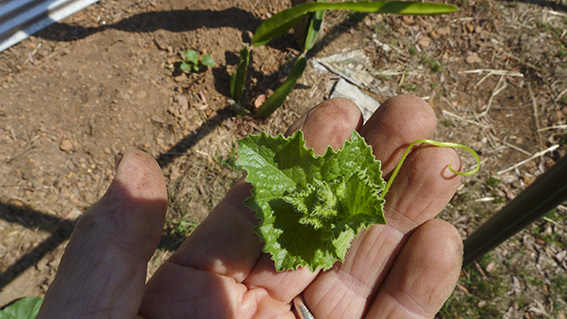
Until now we have just weeded these out, though sometimes we move them to where they can usefully grow or pot them up to give to friends.  This morning I was doing something else in the garden and my eye was caught by the sight of a fresh, bright green new pumpkin leaf.

New pumpkin leaf

Curious, I picked it and ate it.  Delicious!  Fresh, sweet, full of flavour.  Wow.  I would not have suspected that a leaf that size would be tender and sweet.  We now have a new vegetable, and wherever possible the volunteer seedlings will be left in place for a while so we can harvest the young leaves.

We have a new variation on pinching the tips off the pumpkin vines to promote flowering.  Meg McGowan suggested restricting each vine to one square metre – she finds it promotes much more productivity.  We are trying it this pumpkin season.

Not sure whether climate change is really happening in Australia?

If you feel uncertain whether climate change is happening in Australia (as distinct from just climatic variability) then the ABC’s Catalyst program has just released a report that you should see.  The climatic data is set out in detail, using 100 years of Australian weather records in most cases but relying on  high quality data sets identified by the Bureau of Meteorology.


The title of the report is Taking Australia’s Temperature, but in fact it looks at a range of parameters, not just temperature:

  • (temperature: maxima and minima, changes to annual temperature cycles;
  • precipitation – rainfall and snowfall: regional increases and decreases;
  • sea level: changes since the 19th Century (1841 in Tasmania, 1897 in southwestern Western Australia); and
  • sea temperatures: changes and specific warming events.

For an evidence-rich, bias free (in my opinion at least), easy to understand, Australia-relevant presentation of the data you can’t go past this report.

This is a blog about living sustainably in the Lockyer Valley Region, so why am I posting on climate change in Australia?  Because being able to live sustainably does not depend on only local factors.  Everything we do happens in, and is influenced by, a wider context.  If we are not aware of and up-to-date with that wider context there is a good chance that it is going to frustrate our efforts to live sustainably.  That’s one reason.  A better reason is that climate change is very difficult to discern at local scales.  Relying only on what we observe in the Lockyer to make up our minds on climate change is not reliable.  Put simply, you can’t arrive at a valid conclusion if you rely only on local observations – or on data over very short time scales.

Lockyer up with the best in Australia on level of solar PV power installations

A new report by Sunwiz has revealed that the Federal electorate of Wright (containing all or most of the Lockyer Valley Region) has the highest number of domestic solar power installations (solar PV plus solar hot water) of any Federal electorate in the country.  SunWiz has performed an analysis of Clean Energy Regulator data as of 1 October 2012 to identify the top solar electorates.

The electorate of Wright has a total of 26,417 installations, made up of 16,420 solar PV and 9,998 solar hot water systems.

Of course, raw figures on the number of installations in an electorate are not particularly meaningful, given that there is some variation in household numbers per electorate (though electorates generally have populations of around 150,000).  The percentage of households with solar installations (known as “penetration”) is a much more useful number, both for comparison and for revealing the level of uptake of renewable energy at the household level.

Wright figured 6th in level of penetration of solar PV (out of 150 electorates) with a penetration level of 20% – one in five dwellings (the national maximum was 23%) and 15th in solar hot water with 12% – one in eight (national maximum 21%).

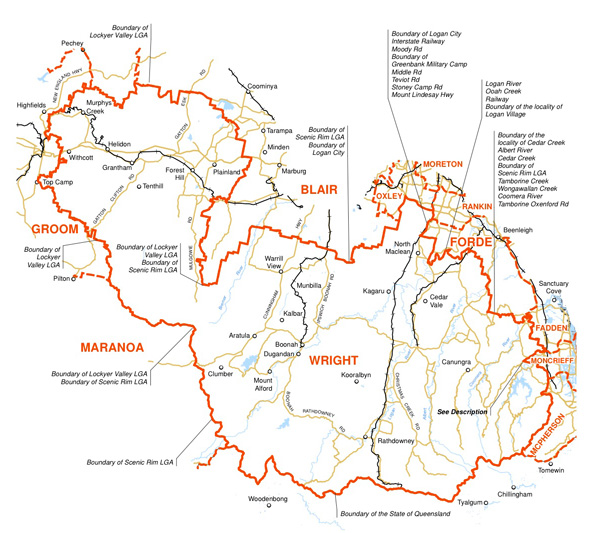
The electorate of Wright encompass an area stretching from the western Gold Coast through the rural areas left out of the more urban electorates between Logan City and the NSW border, before curving northwest to include the Lockyer Valley Region west of Ipswich. As well as the western edge of the city of Gold Coast, Wright includes the towns of Beaudesert, Jimboomba, Boonah, Gatton, Laidley, Hatton and Helidon (ABC 2010 election web site).

Given its location, Wright may not be what you would think of as a particularly Green electorate, and it isn’t, though there was a significant swing to the Greens in the 2010 election.  Conservative parties (LNP, ALP and Family First) – yes, I’ve identified the ALP as a conservative party – got over 80% of the vote.  The voting pattern in that election was:

How does the Lockyer Valley Region fit into this solar power picture?

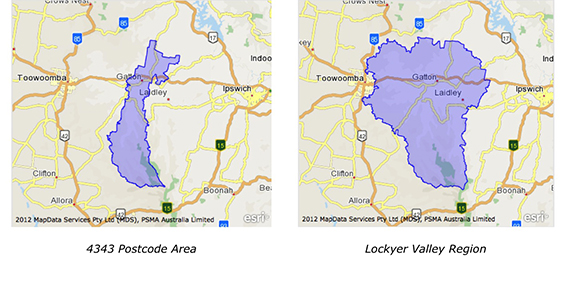
Census records for the Lockyer Valley Region do not include solar PV installation data.  However it doesn’t seem unreasonable to take the 4343 postcode area as a proxy for the Region.  As can be seen from the map below, it clearly takes up a significant proportion of the Region.

The Sunwiz analysis is based on postcode data (their methodology is explained at the foot of the web page reporting their findings), but understandably in a national report they do not provide the separate postcode data.

The Clean Energy Regulator’s web site includes detailed data on “small generation units” (= solar panel installations) for each postcode area.  In the 4343 area 677 units had been installed as of October 2012, with a total generating capacity of 2,012 kW.  The total is likely to be higher than this because the data is based on registration for Renewable Energy Certificates, which can be done up to 12 months after installation.

There were 3,610 occupied private dwellings in the 4343 postcode area at the time of the 2011 Census.  This suggests a “penetration” of solar PV power of 18.7%.  However, solar power is seldom installed on apartments, flats, and similar, and is much more likely to be found on private houses, of which the Census recorded 3,190, leading to a penetration level of 21.2%.  It seems fair enough to say that the solar PV penetration level in the 4343 postcode area is between 18.7% and 21.2%, and that the level for the Lockyer Valley Region is probably in this range.  (There were 11,900 private dwellings, and 11,200 occupied private houses recorded in the Region in the Census, so the 4343 figures represent 30.3% and 28.9% respectively of these totals. Seems like a pretty good sample).

What this means is that the penetration level for solar PV power installation in the Lockyer Valley Region (around 18.7-21.2%) is clearly of the same order as that for the larger Wright electorate (20%) and close to the highest penetration rate in the country (23%).
The Soup Kitchen is open again

Following the bushfire (more on this later) that burned out about 80% of our bush 13 days ago, there is very little food for the our wallaby population.  As in the 2009 fire, we have set up a “soup kitchen” to tide them over until enough grass comes through to feed them.

The menu is simple: water (we always put out water pots for them because it is very dry here on the sandstone ridge), pony pellets, and racehorse-grade lucerne (alfalfa).  They much prefer the pony pellets over the lucerne, which is OK with us as the pony pellets cost $10 per bag, while the top-grade lucerne is $10 per bale wholesale and would not last as long as a bag of pony pellets if they decided to eat it.  Any leftover lucerne will make good mulch for the garden.

It’s hard to know how many wallabies we are feeding. They come and go for much of the day and all night, but there are four feeding stations, and there are sometimes 3-4 animals at each at the same time.  Probably nearly half of the females coming to the food are carrying well advanced joeys in their pouches.

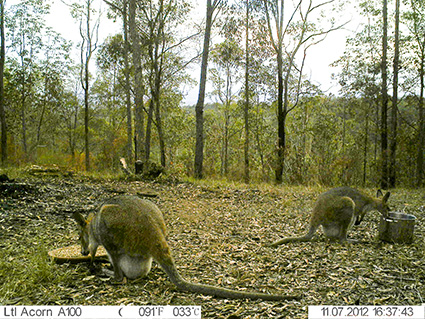
Female Red-necked Wallabies at a feeding station

We set up a couple of camera traps (trail cameras) to check whether we are also feeding pigs and deer, but so far there aren’t any signs of them at our feeding stations.  We can see by their tracks that they are moving through our property from the National Park (also burned out) to get to the stone-fruit orchard next door.  The windfall fruit lying on the ground there are a favourite of the pigs, and the succulent leaves on the trees  attract the deer.  Our pony pellets and lucerne probably can’t compete with either of those.

One thing we did discover was that at a certain age the young male Red-necked Wallabies get around in a group.

A “gang” of young males takes over a feeding station.

In addition to checking for feral animals, the camera records provide us with great entertainment in the form of interactions between the wallabies, confrontations they have with possums, and views of joeys (baby wallabies) hanging their heads/tails/legs out of the pouch.

Wallaby vs Possum stand-off

Even the possums get possessive about the feeding stations sometimes.

Mother Brush-tailed Possum defends the feeder (and her young one) from an interloper

Some surprising things get into the camera trap images.  The data on the bottom right of the photo shows date (ddmmyyy) and time.

A bat zooms over one of the feeding stations – possibly a Flying Fox (one of the Megachiroptera).  Its image is distorted by the relatively slow shutter speed.

There is “green pick” coming up already in the burnt areas, and some of the wallabies are starting to feed there, though it would be hard work for a mother with a large joey in the pouch or “at-heel” to get enough of this to sustain herself and the joey.  Some of the females will have a joey at-heel but still getting milk from the mother, another in the pouch, firmly attached to a nipple, and another in the early stages of gestation, and their nutrient needs will be even greater.

We’ve had 69mm of rain since the fire went through, so the grass should come back relatively quickly.  We plan on starting to gradually reduce the food we supply in the next couple of weeks.

One more reason we love living here

This is the morning view to the west from our access track alongside the house a couple of weeks ago.  The sun was coming through a break in a huge fog bank to the east.

The msit is lying in the valley of Lilydale Creek and its tributaries.  Our western boundary runs along the top of the first ridge (with the light on it).  Beyond that is all Lockyer National Park – around 9,000 hectares of it, and no fence between us and the Park.  In that direction there isn’t another house for maybe 10 km.  We heard a Koala calling from somewhere down in the first gully (below the dark foreground trees) a couple of nights ago.

For those who have seen the Helidon Hills Smokespotters web site, the smoke in the page title photo on that site was from a large bushfire that had just crossed into this catchment at the top right of this photo.

Birds in September

Twenty-nine species of birds this month.  As usual, probably nowhere near the total that were somewhere on the block, but unless we have time get down into the gullies regularly there must be a lot of species that we miss.

Funny how the count is generally in the high twenties, even though the actual species recorded varies from month to month.  There are the “stayers”, such as the Buff-rumped Thornbills, White-throated Honeyeaters, Eastern Whipbirds, Pied Currawongs and Rainbow Bee-eaters to name just a few.  However I suspect that even among some of these, it isn’t the same birds staying throughout the year.  For instance, even though the White-throated Honeyeaters are seen in every month, in some months there are birds present which clearly have  broader white band around their nape than the usual individuals.  A migratory sub-species?

Apart from the arrival of the Channel-billed Cuckoos (or to be precise, the first calls for the season – they may have arrived earlier and just not been calling), there were a few other highlights. The first territorial challenge calls of the Tawny Frogmouths for the season, for instance. This call had me baffled for years.  It’s a very low-pitched, “pumping”, oom-oom sound. So low-pitched that sometimes I think that I feel it more than hear it.

I couldn’t find a description of the call anywhere and no one I described the call to could come up with a reliable identification of the species. Then a few months ago our friends Richard and Kathryn Johnson were here and I played a recording of the call to them.  They burst our laughing.  Richard and Kathryn have lived with Ed, a flightless Tawny Frogmouth for more than 30 years, since he came to them as part of Kathryn’s wildlife rescue and recovery work in Townsville.  Apparently Ed’s presence in wild Tawny Frogmouth territory elicits territorial calling duels with exactly this call – sometimes with the wild bird standing on top of Ed’s cage and both of them calling at top volume.

Now that we know what the call is we can actually “census” the Frogmouth territories in our neighbourhood, because once one starts up the birds with neighbouring territories will start calling too.  This kind of very low frequency sound carries for a long distance on the night air.

Tawny Frogmouths (photo: Alan Grimes)

By the end of September the Eastern Yellow Robins weren’t coming around the garden nearly as often as they did in August.  We’d see them perced sideways on trunks in lookout-mode, or working their way through the foliage in search of insects, but now we generally only hear them in the dawn chorus and they are probably spending their days in the (slightly) damper gullies.

We didn’t see any Jacky Winters this month, though our records show that they can be seen here in most months and they were very common in August.

September Wildflowers

We recorded six species of wildflowers this month.  Nowhere near the total that were flowering on our block, but we have been just too busy to get around all corners of the bush, and when we were out and about there just wasn’t time to make a note of what was flowering.  Certainly, though it’s now officially Spring, the number of flowering species was way fewer than in August.

The noteworthy species were the Dogwood (Jacksonia scoparia) and a kind of everlasting daisy (Coronidium oxylepis subspecies lanatum).

The Dogwood has flowered prolifically this year, and it’s only at this time of year that the sheer numbers of this understorey species become apparent. In angled sunlight their flowers light up the shadows in the bush like yellow fairy-lights.  When they come up in the “lawns” around the buildings we generally leave them because of the wonderful spectacle they make when they flower.

We hadn’t realised until this year that the Red-necked Wallabies eat the flowers of this species, reaching up with their front paws to pull a flowering branch down within reach of their mouths.  Steve and Alison Pearson, in their book Plants of Central Queensland, say that the aborigines collected pollen from the flowers.

The name Dogwood comes from the smell of the smoke when this plant is burned green.  You’d think someone nearby had stepped in something nasty.  Though they don’t burn readily when growing scattered in the bush, a heap of recently cleared Dogwood burns fast and very hot.  I’ve got the burn scars to prove it.

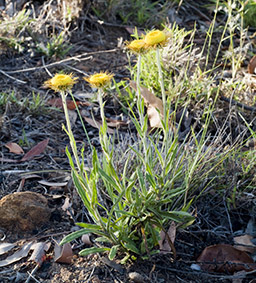
Coronidium oxylepis

The everlasting daisy we have here doesn’t seem to have a common name, though I have seen it referred to once as the Woolly Pointed Everlasting, which seems to be a compilation of its main features rather than a real common name.  Until recently its Latin name was  Helichrysum collinum.

The last few years have seen an amazing population explosion of this species in the groundcover of the drier ridges on our place.  At this time of year they are very popular with a wide range of insects, butterflies and skippers.

In our part of the Helidon Hills the flowers of this species have a crown of brown/golden pointed bracts surrounding the flower, but in more northerly areas in the Hills I’ve seen them with silver bracts.  Maybe a different sub-species?

Right on time!

We heard the first Channel-billed Cuckoo (Scythrops novaehollandiae) of the season today – 19 September.  In the eight years in which we have recorded their first calls they have occurred on September 7th (1 year), 19th (2), 20th (2), 21st (1), 22nd (1), and 24th (1).  Pretty punctual for a bird that has flown all the way from its winter quarters in southern Indonesia, the Bismarck Archipelago or New Guinea.

These are spectacular birds, unmistakable because of their size, large bill, and the cruciform outline in flight, not to mention their raucous calls.

When they first arrive it is like greeting old friends.  For a few weeks they are more or less discreet, not often heard or seen, but after a while they become more obvious, calling frequently and being chased in mad dashes in and out of the trees by other large birds which are their unwilling hosts.

Eventually they engage in night-long calling sessions, well and truly wearing out their welcome, particularly as they seem to prefer to hold their meetings on ridge tops (our house being situated on a prominent one).

To judge by the species which react to their presence they probably parasitise the local Pied Currawongs, Magpies and Crows.

[photo: Aviceda, from http://en.wikipedia.org/wiki/File:Channel-billed_Cuckoo_Sep07_kobble.jpg creative commons licence]

What we cover in this blog

You will find two main kinds of posts in this blog.  The first will be about our journey toward a sustainable way of life on our 35 ha in the Helidon Hills.  In these posts we will describe how we have tried to develop a variety of “life support” systems, ranging from mundane topics such as our waste management approaches to how we try to arrive at an ecologically sustainable way of managing the bushland for which we have assumed stewardship.

The second kind of post will be about the efforts of the residents (and government) in the Lockyer Valley Region to achieve sustinable lifestyles and resource use.

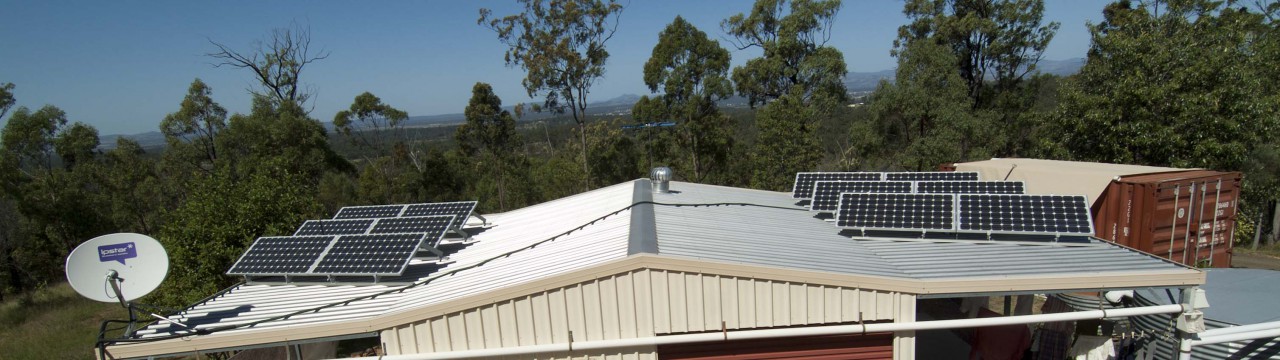
At this stage the life support systems in place or under development include: stand-alone PV solar power; off-mains water supply (all collected from rain on the roofs of our buildings); solar hot water; wood-fired heating; passive solar building design; greywater treatment; composting toilets (indoor and outdoor); worm farms; compost making; vegetable growing (in-ground and wicking pots); weed control; and vegetation mosaic fire management.

We aren’t clear yet exactly what will feature in the posts on the efforts of others to be sustainable in the Region, but for sure it will range from the initiatives of some remarkable individuals to large-scale organic agriculture.

Please, join us in this journey of discovery, and become involved in the discussion.