March wildlife

Pretty quiet month for birds, not necessarily because there weren’t many birds about – just that there wasn’t much time devoted to watching and/or identifying birds.  Seventeen species listed, out of 58 species that we’ve seen in the ten years we have records for March.

We did see two bird species that we hadn’t seen here in March: Golden Whistler and Spotted Quail-thrush.

The Spotted Quail-thrush is a species that we don’t see very often. They are quite shy, spend most of their time on the ground with a preference (here at least) for relatively sparse groundcover in rocky areas, and are likely to walk away quietly when disturbed.

Spotted Quail-thrush. [Copyright Kevin1234 - Creative Commons Attribution-ShareAlike]

Spotted Quail-thrush. [Copyright Kevin1234 – Creative Commons Attribution-ShareAlike]

The one I saw in March flew in straight and low and landed on a heap of Acacia logs just in front of me, with an alert, almost “Road Runner” look, before flying off almost immediately

The Golden Whistler sighting extends our records of this species by one month – previously April to August, now March to August.

Of the 15 other bird species seen, 12 have been seen here in every month of the year, including the Yellow-tailed Black Cockatoos which were very active throughout the month.

Welcome frog sightings were the Graceful Tree-frog (Litoria gracilenta) – under the light outside the front door, instead of its usual very elegant pose along a slender branch with its legs tucked up under its body –  and the Green-thighed Frog (Litoria brevipalmata).

One of our favourite reptiles was common in March. Burton’s Snake-lizard (Lialis burtoni) seemed to be everywhere.  This is how they are often seen:

Lialis burtoni_DSCF4178_webThey often seem to be hoping that their somewhat cryptic colouration will keep them from being seen – though in fact I think they are often sitting in wait for some prey to come along and just choose to ignore the temporary human disturbance.  In fact we had one in March that kept up an “ambush” pose on the ground under the bottom rung of a ladder while we were up and down replacing hot water system tubes for half an hour or more.  Another was seen sunning itself on a railway sleeper on the edge of a garden bed, within less than two metres of us watching from the window, and within two metres of a Red-necked Wallaby and her joey grazing on the garden bed.

Burton’s Snake-lizards are an amazingly adapted lizard.  Their main (only?) prey is other lizards, and they have modified their body shape to be able to get into crevices where skinks and geckoes like to hide.  Their jaws are elongated, to be able to grab and squeeze their prey, and the top jaw hinges where it joins the skull.  I think this is so that they can extend their gape to get an even pressure between the two jaws.

Lialis_burtonii_DSCF0687_proc1_crop2This one was lurking in the grass and I nearly stepped on it.  Just as I saw it, it darted forward to grab this skink.  It’s first grip was across the back, but it quickly flipped the skink up in the air and caught it across the chest, holding it tightly until it suffocated.  You can see the line of the upper-jaw hinge just behind its eye.  Once the skink had ceased struggling the Snake-lizard moved so as to get the skink’s head into its mouth.

Lialis_burtonii_DSCF0693_webWithin five minutes there was only the skink’s tail protruding from the its mouth, and five minutes later it went off, no doubt to find somewhere safe to rest and digest its meal.

Now let’s see what April brings by way of wildlife.

Garlic and green manure

We tried growing garlic last year, with some success, but I had the feeling that if we’d prepared the ground a bit better the bulbs might have been larger, so this year we decided to try adding green manure to the soil a month or so before planting the garlic.  With this in mind we planted the bed up with lemongrass about three months ago.

Before reading further you need to understand that on our place “soil” is mostly a concept.  We live in rugged sandstone country and what passes for natural soil is mostly rocky gravel with sand and (perhaps) some humic material.  If we want good soil we have to make it.

Another source of complexity is that because of the depredations of possums, wallabies and bandicoots we need to grow most of our vegetables behind fences topped off with a strand of electric tape.  It wasn’t always like this.  For the first six or seven years we seemed to have a rock-solid agreement with the wildlife (apart from the parrots) that if we didn’t eat their food, they wouldn’t eat ours.  However over the course of a year, and strangely it was a very wet year when there was plenty of natural food for the wildlife, they suddenly decided that our vegetable were infinitely preferable to bush tucker.

Anyway, this is a long-winded way of getting to the point that there are few things we can grow unprotected, but these include all the onion-garlic group, lemongrass, turmeric, ginger, and citrus.  So, in order to be economical with the fenced area, the garlic gets grown ‘in the open’.  This pretty much means that it goes into a terraced garden bed behind a rock wall, which tends to make the whole thing “well drained”, particularly if there isn’t much humic material in the soil to start with.  Hence one of the attractions of green manuring, and the choice of lemongrass as one of the components of the green manure – nothing was going to graze it off.

The functions of green manure are said to include

  • increasing the percentage of organic matter in the soil, and thereby improving water infiltration and retention, aeration and enhancing other desirable soil characteristics, including soil structure;
  • promoting a more varied and healthy soil biota; and
  • adding nutrient resources that deep-rooted green manure crops bring up from deep in the soil (but lemongrass is shallow-rooted).

Here’s the harvest of lemongrass from what will be the garlic bed.  It was densely planted three months before we cut it in the middle of March.  About half of the crop we gave away to friends in the Indonesian community here – it’s a staple of many Indonesian dishes – which is the material in the buckets and pots on the bank.  The heap in the middle is for the green manure, and the lemongrass still growing on the left of the photo gives an idea of the size of the plants we harvested.  The bed in the foreground is where the green manure, and later the garlic, will go.

Lemongrass garden and harvest_smallP1050476

I also wondered whether the aromatic oils in the lemongrass might have a useful effect in inhibiting soil pests like nematodes, but I couldn’t find anything on this.  In fact I couldn’t find anything at all on lemongrass as a green manure.

We also decided to add the fresh green growth from the pigeon peas.  Pigeon peas (Cajanus cajan) are an evergreen perennial legume shrub that grows to more than two metres in good conditions.  Cath Manuel has an informative short article on pigeon peas over at Soil to Supper, and there’s even more detail on the Tropical Permaculture site.  Both recommend them as a mulch or soil improver, and NSW Agriculture says they are an excellent rotation crop for building up soil nitrogen and breaking weed and disease cycles.  Pigeon pea hosts the VAM fungus which allows the plant to access phosphorous and zinc in the soil, and presumably this is incorporated into the plant, adding to its usefulness as a green manure.

The other ingredient in our green manure mix was mulberry stems and leaves.  We coppice mulberries rather than growing them as trees, for two reasons.  First, the variety we have tends to grow straight up.  No amount of pruning or shaping seems to be able to persuade it to grow as a relatively low spreading tree that one could easily harvest fruit from.  Second, ultimately we will mainly want the leaves as a food supplement for poultry.  We learned from our good friend Thanongsi, who runs a successful demonstration sustainable agriculture farm in central Laos, that he finds he does not have to provide any supplements to goats or poultry that are given mulberry leaves as a component of their fodder.  So presumably these nutritional supplements are going to be incorporated into the green manure.

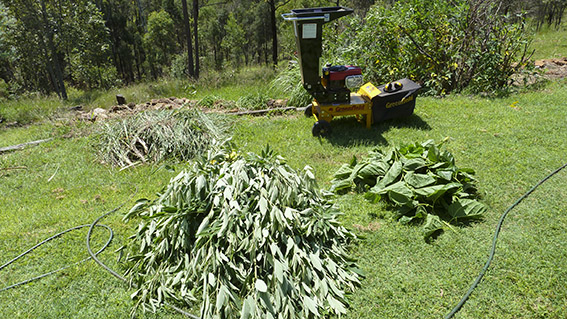
Here are our green manure ingredients ready for mulching.

Green Manure components_P1050477_smallIn the background is the lemongrass, the heap in the foreground is the pigeon pea, and on the right is the mulberry.  It is important to use only the green and sappy ends of the branches for green manure, to make sure that it breaks down quickly and easily in the soil.  Of course the blades of the lemongrass are typically coarse and hard, but when finely mulched and combined with the other ingredients should break down readily.  One advantage of the mix of ingredients is that when combined it isn’t so “wet” that it will choke up the chipper/mulcher (seen in the background of the photo above).  I’d highly recommend this machine from Greenfields.  It has a very sturdy direct drive from the motor to the chipper blades (rather than a belt-drive which would need regular adjustment) and can chip green branches up to 50mm diameter without even dropping the revs.  We’ve chipped everything less than 50mm in diameter from about ten full-sized trees with this machine, as well as a lot of prunings, and it is still on it’s first set of blades (which can be re-sharpened, but haven’t needed it yet).

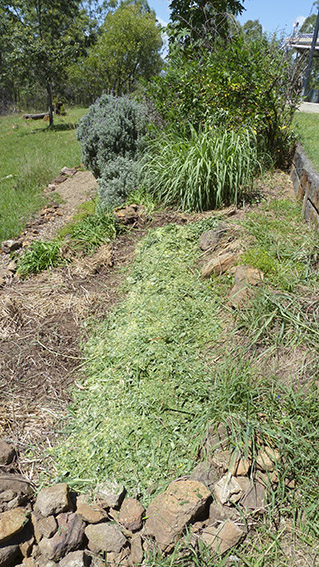
Here’s the mulched ingredients on the bed, ready for spreading and digging in, after which it will be watered and covered with a thick barley straw mulch for the next month.  You can see the “shorn” pigeon pea bushes in the background – they hardly look like they’ve been touched.

Green manure before spreading_P1050479_smallI’ll let you know what it looks like when we dig it over to plant the garlic (which was ordered today from GreenHarvest).

Autumn fungi

March was an amazing month for fungi.  The much higher than usual rainfall combined with the unseasonal high temperatures seemed to be perfect for mushrooms.

The Red-staining Polypore – not a particularly romantic name, but referring to the multiple pores on the underside of the cap that turn red when bruised (see photo below) – was one that was much more common than usual.  Its scientific name is Amauroderma rude.

Here’s what the top of the cap of a fairly fresh specimen looks like.

Amauroderma rude_DSCF3603_Evernoteand the underside, “bruised” when I squeezed it a bit while picking it up

Amauroderma rude_DSCF3606_smallThis species grows on a woody stem that starts out looking like an old brown stick standing vertically in the ground, then gets a bit of “white fungus” on the top end, before gradually morphing into a more or less classic mushroom shape.  Here’s a time sequence – three shots, three days apart.

Amauroderma rude SEQUENCELater the cap becomes a dark “tobacco” brown, going through a stage where it has a narrow white margin which is lost on many specimens.  The mature cap, like the stem, is hard and woody.

I’ll post some more shots of our autumn fungi as I find time to process the photos.

Peak oil, fracking and the fate of technological society

Been a while between posts – mostly due to ongoing shoulder problems causing chronic pain and a resultant lack of interest in doing anything that requires focussed concentration.  Now I have discovered that the physical posture associated with sitting meditation takes the pressure off the damaged areas and virtually eliminates the pain – possibly for 12 hours or more, so more blogging may be on the way.

I’ve just been reading a great post by the Archdruid, addressing the apparently increasingly widespread view that coal seam gas and shale oil fracking have solved the world’s fossil fuel dilemma by permanently banishing the spectre of peak oil and, starting with the US, have put us back on the road to endless technological progress and economic growth.  The reality, as he says so eloquently is that:

… technological progress, as well as the sciences that helped to make it possible, are subject to the law of diminishing returns; furthermore, that what has been called progress is in large part a mere side effect of a short-term, self-limiting process of stripping the planet’s easily accessible carbon reserves at an extravagant pace, and will stop in its tracks and shift into reverse as those reserves run short; more broadly, that modern industrial society is in no way exempt from the common fate of civilizations.

Click HERE to read a very well argued presentation of the evidence that the reserves can be produced using fracking and other CSG technologies are within the predicted long tail of fossil fuel reserves that would become accessible once prices were sufficiently high, and make no difference to the arrival of peak oil or the eventual outcome.

Back again!

Yep, it’s been a long time between posts.

Lots of reasons: severe damage to arm muscles and tendons fighting fires last October, leading to difficulty doing most things; very severe wet weather, requiring track maintenance and other out of the ordinary chores; needing to set up bibliographic database for someone special; finding new data sources and getting engrossed for a few weeks in researching a period in my father’s life for the biography I’m preparing on him; etc.etc.

It has been wet, wet, wet.  We’ve had 565mm of rain to the end of February.  That’s nearly 75% of our average annual rainfall, and the highest January-February total since we started recording rainfall here in 2007.  Even in 2011, when we had the Grantham and Toowoomba floods in the area, we recorded only 505mm.

Grey&Rainy_P1040940_web

A pretty typical view from the porch in January and February

A rare shaft of light from the west on a rainy afternoon

A rare shaft of light from the west on a rainy afternoon

Now the wet weather seems to have gone for a while (give or take a cyclone hanging about some distance off the NE Queensland coast and uncertain whether to visit us).

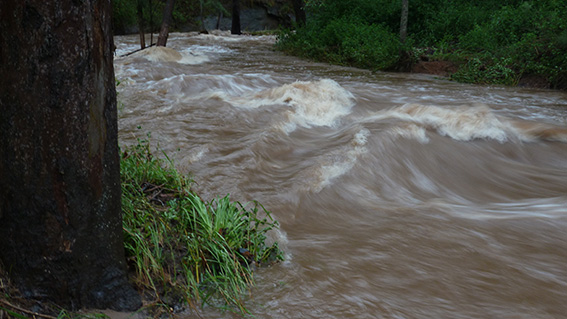
A lot has been happening since my last blog.  Lots of days when we couldn’t go anywhere, either because the creek crossing was so far under rushing water that there was no way any sensible person would try to cross it, or the crossing had been so trashed by said rushing water that even our Subaru would have done itself some damage trying to cross.  Not that we were hankering to go anywhere – there’s always the feeling when we set out down the hill of “Why am I leaving all this peace, beauty and rampant nature – even for an hour/day/whatever?”

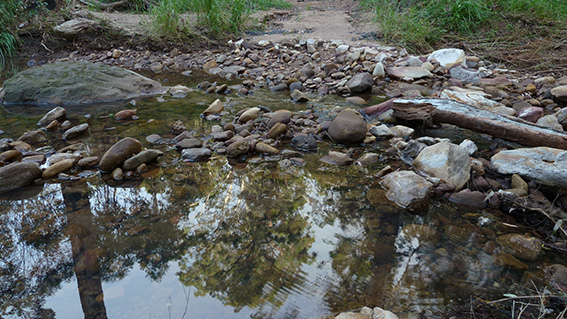
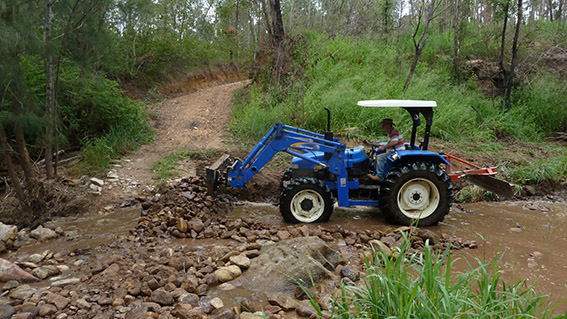
Once the rain seemed to have eased our good friend and neighbour, John, dropped by with his tractor and repaired the crossing.  For most of January and February the Subaru had been parked on the street side of the crossing, so that when the water was low enough to wade across we could get into town.

2013 Jan Aust Day flood CrossingP1040951_web

Looking downstream from the back creek crossing on Australia Day (26 January)

2013 Jan-Feb CrossingP1050018_web

The state of the crossing once the water went down

2013 Jan-Feb CrossingP1050036_web

John rebuilding the crossing

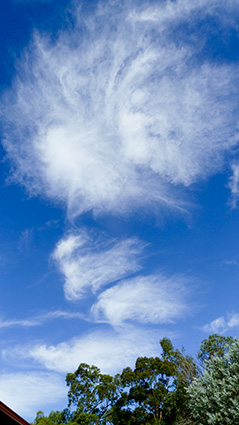
Autumn skies at last

Autumn skies at last

Continue reading

Would your friends believe PriceWaterhouseCooper about global warming?

Having trouble convincing your friends that we need to take global warming seriously?

Do they think that human induced climate change is some whacko left wing, eco-nut conspiracy?

Maybe they’d listen to a staid pillar of the establishment like PriceWaterhouse Cooper on the topic?

Stop banging your head against a brick wall – point them to the PWC website at:

 http://www.pwc.co.uk/sustainability-climate-change/publications/low-carbon-economy-index-overview.jhtml

Here’s what PwC say:

We use the carbon intensity for countries as a measure of progress towards a low carbon economy. The carbon intensity of an economy is the emissions per unit of GDP and is affected by a country’s fuel mix, energy efficiency and the composition of the economy (i.e. extent of activity in carbon-intensive sectors).

It’s time to plan for a warmer world. The annual Low Carbon Economy Index centres on one core statistic: the rate of change of global carbon intensity. This year we estimated that the required improvement in global carbon intensity to meet a 2°C warming target has risen to 5.1% a year, from now to 2050. We have passed a critical threshold – not once since World War 2 has the world achieved that rate of decarbonisation, but the task now confronting us is to achieve it for 39 consecutive years.

The 2011 rate of improvement in carbon intensity was 0.7%, giving an average rate of decarbonisation of 0.8% a year since 2000. If the world continues to decarbonise at the rate since the turn of the millennium, there will be an emissions gap of approximately 12 gigatonnes of carbon dioxide (GtCO2) by 2020, 30 GtCO2 by 2030 and nearly 70 GtCO2 by 2050, as compared to our 2-degree scenario.

Even doubling our current rate of decarbonisation, would still lead to emissions consistent with 6 degrees of warming by the end of the century. To give ourselves a more than 50% chance of avoiding 2 degrees will require a six-fold improvement in our rate of decarbonisation.

In the emerging markets, where the E7 are now emitting more than the G7, improvements in carbon intensity have largely stalled, with strong GDP growth closely coupled with rapid emissions growth. Meanwhile the policy context for carbon capture and storage (CCS) and nuclear, critical technologies for low carbon energy generation, remains uncertain. Government support for renewable energy technologies is also being scaled back. As negotiators convene every year to attempt to agree a global deal, carbon emissions continue to rise in most parts of the world.

Business leaders have been asking for clarity in political ambition on climate change. Now one thing is clear: businesses, governments and communities across the world need to plan for a warming world – not just 2°C, but 4°C, or even 6°C.

If you need more detail you can download the pdf of PwC’s report Too Late for Two Degrees: Low carbon economy index 2012.

Resilience – the pumpkin variety

One of the key characteristics of a sustainable system is resilience.  A good working definition of resilience is ‘a built-in ability to avoid or recover from an impact or disturbance’.  In the natural world (I’m including vegetable growing as part of the natural world, bit of a stretch perhaps) resilience can be manifested at many scales, from the overall system right down to individual species.

In food production systems we should always be striving for resilience, and this becomes more significant as we begin to bear the brunt of climate change.  The fundamental weakness of agro-industrial systems of food production is that they have sacrificed resilience in the quest for greater short-term profits.

You might recall that some time ago I referred to my experiment in restricting pumpkin vines to around one square metre, after advice that they would be likely to be as productive if confined by pruning to that small area as they would  be if allowed to “free range”.  Because free range pumpkins take up such a lot of space I’m keen to prove that the “area restricted” approach works.

Unfortunately I didn’t reckon with the impact of heatwaves (or, more accurately, I didn’t respond quickly enough when we experienced a major heatwave over the last few weeks, with temperatures up to 38 degC. and quite low humidity).

Here’s what it does to a pumpkin vine:

Pumpkin Sunburn_P1040879_smallNot pretty, and not boding well for a plentiful harvest.

This vine was planted in the corner of the mulched area under a lime tree, and has been more or less restricted to one square metre (it’s probably more like 1.5×1.5m now).  Another part of the vine scrambled across the mulched area directly under the tree.  Here’s what it looked like at the time the above photo was taken:

Pumpkin_no Sunburn_P1040876_smallStrangely enough, even where it isn’t directly under the shade of the lime tree it isn’t sunburnt.  Maybe having the majority of it in shade gave the whole runner some greater resilience.

Lesson:  have structures ready for hanging shading material, so that it can be installed when there is the first hint of unusually high temperatures.  That’s another kind of resilience – being ready to respond to inclement situations so as to avoid negative impacts.

It’s not that I wasn’t aware of this kind of impact, just that we haven’t had really hot weather for four or five years, so I had taken my eye off the ball.  No excuse, I’ve been following Scarecrow’s Garden for a long time and, being in the mid-north of South Australia, she has many strategies for dealing with hot weather.

Nothing to do with sustainability, or is it?

I’m not sure exactly how this relates to sustainability, but I have a gut feeling that it does.  But the real reason I’m posting this is that it is such a simple, straightforward answer to the crap arguments made endlessly (and mindlessly) by the US gun lobby.

It’s from White Coat Underground, one of my daily fixes of common sense and sanity in an all too often crazy world.  I won’t rehash the gun lobby’s arguments – if you don’t know them already they’ll soon be coming to a TV news, newspaper, magazine, web site near you.  Over to White Coat Underground:

Guns have never played a part in the maintenance of a democracy in the US. Gun ownership in the colonies, which existed for more than a century before the revolution perhaps made it easier to form an army to oppose the Brits, but really, without the external support of France, without the distances involved, the war would have lasted much longer. The colonies were, fundamentally, un-rulable and the real question was how much blood would have to be spilled to prove it.

The civil war, in which a large number of Americans rebelled against what they saw as an unjust government killed people—lots of people. It destroyed large swaths of the country. And the war was not won because Unionists kept guns at home, but because the industrial north could manufacture sophisticated weapons in large numbers.

The so-called disarming of the population feared by the gun-nuts isn’t happening, and if it did (we can only hope), it wouldn’t change our form of government, wouldn’t change our ability to resist tyranny from home or abroad. If the US government really wanted to become a dictatorship (unlikely to ever happen), disarming the population wouldn’t even be necessary. The navy could simply drop a JDAM on people they didn’t like.

But we do have constitutional protections against dictatorship, and they’ve worked for centuries. We have a tripartite government with checks and balances, [and] we have a military that is forbidden from intervening domestically.

More strength to the forces for gun control in the US.

What do you say to them when ….?

It has occurred to me in the last few days that one of the aspects of trying to live as sustainable a life as possible is that one is often challenged by people along the lines of “Well, your efforts are all well and good, but what good do they really do when ….?” and cite some “statistic” or “fact” that in their mind challenges the whole point of trying to live sustainably.

Maybe one thing this blog can do is to provide answers to some of these challenges.

A good one arose in the days following the recent Tasmanian bushfires.  I’ll let the Philip Gibbons from the Australian National University tell the story as he did for The Conversation on January 10:

Fact check: do bushfires emit more carbon than burning coal?

By Philip Gibbons, Australian National University

“Indeed I guess there’ll be more CO2 emissions from these fires than there will be from coal-fired power stations for decades.” – acting Opposition leader, Warren Truss, January 9, 2013

On Wednesday, leader of the National Party and acting Opposition Leader, Warren Truss claimed carbon emissions from the current bushfires are equivalent to decades of carbon emissions from coal-fired power.

The current bushfires are so large that the statement by Warren Truss seems plausible.

This spurred me to do some research to find out.

Coal-fired power stations in Australia emit around 200 million tonnes of CO2 per year. This does not include emissions from our coal exports.

Around 30 tonnes of CO2 per forested hectare were emitted by the Black Saturday Fires in 2009.

Bushfires this year have so far burned around 130,000ha of forest, so have emitted nearly 4 million tonnes of CO2.

So, the bushfires this year have emitted an amount of CO2 equivalent to 2% of Australia’s annual emissions from coal-fired power.

The current bushfires must burn an area of forest greater than Tasmania to generate CO2 emissions equivalent to a year of burning coal for electricity.

And the current bushfires must burn an area of forest the size of New South Wales to generate CO2 emissions equivalent to a decade of burning coal for electricity.

However, the carbon emitted from bushfires is not permanent. Eucalypt forest regenerates after fire, and will quickly begin to sequester from the atmosphere the carbon that has been lost from the current bushfires.

The same cannot be said of coal-fired power stations.

Read more about the relationship between bushfires and emissions.

Philip Gibbons receives funding from the Australian Government, the Government of the Australian Capital Territory and the Australian Research Council.

This article was originally published at:

The Conversation
The Conversation provides independent analysis and commentary from academics and researchers.We are funded by CSIRO, Melbourne, Monash, RMIT, UTS, UWA, Canberra, CDU, Deakin, Flinders, Griffith, La Trobe, Murdoch, QUT, Swinburne, UniSA, USQ, UTAS, UWS and VU.
Read the original article.

New ideas for things to plant in the vege garden

Susan Kwong has set up a new database/wiki on perennial plants or plants that can be “perennialised” in Australia’s temperate climate zones. She takes the view that the plants we currently grow as annuals were probably originally “domesticated” by selecting for individuals which produced edible crops quickly, and which were either already annuals, or were made annual by a process of selection.  From her point of view, growing annuals as basic food crops introduces an element of uncertainty into every year – if the annual crop fails there not only isn’t any food from it, there aren’t any seeds for the next year’s crop.

Some annuals can be “perennialised” by selecting more long-lived, longer producing individuals so that, once established, they carry over their production into second and subsequent years.

So far there doesn’t seem to be much focus on the process of perennialising specific annuals, but the database is a wealth of information that isn’t just relevant to Australia’s temperate zones – a lot of the plants are grown in the sub-tropical zone (includes the Lockyer Valley) as well.

Here’s the article where she sets out the concept and the thinking behind it (someone should tell her about using shorter paragraphs for legibility and maintaining reader interest).

It turns out that a lot of the plants documented in the database so far are things that you might not have thought about as food plants at all, or might not have been aware of.  Here’s an example from the first set of plants, published in September.

Tree OnionsThe second data set is here: http://www.permaculturenews.org/2012/11/21/food-from-perennialising-plants-in-temperate-climate-australia-for-october-2012/

What I find most useful about this database is that it introduces me to new food plants, and gives me additional information about the ones I already know.

For example, a while back I was looking to identify something we’ve been growing successfully for two seasons now (in the post about wicking pots in November).  It’s the plant in the foreground.

Well, in the latest monthly issue of Susan Kwong’s perennialising database I found it listed as non-heading Chinese Cabbage (Brassica rapa, subspecies chinensis). Definitely the same plant, but I was a bit surprised about the common name.  Here in Australia Chinese Cabbage is usually used for wombok (Brassica rapa ssp. pekinensis) and I didn’t know there was a non-heading variety. This is a plant that I’m really familiar with as my parents used to grow this as a commercial crop on our farm at Eight Mile Plains (which at that time – early 1950s – was well outside Brisbane).  I have no idea where they marketed it, being too young at the time to take an interest in such things.

A bit of digging on the internet and I ended up with an informative article about Asian versions of Brassica rapa on Google.  In Australia chinensis is known as pak choy or pak choi, and in fact I found it in my Evernote database where I’d clipped it from the October issue of the perennialising database as Brassica chinensis (Bok Choy).

Problem solved.  It is a non-hearting Chinese Cabbage (because it is the same species as what is commonly called Chinese Cabbage), but it is a different sub-species (chinensis) and is best known in Australia as Pak Choy.

And I still have to get myself some seeds of gai laan, which is what I originally thought the pak choy was, and which looks like a very interesting vegetable – one of its other names is Chinese broccoli.